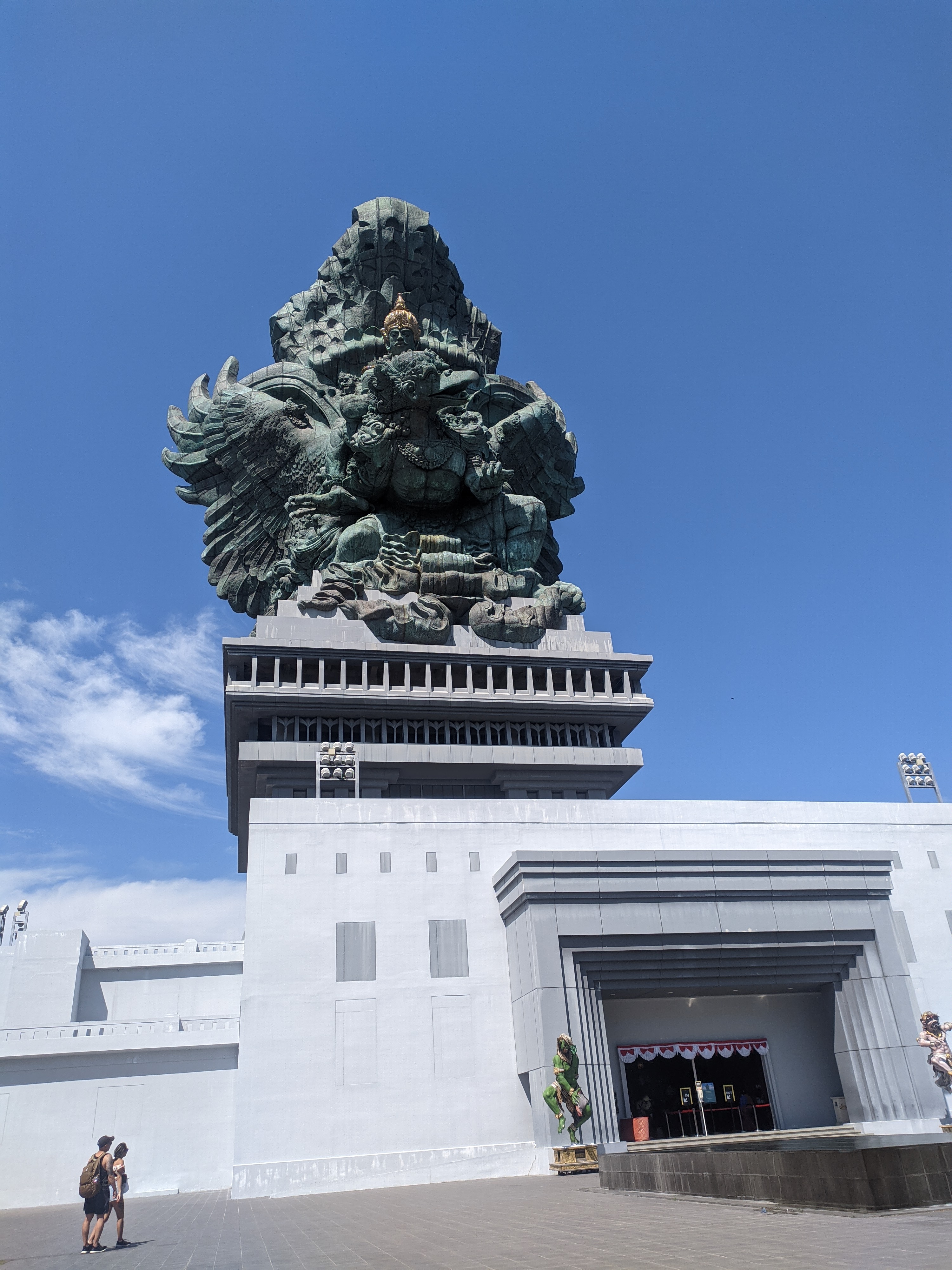
Garuda Wisnu Kencana Statue
It took four Indonesian presidents, one devastating financial crisis, a sixteen-year construction pause, and roughly $100 million before the last copper panel was bolted onto the tail of the Garuda. When the statue was finally completed on July 31, 2018, the bird's tail -- the highest point of the entire structure -- was the final piece the crane lifted into place, a fitting conclusion for a project that had been reaching upward since 1990. The Garuda Wisnu Kencana statue rises 121 meters above its hilltop site on Bali's Bukit Peninsula, with a 46-meter pedestal bringing the total monument height to 167 meters. That makes it taller than the Statue of Liberty, heavier than any other statue in Indonesia at 4,000 tonnes, and the second tallest statue of a Hindu deity in the world.
The Sculptor's Vision
Nyoman Nuarta designed the statue in 1990, commissioned under Tourism Minister Joop Ave, Energy Minister Ida Bagus Sudjana, and Governor of Bali Ida Bagus Oka. The subject he chose -- Vishnu riding Garuda -- draws from one of Hinduism's most enduring stories. Garuda, a divine eagle-like being, struck a bargain with the god Vishnu: he would serve as Vishnu's mount in exchange for the right to use Amrita, the elixir of life, to liberate his mother from enslavement. It is a story about devotion, sacrifice, and the lengths one will go for family. Nuarta wanted to render it at a scale that would make the myth inescapable, visible from across southern Bali, a landmark that would anchor Balinese Hindu identity to the landscape itself. The ambition was enormous. So were the obstacles that followed.
Crisis, Controversy, and Resurrection
Groundbreaking came in 1997. Within months, the Asian financial crisis tore through Indonesia's economy, and the project collapsed along with it. For sixteen years the statue existed only as a design and a partially prepared site, an increasingly awkward monument to interrupted ambition. During the hiatus, religious authorities on the island voiced objections. Some argued that a structure this large could disrupt Bali's spiritual balance. Others felt the project's commercial nature was inappropriate for a sacred subject. But supporters countered that the statue would revitalize barren limestone land and attract visitors who might otherwise never see the Bukit Peninsula. In 2013, property developer PT Alam Sutera Realty agreed to finance the remaining construction. Work resumed with new urgency, and the project that had languished through four presidential administrations finally began to take physical shape.
754 Modules, 1,500 Pieces
Building a 121-meter statue on a tropical hilltop presented engineering challenges that had no off-the-shelf solutions. Nuarta's studio fabricated the statue in Bandung, West Java, as 754 discrete copper-and-brass modules. These were shipped to Bali, but even the modules were too large for the cranes available on site, so they were cut into 1,500 smaller pieces for assembly. The internal structure is a stainless steel frame and skeleton surrounding a steel and concrete core column -- the engineering equivalent of a skyscraper, but shaped like a god riding a bird. Garuda's complex aerodynamic form required custom structural joints where up to 11 enormous steel girders converge at single points; standard construction joints handle four or six. The outer skin alone covers thousands of square meters of copper and brass sheeting. Vishnu's crown is covered in golden mosaics that catch the equatorial sun. The entire structure is designed to withstand earthquakes and tropical storms and is expected to endure for at least 100 years.
A Landmark Claimed by the Sky
President Joko Widodo inaugurated the completed statue on September 22, 2018, nearly three decades after Nuarta first put pencil to paper. At night, a dedicated lighting system turns the copper surface into a glowing beacon visible from miles across southern Bali. During the day, the statue dominates the skyline of the Bukit Peninsula, its silhouette unmistakable from aircraft approaching or departing Ngurah Rai International Airport just minutes to the north. The monument stands as the tallest statue in Indonesia and the second tallest Hindu deity statue in the world. For pilots, it serves as one of Bali's most obvious visual landmarks -- a 167-meter figure of a god on a bird, planted on a hilltop, gleaming in the sun. From the ground, the experience is different: visitors stand at the base and look up at 4,000 tonnes of metal overhead, the Garuda's wings spread wide, Vishnu's expression serene, the myth made literal and impossible to look away from.
From the Air
Located at 8.81S, 115.17E on the Bukit Peninsula at the southern tip of Bali, Indonesia. At 167 meters total height including pedestal, the GWK statue is one of the tallest structures on Bali and a prominent visual landmark from the air. Extremely visible on approach to Ngurah Rai International Airport (WADD/DPS), which lies just north of the Bukit Peninsula. Best viewed from 1,500-3,000 feet AGL. The statue's copper-and-brass surface catches sunlight and is identifiable from considerable distance. The Bukit Peninsula's distinctive shape at Bali's southern tip provides clear geographic reference.