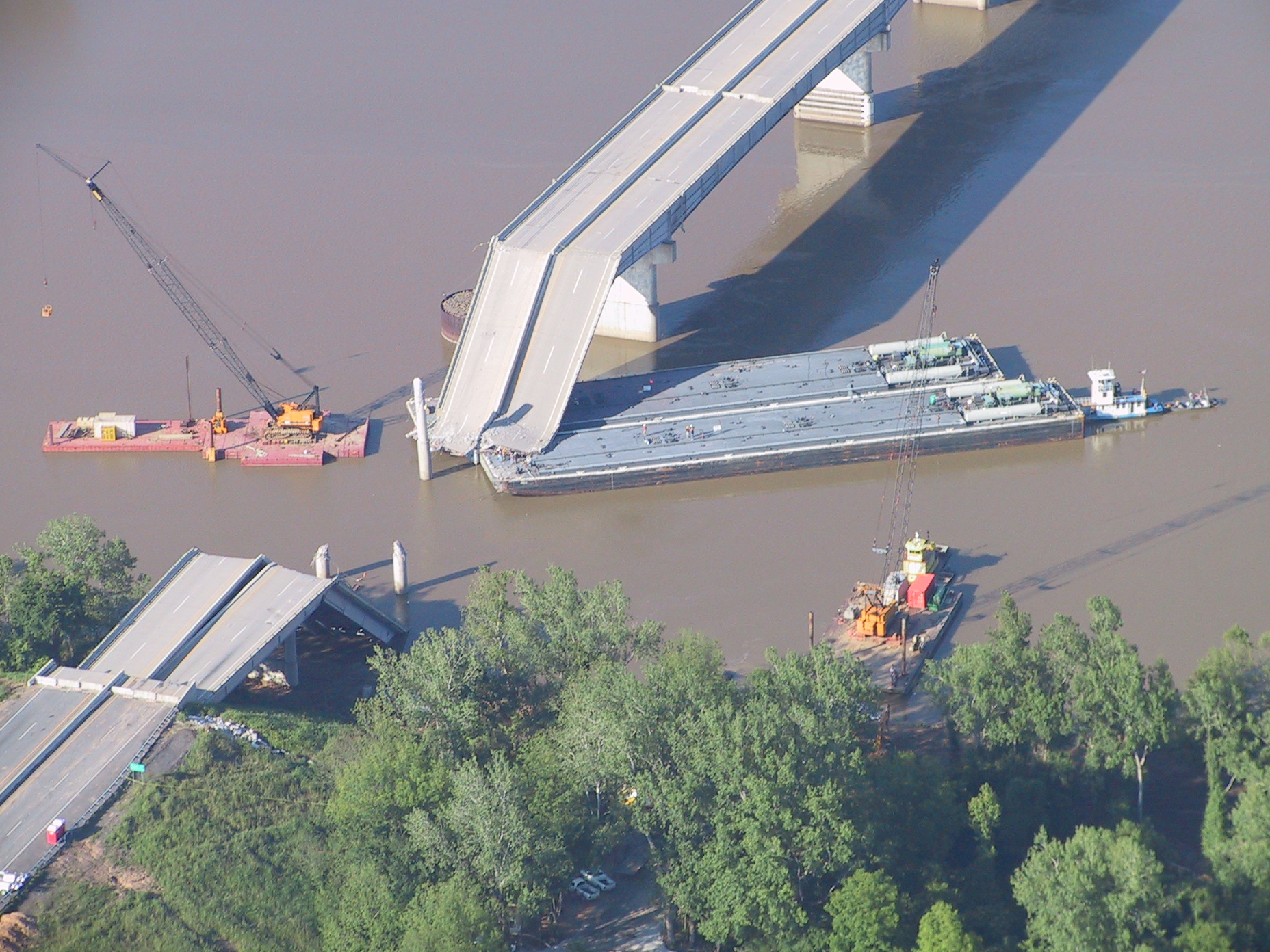
Gasconade Bridge Train Disaster
The train carried 600 of St. Louis's most important citizens, and the champagne was already flowing. November 1, 1855, was supposed to be a day of triumph -- the inaugural run of the Pacific Railroad from St. Louis toward Jefferson City, a critical step in Senator Thomas Hart Benton's vision of making St. Louis the eastern terminus of the first transcontinental railroad. The locomotive Missouri pulled 14 cars through rain and celebration. At about 1:30 in the afternoon, the train reached a 760-foot wooden trestle spanning the Gasconade River. The bridge, still unfinished and supported by temporary trestlework, collapsed. The locomotive tipped backward onto the first passenger car, the one carrying the dignitaries. More than 30 people died in what became the first major deadly bridge collapse in American history.
A Dream on Rails
The Pacific Railroad had been building westward from St. Louis since July 4, 1851, driven by Senator Thomas Hart Benton's determination to make Missouri the gateway to the Pacific. By 1853, tracks reached Kirkwood. By 1855, the railroad stretched to Jefferson City. The Gasconade River crossing was the critical link -- a planned truss bridge of six spans resting on five stone piers, 32 feet high. The stone piers were complete, but the bridge superstructure was not. To accommodate the inaugural celebration, engineers strengthened temporary wooden trestles and tested them with heavy gravel cars. The trestles were traditional railroad construction: posts driven into the riverbed, capped and strung with timbers, stabilized with diagonal planks and two-inch oak dowel rods. The construction firm, Stone, Boomer & Co. of Chicago, were described as 'men of great experience building bridges in the West.'
Thirteen Cars Into the River
The excursion departed St. Louis's 7th Street Station at 9 a.m. with music and speechmaking. Three cars were dropped at Cheltenham to reduce weight. Guests boarded at stations along the line; National Guardsmen joined at Hermann. Among the passengers were Henry Chouteau of St. Louis's founding family, Mayor Washington King of St. Louis, Mayor Madison Miller of Carondelet, and hundreds of prominent citizens. The engineer had been instructed to accelerate through a curve before the bridge, then cut steam and coast across at four miles per hour. Witnesses estimated the actual speed at 15 to 30 miles per hour. The rough, newly installed track leading to the abutment likely derailed the locomotive on the first section of the bridge. Floorboards were found broken in half. The engine and ten cars plunged into the Gasconade River.
Survivors and Scavengers
The quick work of brakeman Radcliff saved the last four cars from following the others into the riverbed -- three derailed beside the tracks, but only the final car remained on the rails. At least 31 people were killed outright, a number later revised to 43 as the injured succumbed. Newspapers named 136 wounded but estimated up to 200 more went unnamed. In an era before germ theory and sterile wound dressing, even simple injuries could prove fatal from infection. The true death toll remains unknown. Newspapers reported that some victims were robbed of their valuables at the wreck site. Irish settlers at nearby Miller's Landing -- soon to be renamed New Haven -- converted buildings into temporary hospitals and were widely praised for their hospitality. Conductor English walked back to Hermann to summon a relief train.
The Road Not Taken
The investigation commission cited excessive speed as the primary cause, though contractor Darius Hunkins offered a contrary opinion to the New York Times, arguing that the bridge timbers were insufficient, with trestle supports spaced at 16 feet rather than the standard 10. The disaster's consequences extended far beyond the Gasconade Valley. A Pacific Railroad train did eventually reach Jefferson City four months later, but St. Louis's ambition to anchor the transcontinental railroad was fatally undermined. When the First Transcontinental Railroad was completed at Promontory Summit, Utah, in 1869, it stretched from Sacramento to Omaha, bypassing Missouri entirely. The Pacific Railroad was renamed Missouri Pacific in 1867 and eventually merged into Union Pacific in 1982. The Gasconade River bridge itself was burned during the Civil War in 1861, when Governor Claiborne Jackson and General Sterling Price ordered railroad bridges destroyed as they fled St. Louis ahead of Union General Nathaniel Lyon.
From the Air
Located at 38.6692°N, 91.5533°W over the Gasconade River in Gasconade County, Missouri, at approximately 550 feet MSL. The Gasconade River joins the Missouri River nearby. The disaster site is in the Missouri River valley between Hermann (east) and the town of Gasconade. The terrain is rolling Missouri River bluffs with extensive forested hills. Nearest airports include Hermann Municipal Airport and Washington Regional Airport (KFYG) approximately 25 nm east. The Missouri Rhineland wine country extends along the river valley. Best viewed at 1,500-3,000 feet AGL to see the river crossing and valley context.