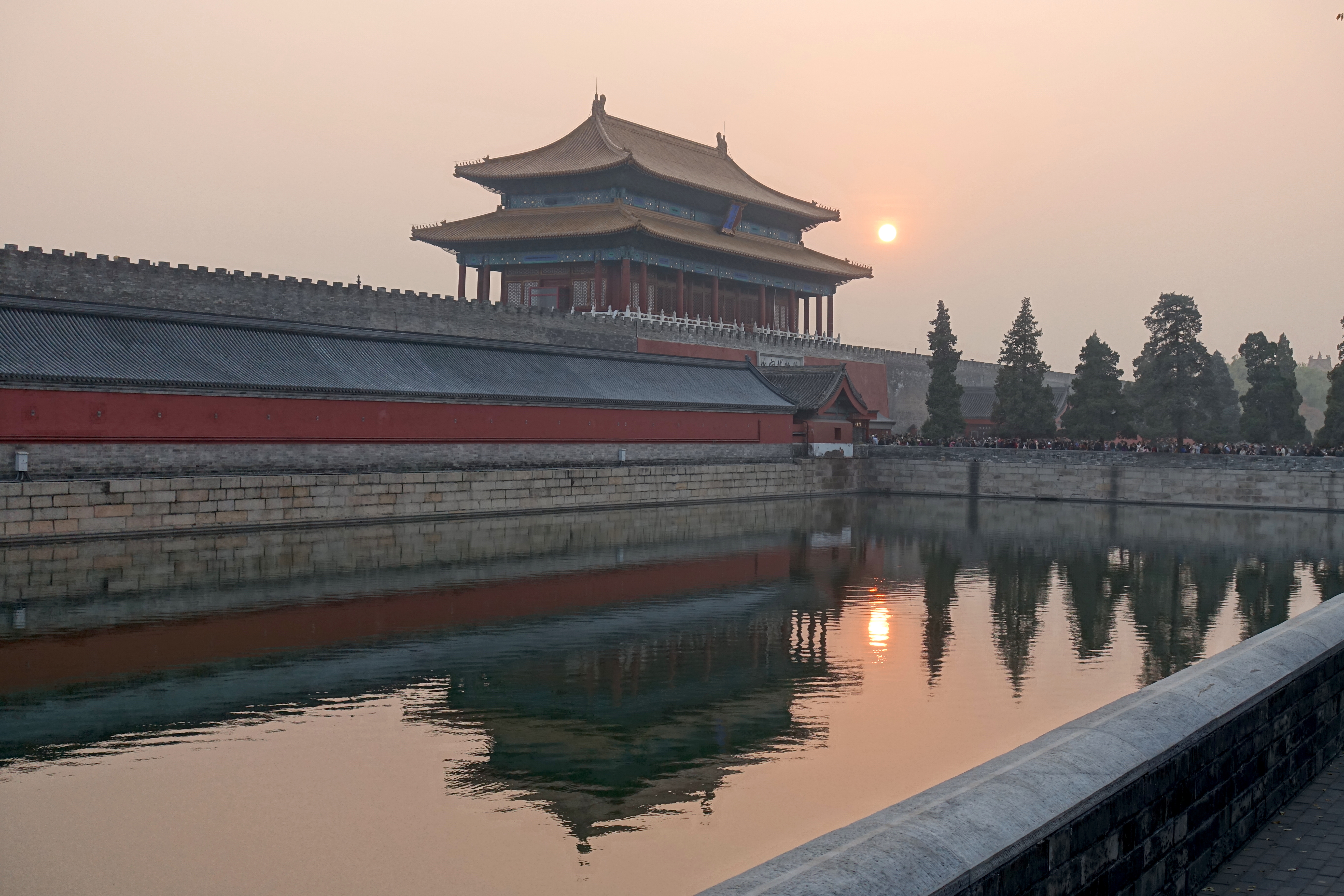
Gate of Divine Prowess
Every palace needs a back door. At the Forbidden City, that back door is the Gate of Divine Prowess, the massive northern portal where the grandeur of the imperial complex meets the city beyond. While tourists today stream through the southern Meridian Gate and exit here, walking out beneath its imposing tower toward Jingshan Hill, the gate's history reveals the social hierarchies that governed every threshold in the palace. This was not the emperor's entrance. This was the gate for workers, servants, and women whose futures hung on a selection process they did not choose.
The Tortoise and the Taboo
When the gate was built in 1420, during the eighteenth year of the Yongle Emperor's reign, it bore the name Black Tortoise Gate -- Xuanwu Men -- after the divine guardian of the north in Chinese cosmology. The Black Tortoise, one of the Four Symbols representing cardinal directions, was a fitting patron for a northern gate. But when the Kangxi Emperor of the Qing dynasty ascended the throne, a problem emerged. His birth name, Xuanye, shared the character xuan with the gate's name. Chinese naming taboo demanded that the character of a reigning emperor's name be avoided in all public usage. The gate was quietly renamed the Gate of Divine Might, purging the offending character while preserving the martial dignity appropriate to a palace entrance.
Threshold of Hidden Lives
The Gate of Divine Prowess served as the palace's service entrance in the fullest sense. Palace workers -- the army of laborers, cooks, and craftspeople who kept the vast complex functioning -- passed through here rather than through the ceremonial southern gates reserved for officials and the emperor himself. More poignantly, women being sent into the palace for selection as imperial concubines also entered through this gate. For many of these women, crossing the threshold of the Gate of Divine Prowess was a one-way passage into a world of gilded confinement, where rank, favor, and survival depended on the emperor's attention. The gate's imposing mass, spanning the full width of the northern wall with its watchtower rising above the moat, offered no hint of what waited inside.
A Gate, Not a Battlefield
One persistent confusion deserves clearing up. The Xuanwu Gate Incident -- a famous palace coup in Chinese history -- shares part of this gate's original name but occurred at an entirely different location, in an entirely different dynasty. That violent power struggle took place during the Tang dynasty in the seventh century, when the capital was Chang'an, more than a thousand kilometers to the southwest. By the time Beijing's Black Tortoise Gate was built, the Tang dynasty had been gone for five hundred years. Today, visitors exiting through the Gate of Divine Prowess step onto the street facing the southern slope of Jingshan Park, where the artificial hill built from the excavated moat earth offers one of the finest panoramic views back over the golden rooftops of the palace they just left behind.
From the Air
Located at 39.9209N, 116.3904E on the north side of the Forbidden City in central Beijing. The gate sits directly south of Jingshan Park's artificial hill. From the air, it marks the northern boundary of the Forbidden City's rectangular compound. The moat running along the outer wall is visible as a continuous water feature. Beijing Capital International Airport (ZBAA) lies approximately 28 km to the northeast. Best viewed at 1,500-3,000 ft AGL.