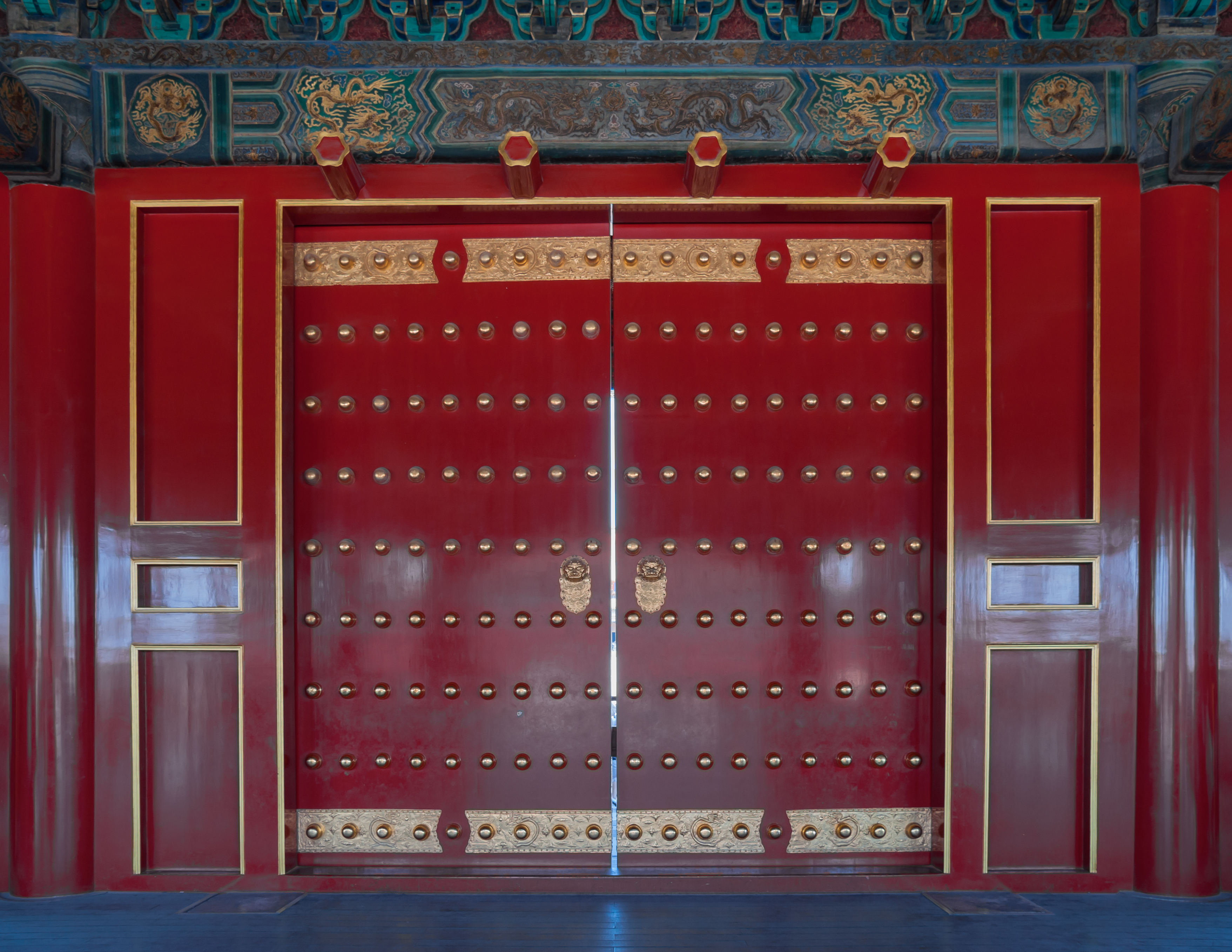
Gate of Supreme Harmony
A tipped lamp in the guard room changed the course of Chinese architecture. In 1886, fire consumed the Gate of Supreme Harmony, the grand portal separating the Forbidden City's entrance plaza from its ceremonial heart. The blaze destroyed a structure that had stood since the Ming dynasty, when it bore the name Fengtianmen -- the Gate of Receiving Heaven's Mandate. What visitors see today dates from the rebuilding completed in 1894, a Qing dynasty reconstruction faithful enough to the original that the gate still commands the same authority it held when Ming emperors sat here at dawn to govern an empire.
Governing at the Gate
In the Ming dynasty, the Gate of Supreme Harmony served a purpose far beyond mere passage. The emperor held morning court sessions here, meeting ministers to discuss affairs of state at a threshold that symbolized the boundary between the outer world and imperial power. For much of the dynasty, these sessions were largely ceremonial -- a performance of diligence rather than substantive governance, demonstrating that the emperor was awake, attentive, and worthy of his title. When the Qing dynasty replaced the Ming, the new emperors attended court far more frequently, and they moved their working sessions to the Gate of Heavenly Purity, deeper inside the palace complex and closer to the imperial living quarters. The Gate of Supreme Harmony was thereafter reserved for banquets and major ceremonies.
Five Bridges Over Golden Water
The space around the gate is one of the most carefully choreographed landscapes in imperial Chinese architecture. Between the Gate of Supreme Harmony to the north and the Meridian Gate to the south stretches a vast plaza bisected by the Inner River of the Golden Water, a serpentine canal spanned by five marble bridges. The number five was no accident -- it corresponded to the five Confucian virtues and reinforced the imperial numerology that governed every dimension of the Forbidden City. The gate itself measures seven bays wide and three bays deep, covering 1,371 square meters. It is flanked by two smaller gates: Zhendu Gate to the west and Zhaode Gate to the east. The central stairway and the central entrance of the Meridian Gate beyond were reserved exclusively for the emperor and his immediate attendants.
Lions at the Threshold
Visitors approaching the gate pass a pair of massive bronze guardian lions, imperial sentinels cast in the traditional form that has guarded Chinese palaces for centuries. The female lion, positioned to the left of anyone entering, plays with a single cub beneath her paw, symbolizing the nurturing of the dynasty's future. The male, to the right, rests his left paw on a globe, an ancient gesture interpreted as feeling the pulse of the earth -- a sovereign's claim to universal dominion. Incense burners ring the stairs, their smoke once filling the air during ceremonies to create an atmosphere of otherworldly solemnity. Beyond the gate lies Harmony Square and the Hall of Supreme Harmony, the Forbidden City's largest and most important building, where enthronements and imperial weddings took place beneath a ceiling embedded with a legendary dragon mirror that, according to court mythology, would drop and kill any illegitimate occupant of the throne.
From the Air
Located at 39.9140N, 116.3908E within the Forbidden City compound in central Beijing. The gate sits along the central north-south axis, between the Meridian Gate (south) and the Hall of Supreme Harmony (north). The serpentine Golden Water canal crossing the plaza is visible from lower altitudes. Beijing Capital International Airport (ZBAA) is approximately 28 km northeast. Best viewed at 1,500-3,000 ft AGL.