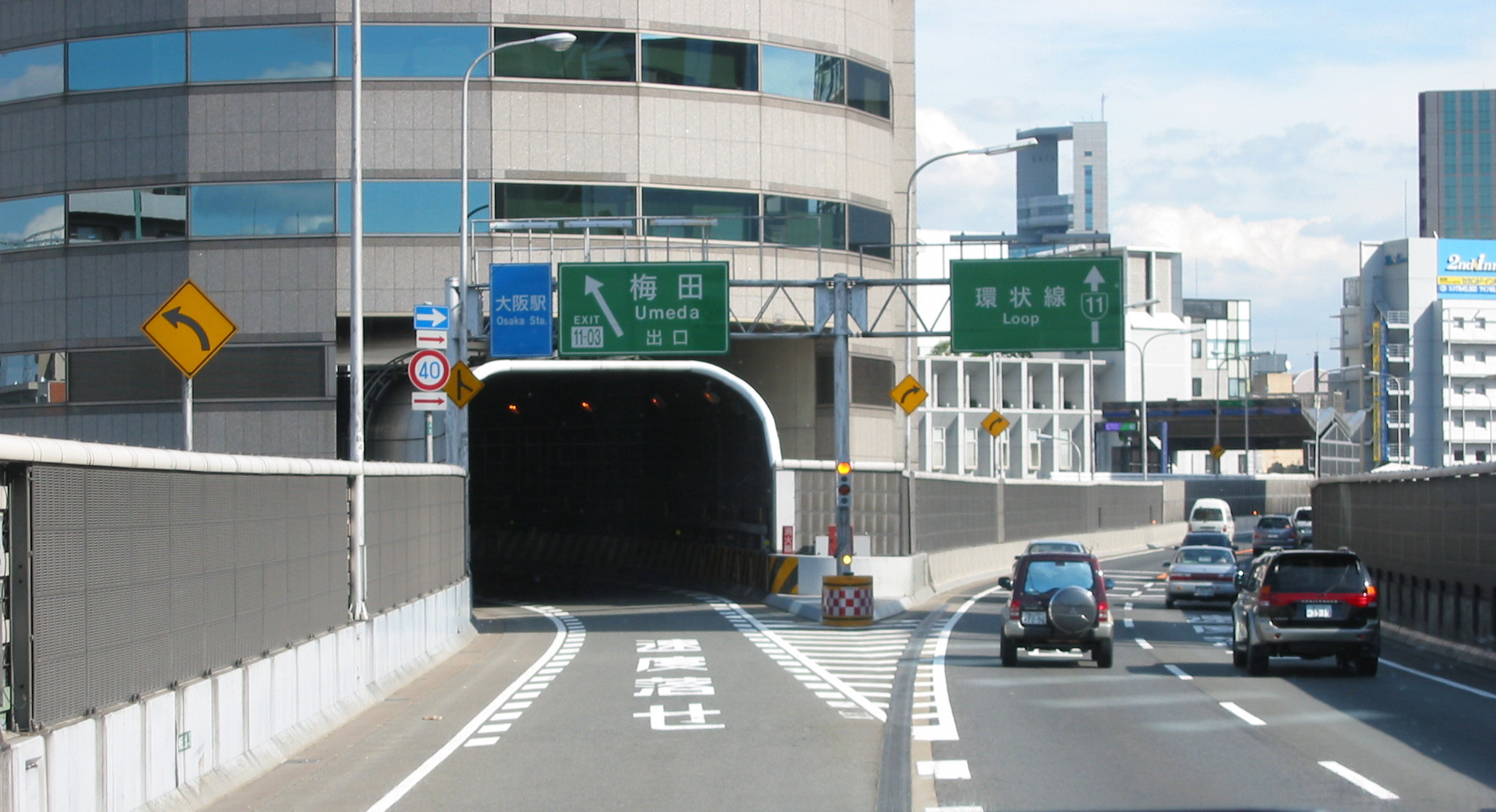
Gate Tower Building: The Skyscraper with a Highway Through Its Heart
An elevator in the Gate Tower Building skips the fifth, sixth, and seventh floors. Not because of superstition or mechanical limitation, but because a four-lane highway exit ramp occupies those levels. The Hanshin Expressway's Ikeda Route passes directly through the middle of this 16-story office building in Fukushima-ku, Osaka, entering one side and exiting the other in a cylindrical tunnel that does not touch the building's structure at all. The highway is a bridge. The building is a building. They share the same address but inhabit entirely separate structural systems, insulated from each other by vibration dampeners and soundproofing. It is one of the most photographed buildings in Japan, and it exists because a charcoal merchant's descendants refused to sell their land.
The Standoff That Built a Landmark
The plot of land had belonged to a wood and charcoal business since the early Meiji period, passed down through generations as the neighborhood around it transformed from Osaka's industrial fringe into prime commercial real estate. By the 1980s, the old fuel business had faded as Japan moved to modern energy sources, and the aging company buildings were ripe for redevelopment. In 1983, the owners applied for building permits to construct an office tower. The permits were denied. The Hanshin Expressway Corporation had already planned the Ikeda Route to pass directly over the property. Normally, highway corporations simply purchase the land they need. But the property holders refused to sell. For approximately five years, the two sides negotiated, neither willing to yield. The resolution was unprecedented: build the building around the highway, and the highway through the building.
Rewriting the Law for One Building
The compromise required changing Japan itself -- or at least its legal code. In 1989, highway laws, city planning laws, city redevelopment laws, and building codes were all partially revised to allow the unified development of highways and buildings within the same physical space. The legal framework was originally designed for a different project entirely: facilitating construction of Tokyo's second ring road near Toranomon in Minato ward. But that project never used the new rules. Instead, the Gate Tower Building in Osaka became Japan's first structure to have a highway pass through it when it was completed in 1992. The precedent remains extremely rare. In most cases where highways and buildings must coexist, the roads go underground. Threading a highway through the midsection of an occupied office tower remains an engineering curiosity that Japan has not repeated.
Two Structures, One Address
The engineering solution is elegant in its separation. The highway off-ramp passes through the building as an independent bridge, supported by its own structural columns planted next to -- but not connected to -- the building's foundation. Inside, the highway section is encased in a cylindrical structure lined with noise-proofing and vibration-dampening materials. Office workers on the fourth floor hear nothing from the road above them. Workers on the eighth floor feel no tremor from the traffic below. The elevator panels confirm the arrangement plainly: the buttons for floors five, six, and seven are absent. The roof of the building features a helipad, adding another transportation layer to what is already Japan's most vertically complex transit node. From the street, the building looks almost ordinary -- a standard glass-and-concrete office tower -- until you notice the highway emerging from its midsection like a thread through a needle.
A Monument to Compromise
The Gate Tower Building has become a symbol of Japanese pragmatism and the art of finding solutions where Western planning might have found only a lawsuit. Similar concepts exist elsewhere -- Hong Kong's Yau Ma Tei Car Park Building once had a highway running through it before demolition, and Chongqing's Liziba Station threads a monorail through a residential tower -- but none achieved the Gate Tower's particular brand of absurdity: a full expressway exit ramp, carrying thousands of vehicles daily, passing silently through the middle floors of an ordinary office building where people answer phones and attend meetings. The building continues to operate as unremarkable commercial office space, its tenants long accustomed to explaining to visitors why the elevator has no button for the fifth floor. The charcoal merchant's descendants got their tower. The highway corporation got its exit ramp. Osaka got its strangest landmark.
From the Air
Located at 34.698N, 135.489E in Fukushima-ku, western central Osaka. The building is identifiable from low altitude by the Hanshin Expressway Ikeda Route passing directly through its midsection between the fifth and seventh floors. From above, the highway appears to enter and exit the building's footprint. The building is near Osaka Station and the Umeda commercial district. Osaka International Airport at Itami (RJOO) is approximately 8 nautical miles to the north-northwest. Kansai International Airport (RJBB) is approximately 27 nautical miles to the south-southwest. Best viewed from low altitude (2,000-3,000 feet) where the highway-through-building geometry is most apparent.