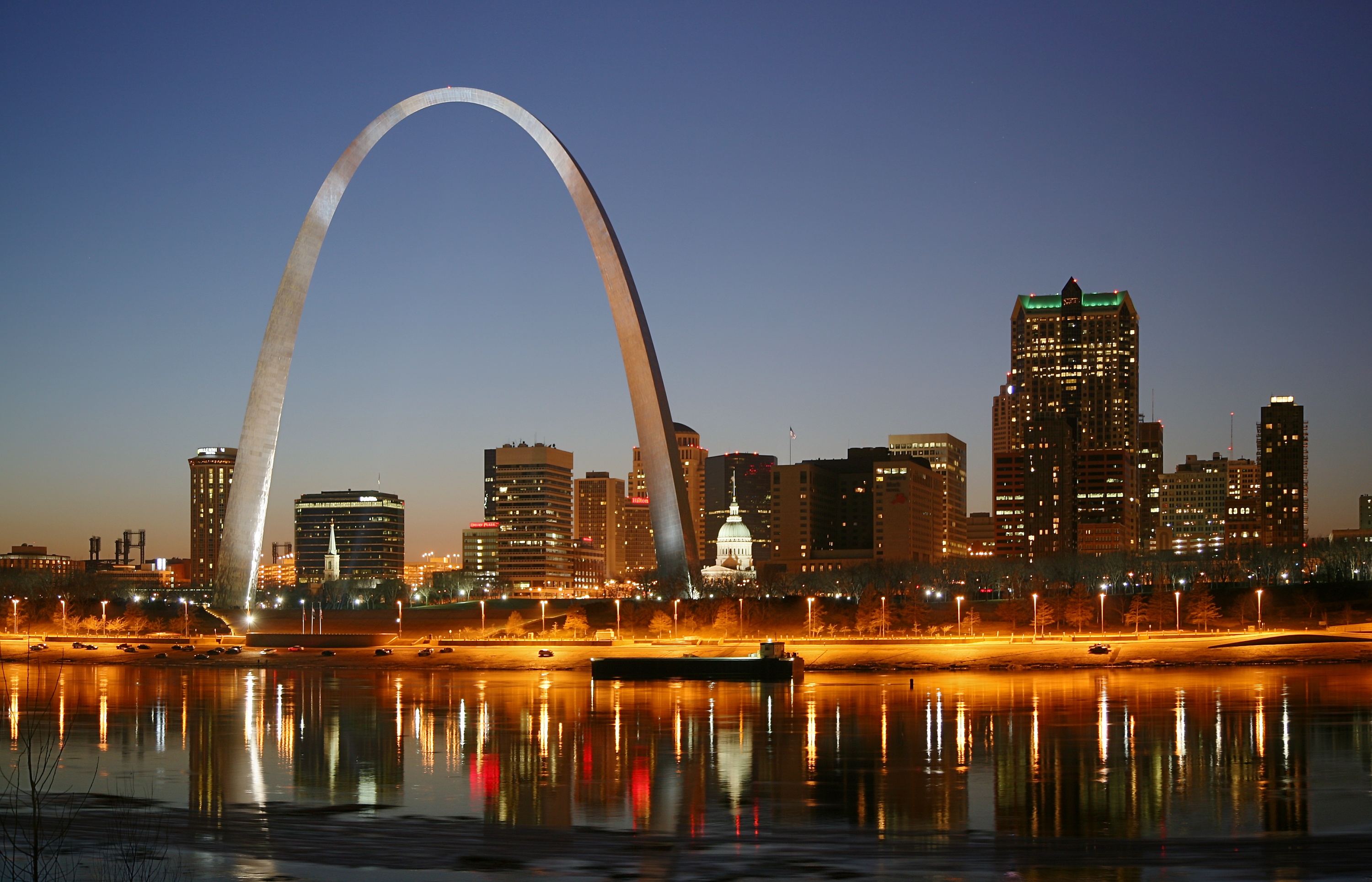
Gateway Arch
A project manager for the arch's construction once said that a 62-story building would have been easier to build. 'In a building, everything is straight up, one thing on top of another,' Stan Wolf explained. 'In this arch, everything is curved.' He was talking about engineering, but the same could be said about the structure's tortured path to existence -- a journey that took 32 years from idea to completion, survived a fraudulent election, a world war, a Korean War delay, the death of its architect, labor disputes, and civil rights protests staged on its own half-built legs.
The Shape of Weight
The Gateway Arch is not a parabola, and it is not a pure catenary. It is a weighted catenary -- the shape a chain would take if its links grew heavier toward the bottom. Eero Saarinen chose this form because it looked less pointed and less steep than an ordinary catenary, creating what he called a 'subtle soaring effect.' The mathematics are precise: a hyperbolic cosine function where the cross-sectional area varies linearly with height. Each of the 142 prefabricated stainless steel sections was filled with concrete and prestressed with 252 tension bars. The cross-sections are equilateral triangles, narrowing from 54 feet per side at the base to 17 feet at the apex. This is the largest single use of stainless steel in any construction project in history. A structural engineer estimated in 1984 that the arch could stand 'considerably less than a thousand years' before collapsing in a windstorm.
Climbing for Justice
On July 14, 1964, during the lunch hour, two members of the Congress of Racial Equality scaled the north leg of the unfinished arch. Percy Green and Richard Daly climbed 125 feet to expose what they called federal funds being used to build a national monument that racially discriminated against Black contractors and skilled Black workers. Protesters on the ground demanded that at least 10 percent of skilled jobs go to African Americans. Four hours later, the two climbers came down to charges of trespassing, peace disturbance, and resisting arrest. The incident spurred the Department of Justice to file the first pattern-or-practice case against AFL-CIO building trades under Title VII of the Civil Rights Act of 1964. Work stopped for a month during the dispute. When it resumed, an AFL-CIO contractor declared that ten African Americans had been apprenticed for arch labor.
Two Bottles of Champagne
When Saarinen won the 1947 design competition, the official notification was addressed to 'E. Saarinen,' and his father Eliel -- a celebrated architect in his own right who had also submitted an entry -- assumed the prize was his. The family opened champagne. Two hours later came the corrective phone call: the winner was the son. Eliel opened a second bottle. The younger Saarinen spent the next fourteen years refining his design, moving the arch to higher ground and adding height and width. He never saw it rise. Saarinen died on September 1, 1961, just months after excavation began. By 1963, a million people a year were coming to watch the construction. By 1964, local radio stations broadcast whenever large slabs of steel were hoisted into place. The arch was topped out on October 28, 1965, as Vice President Hubert Humphrey watched from a helicopter.
The View from 630 Feet
Inside the hollow arch, a unique tram system carries visitors to an observation deck at the top. Each egg-shaped capsule holds five passengers and tilts to keep riders level as it climbs the curved interior on a track system that is part elevator, part amusement ride. At the summit, small rectangular windows look out thirty miles in every direction. Since November 2001, the arch has been bathed in white light between 10 p.m. and 1 a.m. by 44 floodlights in pits below ground level. The arch sits in restricted airspace, but that has not stopped at least ten pilots from flying too close. In 1976, a U.S. Army exhibition skydiving team was permitted to fly through the arch as part of Fourth of July festivities. In 1980, Kenneth Swyers parachuted onto the top and attempted a base jump, but fell to his death when his reserve parachute failed to deploy.
From the Air
Located at 38.625°N, 90.185°W on the west bank of the Mississippi River. The arch stands 630 feet tall and is the tallest stainless steel monument in the world -- unmistakable from any altitude or direction. CAUTION: Restricted airspace surrounds the Gateway Arch. Best viewed from 3,000-6,000 ft AGL on approach from the east. Nearest airports: KSTL (St. Louis Lambert International, 12 nm NW), KCPS (St. Louis Downtown Airport, 3 nm SE). Busch Stadium sits immediately to the south. At night, floodlights illuminate the arch from 10 p.m. to 1 a.m.