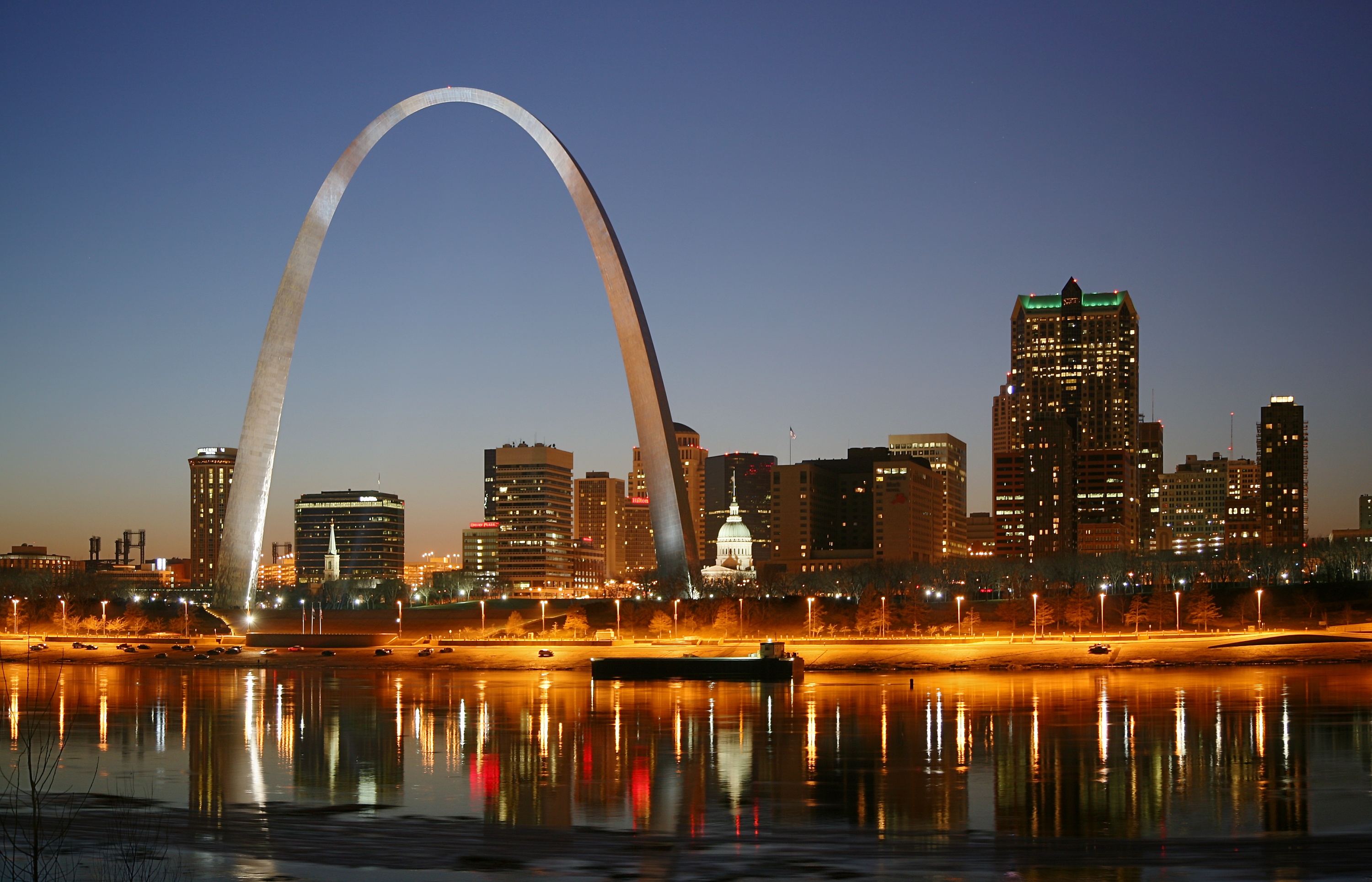
Gateway Arch National Park
The election that created this park was rigged. In September 1935, St. Louis voters supposedly approved a $7.5 million bond to demolish 40 blocks of their own riverfront and build a memorial. Only later did it emerge that the ballot count was fraudulent, and the true number of supporters remains unknown. Yet from that tainted beginning rose something extraordinary: the smallest national park in the United States, a sliver of land along the Mississippi that holds the tallest monument in America, a courthouse that heard the case that tore a nation apart, and a museum buried beneath a gleaming steel curve that has become the defining symbol of an entire city.
Where Three Flags Flew
The ground beneath Gateway Arch National Park has changed hands more dramatically than almost any soil in America. This narrow strip along the Mississippi's west bank was the site of the Three Flags Day ceremony in 1804, when Spain formally handed Louisiana to France and France turned it over to the United States less than 24 hours later. That transaction completed the Louisiana Purchase and cleared the way for Lewis and Clark to push west. The park sits on the original platted area of St. Louis, which also witnessed the Battle of St. Louis during the Revolutionary War -- the only battle west of the Mississippi in that conflict. Luther Ely Smith first imagined a memorial here in 1933, riding a train past the decaying riverfront buildings. He persuaded Franklin Roosevelt to make it a National Park Service unit in 1935, and became chairman of the memorial association for nearly two decades.
The Courthouse That Broke a Nation
The Old Courthouse, built on land deeded by St. Louis founder Auguste Chouteau, is the park's most historically potent building. Its dome, constructed during the Civil War, mirrors the dome placed on the United States Capitol during the same years. Inside these walls, Dred Scott first sued for his freedom in 1846, a case that wound through the legal system for eleven years before the Supreme Court's infamous 1857 ruling denied citizenship to all African Americans. Suffragette Virginia Minor also argued her landmark voting rights case here. The courthouse sat just west of the 40 blocks cleared for the memorial, and was formally added to the park in 1940. It now anchors the western end of the grounds, the fixed historical point around which the arch reaches.
A Father's Champagne
When architect Eero Saarinen won the 1947 design competition for the memorial's centerpiece, the notification went to 'E. Saarinen.' His father Eliel, who had also entered, assumed the letter was for him. The family opened a bottle of champagne. Two hours later, an embarrassed official called to clarify that the winner was the younger Saarinen. Eliel then opened a second bottle to celebrate his son's triumph. The elder Saarinen never saw the arch built; Eero himself died on September 1, 1961, just months after excavation began. Construction ran from 1963 to October 28, 1965, cost approximately $15 million, and was complicated by civil rights protests -- Percy Green and Richard Daly of CORE climbed the north leg in 1964 to demand that African Americans receive at least 10 percent of skilled construction jobs.
Smallest Park, Largest Symbol
Gateway Arch National Park is less than two percent the size of Hot Springs National Park, the next-smallest in the system. Its redesignation from Jefferson National Expansion Memorial to a national park in 2018 proved controversial; the National Park Service itself testified that the site was 'too small and limited in the range of resources' for the title. Yet a $380 million renovation completed that same year transformed the grounds, adding a park over Interstate 70 to reconnect the city to the arch, expanding the underground museum, and more than doubling the number of trees from 1,800 to 4,200. During the Great Flood of 1993, Mississippi waters reached halfway up the Grand Staircase on the park's east side, a reminder that this slender strip of land remains bound to the river that gave it meaning.
From the Air
Located at 38.625°N, 90.185°W along the Mississippi River in downtown St. Louis. The Gateway Arch is unmistakable from the air -- a gleaming steel catenary curve that catches sunlight from any angle. Best viewed from 2,000-5,000 ft AGL approaching from the east over the Mississippi or from the Illinois side. Note restricted airspace around the arch. Nearest airports: KSTL (St. Louis Lambert International, 12 nm NW), KCPS (St. Louis Downtown Airport, 3 nm SE in Cahokia, IL). The Old Courthouse dome and Busch Stadium are nearby visual references.