Gatineau Park
Pink Lake is not pink. Despite its name -- inherited from the Pink family who once owned the surrounding property -- the lake glows an eerie, vivid green, its colour produced by tiny algae suspended in water that never fully mixes from top to bottom. This meromictic oddity sits in Gatineau Park, a vast wedge of forested hills just north of Ottawa that holds prime ministerial residences, centuries-old trees, wolf packs, and one of the most peculiar bureaucratic paradoxes in Canadian conservation: it is the only federal park in the country that is not actually a national park.
The Park That Almost Was
The idea of protecting the Gatineau Hills for recreation dates back to 1903, but the park's creation was delayed for decades by politics, death, and one prime minister's desire for privacy. In December 1913, Dominion Parks Commissioner James B. Harkin wrote to his superiors arguing that Canada's East deserved a national park to rival those in the Rockies, and that Gatineau should be the first. Quebec's Minister of Mines and Forests promised immediate attention to the request -- then died before he could act. No response ever came. It took another twenty-five years before money was finally allotted in 1938 for acquiring Gatineau woodlands and building a parkway. But Prime Minister William Lyon Mackenzie King, whose own summer estate sat on Kingsmere Lake within the park boundaries, feared criticism and wanted privacy. His caution ensured that Gatineau Park was created without the legal protection of the National Parks Act -- a gap that persists to this day, leaving its ecology, boundaries, and land mass uniquely vulnerable.
Prime Ministers and Stone Ruins
Mackenzie King's relationship with the park was deeply personal. Canada's longest-serving prime minister maintained a 231-hectare estate south of Kingsmere Lake, where his cottages -- Kingswood and the primary residence, Moorside -- have been restored and now house interactive exhibits about his era. The estate's most striking feature is a picturesque collection of stone ruins, an assemblage of architectural fragments that King collected throughout his life, arranged amid the forested landscape with a small waterfall cascading down the escarpment nearby. At his death in 1950, King donated the entire estate to the people of Canada. The park also contains Harrington Lake -- known in French as Lac Mousseau -- which serves as the Prime Minister's official country retreat and summer residence. The Speaker of the House of Commons maintains an official residence nearby at Kingsmere, a renovated farmhouse known as The Farm, which was once part of King's holdings. Power and wilderness have always been entangled here.
Ancient Trees and Wild Ridgelines
At the park's western edge, the Eardley Escarpment drops sharply toward the Ottawa Valley, creating dramatic viewpoints and unique ecological conditions. Champlain Lookout, perched atop the escarpment at the end of the Gatineau Parkway, offers sweeping views across the valley, especially spectacular in autumn when the surrounding hillsides ignite in red, orange, and gold. King Mountain, a prominent peak along the escarpment, holds a distinction most visitors never learn: it was the first triangulation point in Canada. The mountain's varied terrain supports an unusual range of vegetation, from evergreen and deciduous forests to windswept savannas, and shelters trees that are nearly 600 years old. For many years, a red cedar cross erected by Father Maguire, a parish priest from Old Chelsea, stood on the summit, visible for miles. It eventually rotted and toppled over the cliff face -- a quiet reminder of time's indifference to human markers on the landscape.
Trails, Lakes, and Four-Season Play
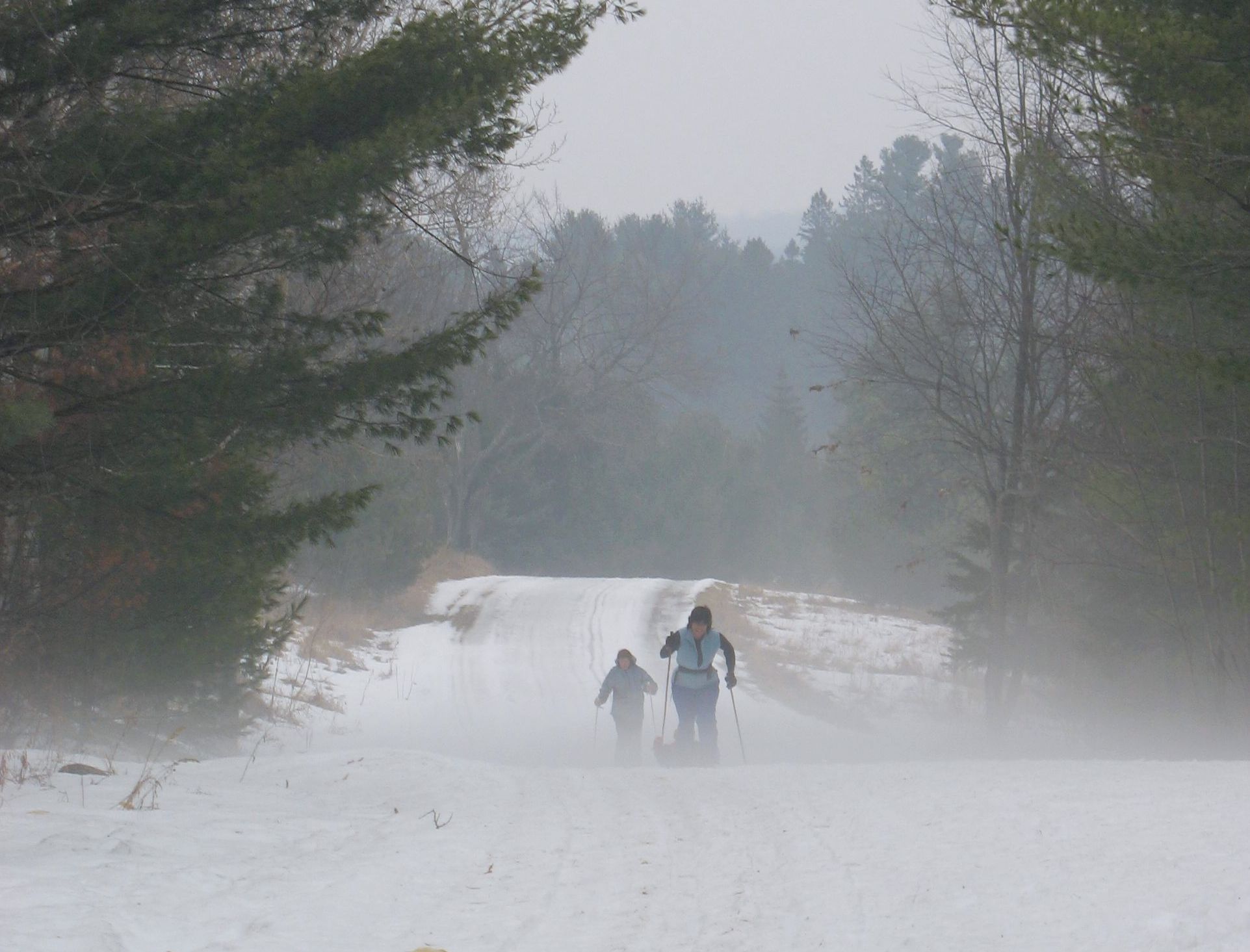
Gatineau Park functions as the outdoor playground for the Ottawa-Gatineau metropolitan area. Hundreds of kilometers of trails serve hikers in summer and cross-country skiers in winter, with the park hosting the annual Gatineau Loppet ski race. Camp Fortune offers downhill skiing and snowboarding in the cold months and ziplines and treetop obstacle courses in summer. Three lakes -- Meech Lake, Lac Philippe, and La Pêche Lake -- provide beaches, campgrounds, and canoe access. Meech Lake carries its own historical weight as the site of Willson House, the government conference centre where the ill-fated Meech Lake Accord negotiations unfolded in 1987. The Trans Canada Trail passes through the park, and cyclists find the steep, demanding routes through the Gatineau Hills a particular challenge. Wildlife thrives in the more remote sections: pileated woodpeckers drum in the hardwood forests, turkey vultures ride the thermals above the escarpment, beavers reshape the wetlands, white-tailed deer browse the clearings, and two wolf packs roam the backcountry.
A Park Without a Safety Net
Gatineau Park's status as the only federal park not protected under the National Parks Act has had real consequences. Private residences exist within its boundaries, and inspection reports from 2013 and 2015 found that 119 structures at Meech Lake had been built without permits, with 80 percent of inspected residents violating shoreline protection bylaws. Multiple private members' bills and government legislation have attempted to address the park's governance since 2005, but none has been enacted into law. Advocates from the New Woodlands Preservation League continue to push for stronger protections and greater public access while opposing further residential development. The park that James Harkin championed in 1913 as the cornerstone of a national system remains, more than a century later, still waiting for the legal protection its founders intended.
From the Air
Gatineau Park is located at approximately 45.58N, 76.00W, directly north of Ottawa across the Ottawa River in Quebec. From altitude, the park appears as a large forested area contrasting sharply with the urban sprawl of Ottawa-Gatineau to the south and east. The Eardley Escarpment along the western edge is a visible ridgeline. Meech Lake, Lac Philippe, and La Peche Lake are identifiable water features within the park. The nearest major airport is Ottawa Macdonald-Cartier International (CYOW), approximately 25 km southeast. Gatineau Executive Airport (CYND) is closer, just east of the park. Best viewed at 3,000-6,000 feet AGL. The Ottawa River provides clear visual orientation, with the park rising into the Gatineau Hills on the Quebec side.