Gatun
Two dollars bought you a hammock for the night in 1849 Gatun. The village sat on the Chagres River, a mandatory stop for gold rush travelers crossing the isthmus of Panama from the Atlantic to the Pacific. They arrived by barge, slept in cane huts on the edge of a broad savannah, and pressed on by mule toward Panama City and the ships bound for San Francisco. Gatun had no particular ambition to be important. Importance kept arriving anyway, carried by whoever needed to cross from one ocean to the other.
Pirates, Rails, and a French City
The name El Gatun appears on Spanish colonial maps, marking a village and river whose founding date no one recorded. In 1671, the pirate Henry Morgan and his men camped near Gatun after sacking and burning old Panama City. For the next century and a half, the village dozed. Then the California Gold Rush struck, and Gatun became a bottleneck on the fastest route to the goldfields. New York financiers formed the Panama Railroad Company, and in 1850 ships carried workers and machinery up the Chagres to Gatun, where construction began working back through swamp toward the Atlantic terminus on Manzanillo Island. The first rail from Manzanillo to Gatun was completed in 1851, and by January 1855 trains crossed coast to coast. When Ferdinand de Lesseps launched his canal project in 1881, the French shipped in prefabricated buildings and renamed the town Cite de Lesseps. French warehouses, quarters, and machine shops sprang up along the railroad line. By the late 1880s, the project had collapsed financially, thousands of workers had died from yellow fever, and Gatun fell quiet again.
The Lock That Made the Town
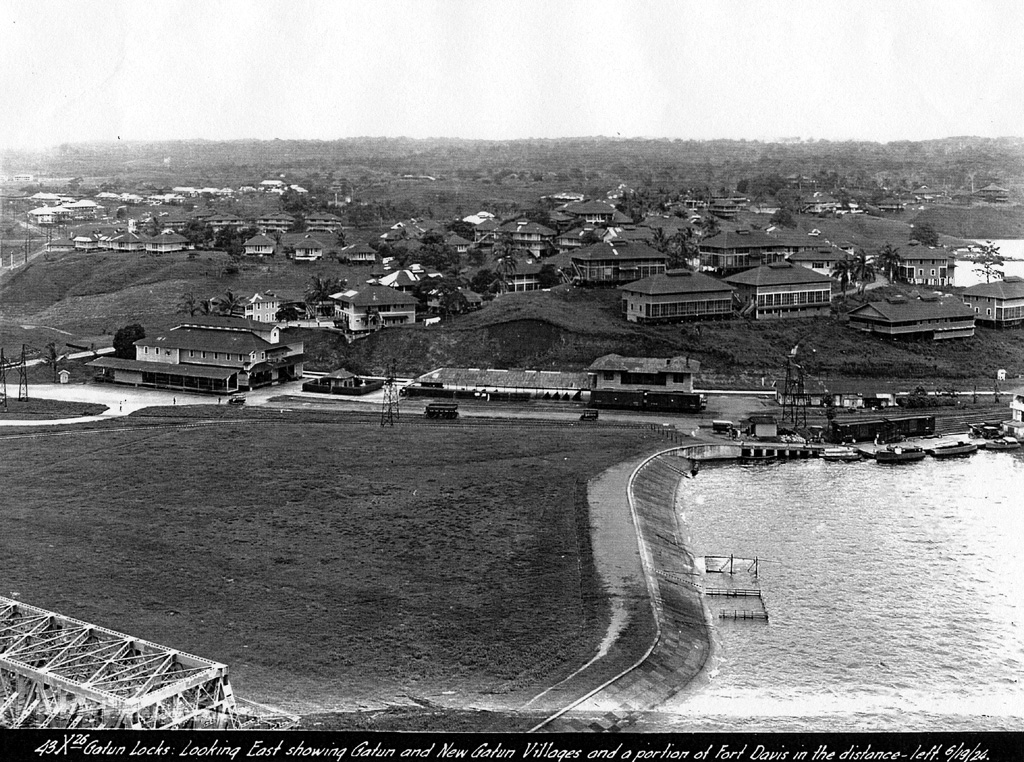
In 1904, the Americans arrived. Chief Engineer John F. Stevens overruled the original plan to dam the Chagres at Bohio, 17 miles from Colon, and chose Gatun as the site for the canal's Atlantic locks and dam. The new American Gatun started as a tent city with a plank road. By June 1907, 97 buildings stood where cane huts had been. In April 1908, the old village and its residents were relocated to a neighborhood called New Town, east of the construction zone. Lieutenant Colonel William L. Sibert established the Atlantic Division headquarters in Gatun and built his house at the edge of town. By March 1913, Gatun's population had swelled to 8,887. Nine months later, with the dam completed and the locks operating, it had dropped to 5,943. Officials projected a future population of 160 American employees and their families.
Life in the Canal Zone
Gatun survived the post-construction bust. In 1928, new quarters were built for 164 local-rate families, and in 1934 a $1.25 million housing project replaced most of the old construction-era buildings with permanent wood and masonry structures. When World War II came, the locks became a strategic target. Twenty-six-foot corrugated steel fences encircled them, barrage balloons floated overhead, street lights were removed, and residents drove with blacked-out headlights. Air raid shelters went up in backyards. After the war, Gatun settled into a comfortable Canal Zone existence. The Tarpon Club, founded in 1914 as the Gatun Fishing Club, hosted Presidents Theodore Roosevelt and Franklin Roosevelt and ex-King Leopold III of Belgium. Three horseman's clubs held shows and competitions. A new clubhouse opened in 1944, praised as the newest and most complete in the canal's clubhouse system.
The Lake and the Peacock Bass
Gatun Lake, created in 1913 by damming the Chagres, was the largest man-made body of water in the world when it formed. Stretching roughly 180 square miles, it serves a dual purpose: providing the water that fills the canal locks with each ship transit and supplying drinking water to Panama City and Colon. The impenetrable rainforest surrounding the lake has functioned as the canal's best defense, preserving one of Central America's most pristine ecological zones. In 1958, a Panamanian aquarist accidentally introduced peacock bass from the Amazon basin into the lake. Locally called sargento, the fish thrived, becoming the dominant game species. Anglers prize them for striking topwater lures and putting up a spirited fight, and Gatun Lake has been ranked among the world's best peacock bass fisheries for more than half a century.
Ghost Town at the Lock Gates
Today, most of Gatun is a ghost town administered by the Panama Canal Authority. The eastern neighborhood once called New Town has been demolished to make room for the canal's expanded third locks channel. Cruise passengers and tourists visit the Gatun Locks observation platform by the thousands but rarely venture into town. The former clinic, school, swimming pool, and fire station still stand, repurposed by the canal authority. The old Sibert Lodge is closed. Canal Zone architecture, built to last, outlived the community it housed. The Tarpon Club, remarkably, still exists, one of the few Gatun institutions that has survived every reinvention the isthmus has demanded.
From the Air
Gatun is located at 9.27N, 79.92W on the Atlantic side of the Panama Canal, where Gatun Lake meets the canal channel leading to the Caribbean. The Gatun Locks are a prominent landmark visible from altitude, appearing as a stepped concrete structure with ships queuing on either side. Gatun Dam stretches east from the locks, holding back the vast expanse of Gatun Lake. Enrique Adolfo Jimenez Airport (MPEJ) at Colon is approximately 5 miles north. France Field, a former U.S. airstrip, lies between Gatun and Colon. Expect tropical heat, humidity, and frequent afternoon convective weather.