Gawhar Shad Mausoleum
Three domes hide inside one another. The outermost is bulbous and covered in light blue-green mosaic tiles that catch the Afghan sun. The innermost gleams with gold leaf and lapis lazuli, forming patterns so intricate they seem to shift as the light changes. Between them sits a structural dome that holds the whole arrangement aloft. This engineering marvel belongs to the Gawhar Shad Mausoleum in Herat, a burial place commissioned not by a king or a conqueror but by a queen -- Gawhar Shad, chief wife of the Timurid Emperor Shah Rukh and one of the most influential patrons of architecture in Central Asian history.
A Mother's Monument
Gawhar Shad built the mausoleum to house the remains of her son, Prince Baysunghur, who died before his father. Completed in 1438, the tomb stood within the Gawhar Shad Madrasa, a religious school that bore her name and formed part of the larger Musalla Complex in northern Herat. The location was deliberate: the Musalla sat near the royal residence in the Bagh-i Zaghan, making it convenient for the dynasty's mourning and remembrance. Over the years that followed, the mausoleum became a family vault. Gawhar Shad herself was interred here, alongside her brother Amir Sufi Tarkhan, her other son Muhammad Juki, and several of Baysunghur's sons, including Sultan Muhammad, Ala al-Dawla, and Ala al-Dawla's son Ibrahim. Even more distantly related Timurids -- Ahmad and Shah Rukh, sons of Abu Sa'id Mirza -- found their final rest within these walls.
Geometry in Stone and Light
The mausoleum's floor plan forms a cruciform shape, its four arms radiating from a central domed chamber. That triple-dome arrangement is the building's engineering signature. The low inner dome creates an intimate ceiling for the burial chamber below. Above it, the structural middle dome bears the weight. And the tall outer cupola -- visible across Herat's skyline -- serves as the monument's public face. Inside, the square burial chamber holds axial niches in each wall. Six grave markers survive, oblong slabs of matt black stone carved with floral patterns. There were once as many as twenty, but the widespread practice of removing and reusing tombstones over the centuries scattered the rest. No one knows exactly how many burials the mausoleum holds.
Damaged, Altered, Diminished
By the 20th century, the mausoleum was deteriorating badly. The cupola had suffered severe damage, and the building's integrity was compromised. A restoration effort in the 1950s intended to save the structure but instead transformed it. Workers built an entirely new eastern facade, demolished the original hexagonal mihrab -- the prayer niche indicating the direction of Mecca -- and replaced it with a rectangular one. The materials used were inappropriate, and the quality of workmanship fell short. Later restorations compounded the problem rather than correcting it. What visitors see today is a building that has been repeatedly patched, its original character partially obscured by well-meaning but clumsy interventions.
The Wider Ruin
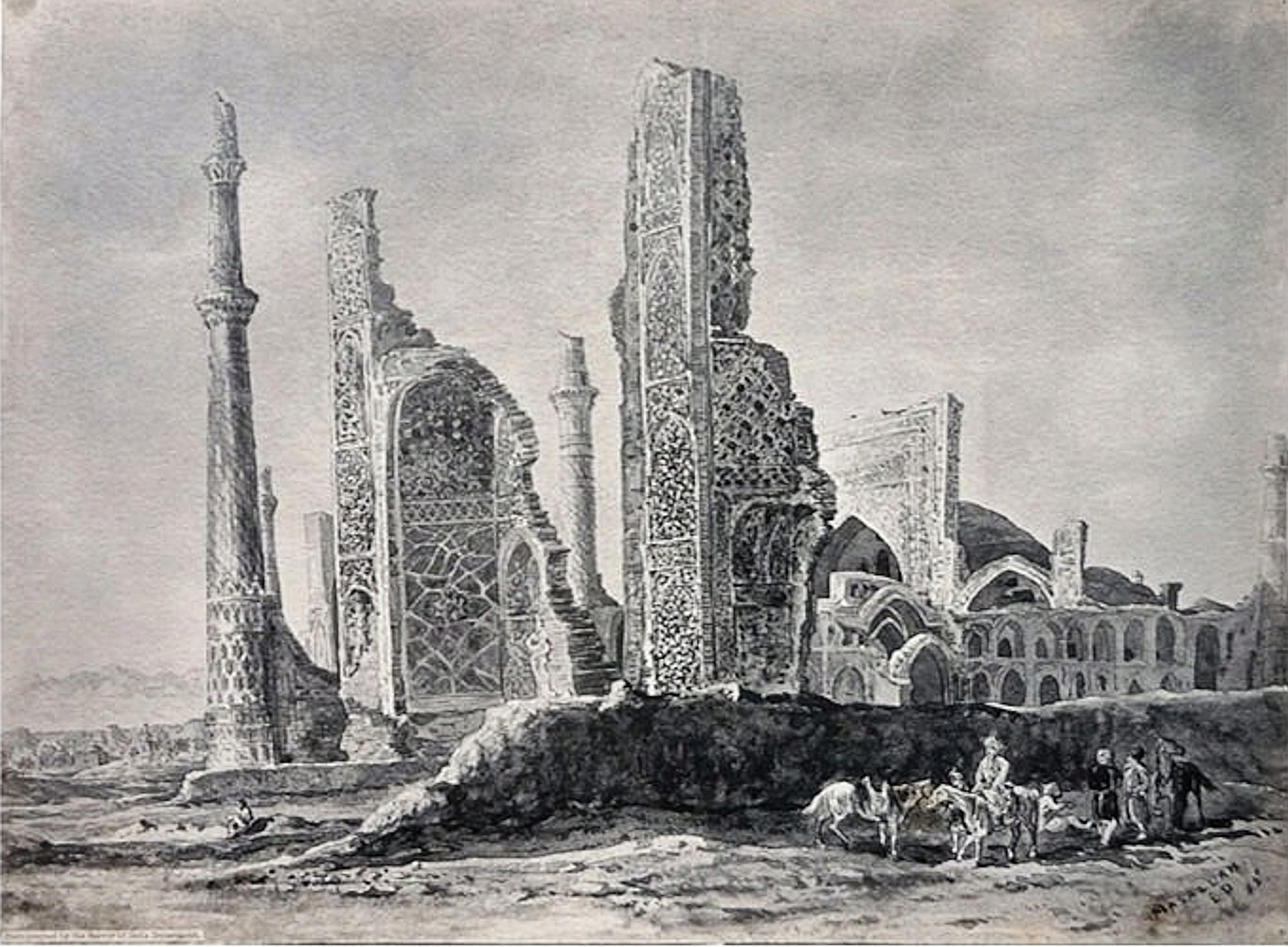
The mausoleum's story cannot be separated from the fate of the Musalla Complex that surrounded it. In 1885, officers of the British Indian Army dynamited much of the complex -- including the magnificent Mosque of Gawhar Shad -- to create clear firing lines in case a Russian army tried to approach India through Herat. The demolition destroyed one of the great architectural ensembles of the Islamic world. A lone minaret still stands nearby, a surviving fragment of the madrasa. The mausoleum itself was spared the dynamite but not the decades of neglect that followed. In 2004, UNESCO added the entire City of Herat, including the Musalla Complex, to its Tentative List of World Heritage Sites. A decade later, UNESCO and the Afghan government coordinated an effort to preserve and replicate the tilework on the exterior dome.
What Endures
The Gawhar Shad Mausoleum is no longer a functioning burial site. It has not served that purpose since the early 20th century. But its surviving elements -- the triple dome, the fragments of lapis and gold leaf, the black stone grave markers with their carved flowers -- still testify to a moment when Herat was one of the great cultural capitals of the world. Gawhar Shad was not merely a royal consort. She was a builder whose ambitions rivaled those of any sultan. The mosques, madrasas, and tombs she commissioned across Timurid territory shaped the architectural language of Central Asia for centuries. That this particular monument bears her name twice over -- the mausoleum she built, in the madrasa she founded -- speaks to a legacy that outlasted the dynasty itself.
From the Air
Located at 34.358N, 62.185E in northern Herat, Afghanistan. The mausoleum is part of the Musalla Complex, identifiable from the air by the surviving lone minaret nearby. Nearest airport is Herat International Airport (OAHR), approximately 13 km south. Best viewed at 3,000-5,000 feet AGL. The dome structure is visible against the surrounding urban landscape in clear weather conditions.