Gayer-Anderson Museum
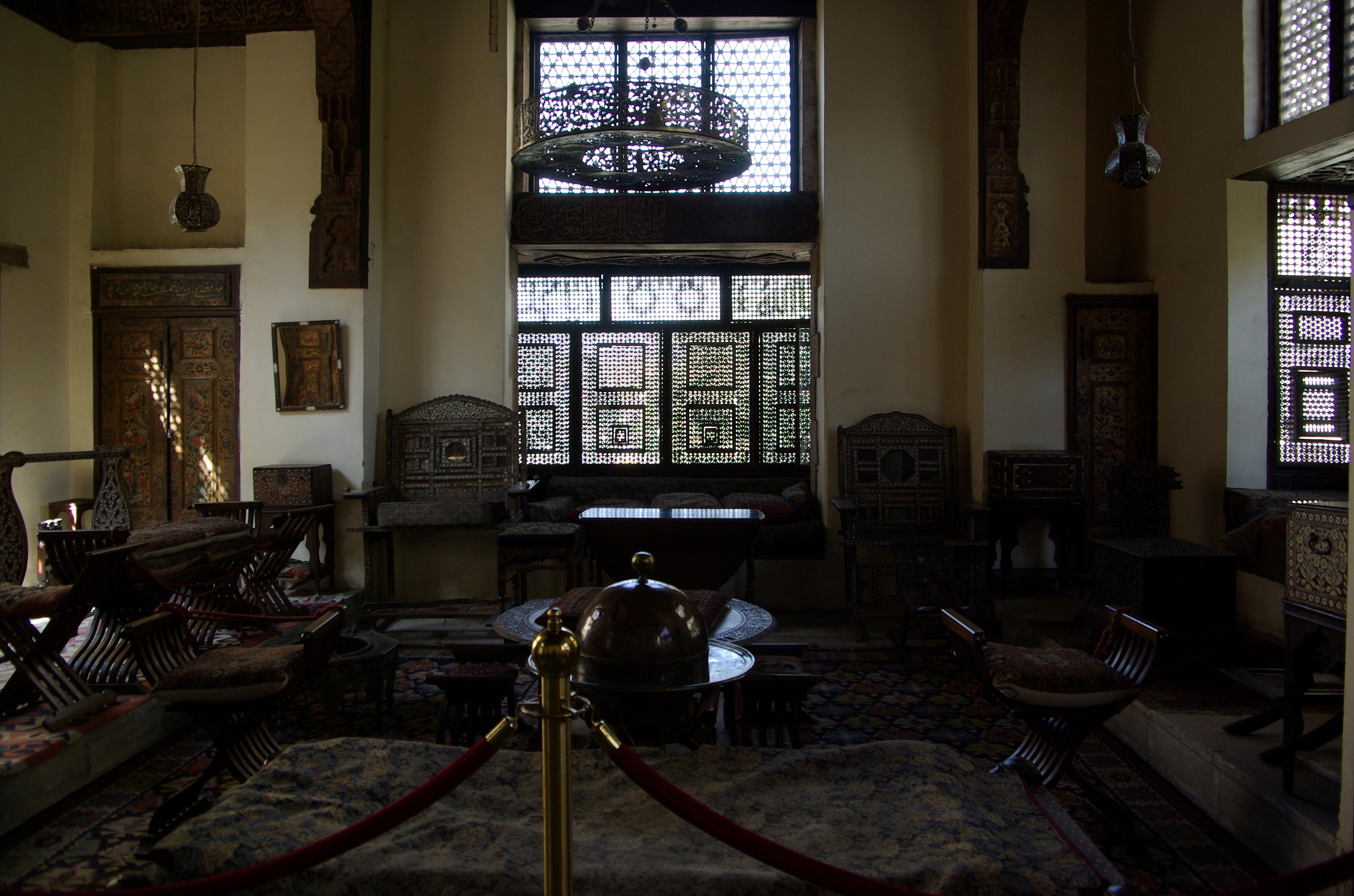
Legend says the well in the courtyard is where Noah's floodwaters drained. A lover who gazes into it will see not their own reflection but the face of their beloved. A buried shaykh protects the house, and once blinded three thieves who stumbled through its rooms for three days before they were caught. These are the stories that Major Robert Grenville Gayer-Anderson Pasha collected about his home, a pair of seventeenth-century Cairene houses joined by a bridge and pressed against the outer wall of the Mosque of Ibn Tulun. He lived here from 1935 to 1942, filling every room with a collector's compulsive abundance. Today the Gayer-Anderson Museum is one of Cairo's least-visited and most rewarding treasures, a place where Mamluk architecture, Ottoman furniture, Persian miniatures, and ancient Egyptian artifacts coexist in rooms that feel more like a private cabinet of curiosities than a state institution.
The House of the Cretan Woman
The older and larger of the two houses was built in 1632 by Hajj Mohammad ibn al-Hajj Salem ibn Galman al-Gazzar. It eventually passed into the hands of a wealthy Muslim woman from Crete, and the house became popularly known as Beit al-Kritliyya, the House of the Cretan Woman. Together with its smaller neighbor, the building leans against the outer wall of the ninth-century Mosque of Ibn Tulun for structural support, a practical arrangement that also gives the complex an air of deep historical layering. The architecture is considered one of the finest surviving examples of Mamluk-era domestic design in Cairo: marble-floored courtyards, mashrabiya window screens, a reception loggia called the Maq'ad, and a fifteen-meter-deep well known as the Bats' Well. The traditional layout divided the house into the Haramlik, the private family quarters, and the Salamlik, the public reception area, connected by a Byzantine-style bridge room.
The Major's Obsession
Gayer-Anderson arrived in Egypt in 1907 as a military doctor transferred to the Egyptian Army. He rose to Major by 1914, served as Assistant Adjutant-General for recruiting, then moved into civilian life as Senior Inspector at the Egyptian Ministry of the Interior and later Oriental Secretary to the British Residency. He retired in 1924 but never left Egypt, devoting the rest of his life to Egyptology and collecting. In 1935, the Egyptian government granted him special permission to live in Beit al-Kritliyya. Over the next seven years, he filled it with objects gathered from across the Islamic world and beyond. A Damascus room, built entirely of carved wood, was transported piece by piece from Syria. A Mohamed Ali room contains Ottoman-era Rococo furniture, including a throne chair that may have belonged to Khedive Ismail Pasha, and a mechanical singing bird from Istanbul. His study held a map of Egypt engraved on an ostrich egg and a mummy case dating to the eighteenth century BCE.
Rooms That Tell Stories
Each room in the museum is its own world. The Persian Room displays objects from the Shah Abbas period alongside an Egyptian bed and a replica of an ancient couch with bulls' feet. The Ancient Egyptian Room still holds the bronze cat with gold earrings that Gayer-Anderson treasured. Upstairs, the Harem is a vast space supported by four columns, its Persian cupboards brought from a palace in Tehran, each holding a different collection. The roof garden is enclosed by mashrabiya screens of Coptic origin, bearing Christian cross symbols, a rarity that has only one parallel in the nearby Coptic Museum. Perhaps the most atmospheric space is the Makhba, a secret chamber positioned above the courtyard well. It was used as a hiding place for people or objects on the wrong side of the law. In a house already layered with centuries of occupation, the Makhba adds one more dimension: the things that were never meant to be found.
Legends Older Than the Walls
Gayer-Anderson did not merely collect objects; he collected the stories that clung to his house. He published them as Legends of the House of the Cretan Woman, and they remain part of the museum's identity. The house was said to be built on Gebel Yashkur, the Hill of Thanksgiving, where Noah's Ark came to rest. Moses was supposedly spoken to by God on this spot. The protecting shaykh, Haroun al-Husseini, lies buried under one corner. Inspired by the legend of the floodwaters draining through his courtyard well, Gayer-Anderson built a sailing boat on the Nile and gave it the French name La Maree, meaning "the tide." Whether any of these legends predate the Major's residence or were embellished by his romantic imagination is impossible to say. But they give the house a narrative depth that no amount of curatorial labeling could achieve.
A Quiet Survivor
The museum today is run by the Supreme Council of Antiquities and sits on Abd al-Magid al-Labban Street in the Sayyida Zeinab neighborhood. The nearest metro station is about a kilometer away, and the most common way to arrive is by taxi, an approach that deposits visitors into the dense medieval fabric of Islamic Cairo before they even reach the door. Unlike the Egyptian Museum on Tahrir Square with its crowds and security barriers, the Gayer-Anderson Museum receives relatively few visitors. Those who do come find something the larger institutions cannot offer: the experience of walking through a home rather than a gallery. The brass bowls in the Maq'ad date from between the fourteenth and seventeenth centuries. The Kiswa fragment in the reception room is green silk. The mashrabiya screens filter Cairo's light into geometric patterns on the marble floors. It is a place assembled by one man's appetite for beauty, sheltered inside architecture built four centuries ago, leaning on a mosque wall laid twelve centuries before that.
From the Air
Located at 30.028N, 31.251E in the Sayyida Zeinab neighborhood of Cairo, adjacent to the Mosque of Ibn Tulun, one of the oldest and largest mosques in Cairo whose spiral minaret is a distinctive aerial landmark. Nearest major airport is Cairo International (HECA), approximately 18 km northeast. Recommended viewing altitude: 1,500-2,500 ft AGL to appreciate the relationship between the museum houses and the massive Ibn Tulun mosque compound. The museum buildings are small and best identified by proximity to the mosque's large open courtyard.