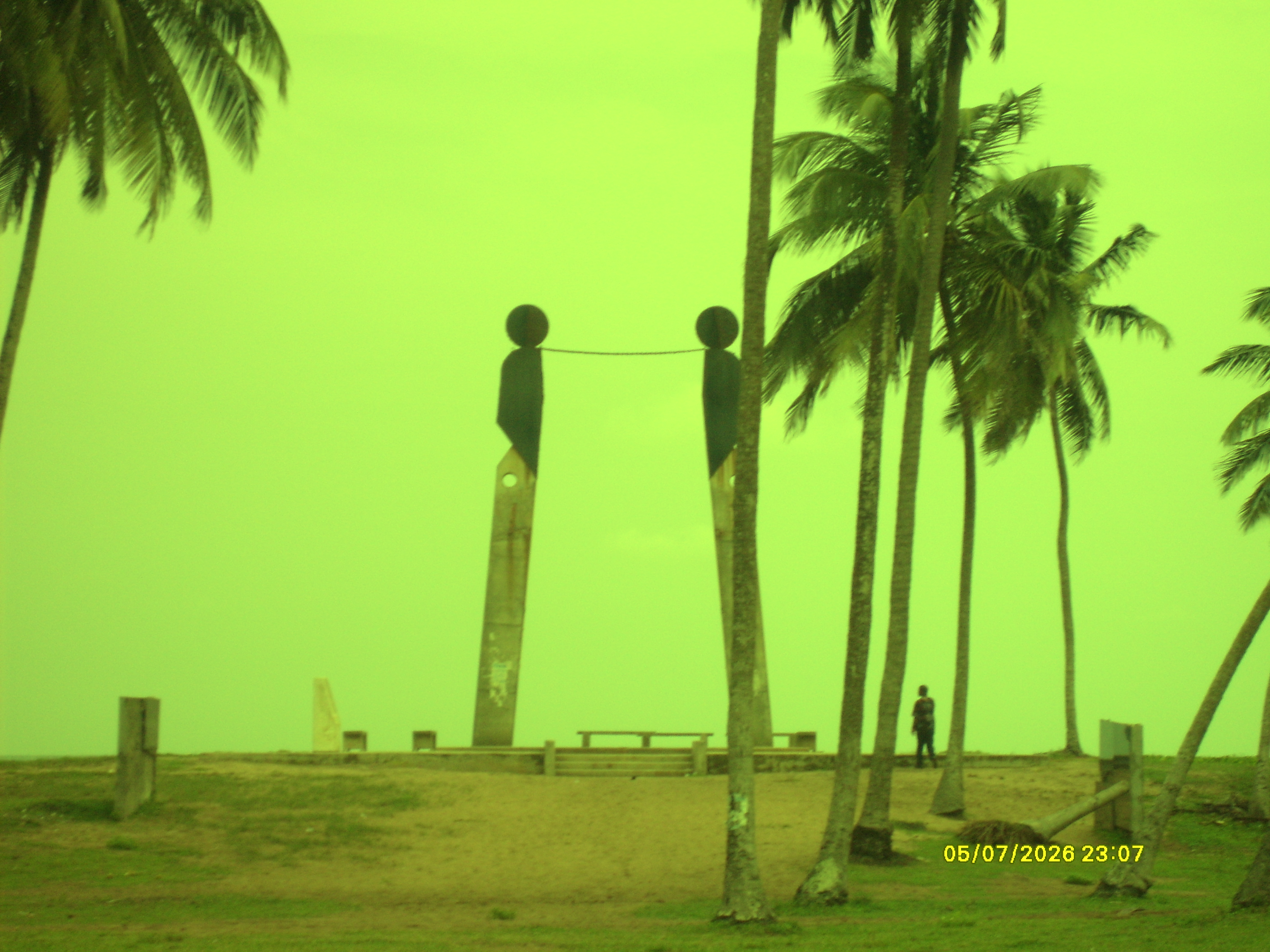
Gberefu Island
In the Ewe language, Gberefu -- or more precisely Agbedefu -- means "life is trouble" or "life is difficult." For the millions of enslaved people who passed through this small island off the coast of Badagry between the sixteenth and nineteenth centuries, the name was an understatement of nearly incomprehensible proportions. Gberefu Island was their last contact with the African continent. Two poles, slightly slanted toward each other and facing the Atlantic Ocean, now mark the spot known as the Point of No Return. They stand as a memorial to the people who were forced past this threshold and onto ships bound for the Caribbean and the Americas, most of whom would never see their homeland again.
The Threshold
Gberefu Island opened as a slave port in 1473, predating European colonization of most of the Americas. According to Nigerian historians, as many as three million enslaved people were shipped from this island between 1518 and 1880. The scale of that number resists comprehension. Three million human beings -- mothers, fathers, children, farmers, warriors, artisans -- walked across this ground, boarded vessels, and vanished into the Atlantic trade that reshaped four continents. The island sits in the lagoon waters off Badagry, close enough to the mainland to be reached by boat but separated enough to serve the slavers' purpose: once captives were ferried across, escape became nearly impossible. The water itself became a wall.
Salt Merchants and Fishermen
Gberefu Island has its own community, one whose story extends beyond the slave trade. The island's first settlers were Ewe people, salt merchants and fishermen from Keta who arrived around 1734 and established two villages under one umbrella: Gbragada and Kofeganme, also known as Yovoyan. By the late eighteenth and early nineteenth centuries, fishing and farming had become the primary occupations. Other ethnic groups joined them over time -- the Egun and the Ilaje -- and the communities live together on the island today. Two chiefs govern Gberefu, both crowned by the Akran of Badagry Kingdom: Chief Yovoyan, the Duheto, and Chief Najeemu, the Numeto. The island's living culture is layered atop its traumatic history, a place where people fish, farm, and raise families on the same ground where their ancestors witnessed unspeakable suffering.
The Spirit Attenuation Well
Along the slave route on Gberefu Island, there is a feature known as the Spirit Attenuation Well. Captives were forced to drink from it or walk around it as part of a ritual intended to make them forget their homeland, their families, and their identities before embarkation. The practice was designed to break spiritual resistance -- to sever the connection between the enslaved person and the land they were leaving. Whether it worked in any spiritual sense is unknowable. What is certain is that the people who were subjected to this ritual were already enduring physical confinement, forced marches, and the terror of an unknown destination. The well remains on the island as a stark artifact of the systematic dehumanization that the slave trade required at every stage, from capture to transport to sale.
Returning to the Point of No Return
Since the late twentieth century, Gberefu Island has become a site of pilgrimage and remembrance. Members of the African diaspora, particularly from the Americas and the Caribbean, travel to Badagry to walk the slave route and stand at the Point of No Return monument. According to statistics reported by The Guardian of Nigeria in 2015, 3,634 people visited the island in just six months. The monument -- two poles leaning toward each other above a raised platform facing the ocean -- was later augmented with a structure called the Ark of Embarkation. These are not celebratory monuments. They are markers of loss, designed to honor the memory of the people who stood on this shore and were denied any choice about what came next. For visitors from the diaspora, the experience is often described as a homecoming that their ancestors were never permitted to make.
From the Air
Gberefu Island is located at approximately 6.394°N, 2.891°E, in the lagoon waters off Badagry in Lagos State, southwestern Nigeria. From the air, it is visible as a small populated island in the coastal lagoon system south of the Badagry mainland. The Point of No Return monument faces the Atlantic Ocean on the island's southern edge. The nearest major airport is Murtala Muhammed International Airport (DNMM) in Lagos, approximately 70 km to the east. Coastal haze and humidity are common year-round. The surrounding lagoon waters and barrier island coastline are prominent visual features at lower altitudes.