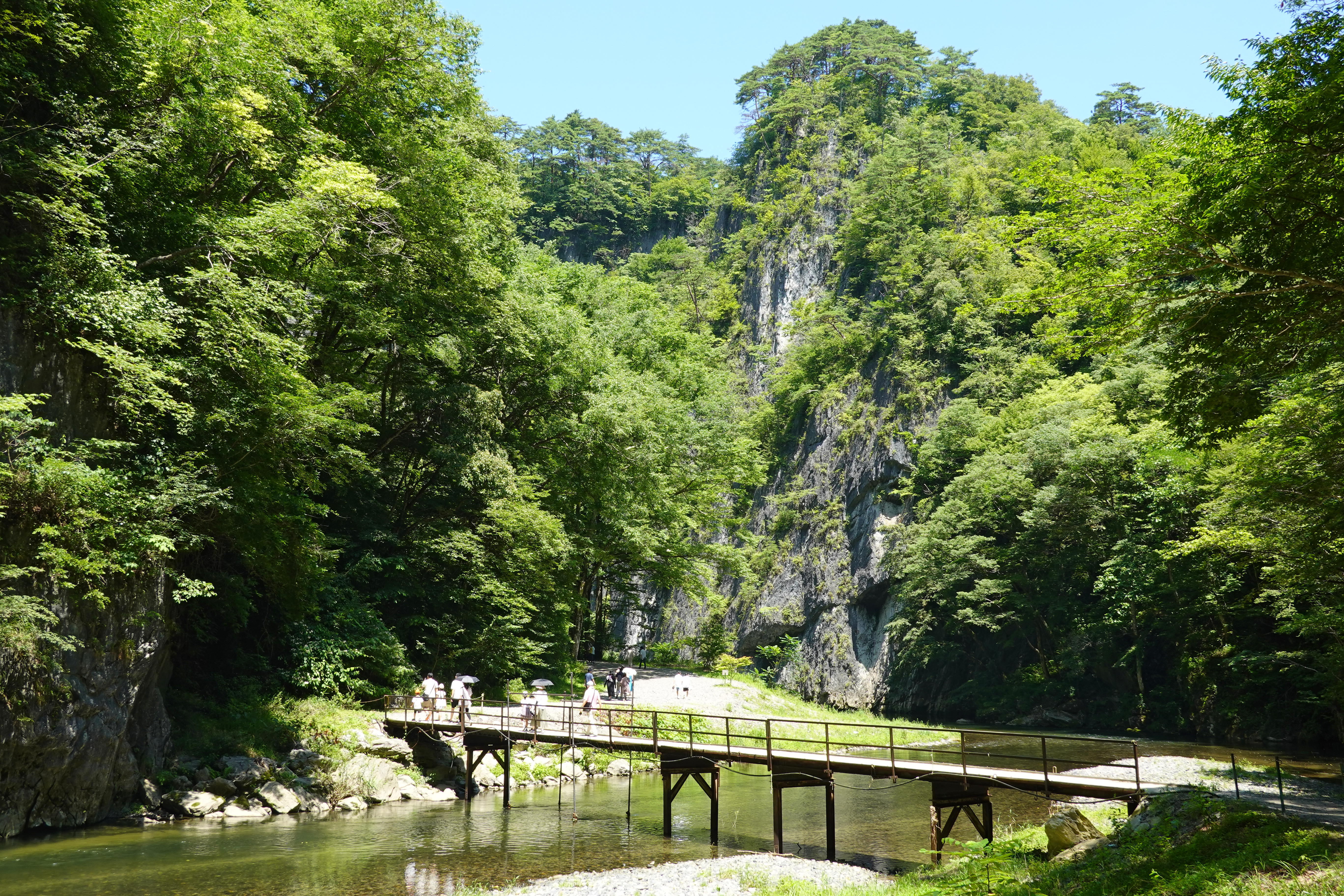
Geibikei
The boatman plants his pole against the riverbed and pushes. The flat-bottomed boat slides forward without a sound, and the limestone walls of Geibikei close in overhead -- fifty meters, eighty meters, topping out at 124 meters of sheer cliff face on either side of the Satetsu River. For ninety minutes, the only sounds are water against wood and, on the return leg, the boatman's voice rising into the narrow canyon as he sings the Geibi Oiwake, a traditional song that has echoed off these walls for generations. This is Geibikei, a ravine in the city of Ichinoseki, Iwate Prefecture, designated a National Place of Scenic Beauty and Natural Monument since 1923, and selected as one of Japan's 100 Landscapes in 1927.
The Lion's Nose
The name Geibi translates to "lion's nose," and it comes from a limestone formation near the far end of the gorge that juts out over the water like a lion's snout. Erosion has been the sole architect here, carving two kilometers of dramatic scenery from the limestone over millennia. The cliffs are studded with fanciful rock formations -- pillars, overhangs, and alcoves sculpted by water and wind -- and interrupted by waterfalls that cascade down the cliff faces into the river below. Unlike its neighbor Genbikei, which cuts through volcanic rock in a narrow, turbulent channel, Geibikei is broad and calm, its waters wide enough to carry the flat-bottomed boats that have become its signature experience. The geological contrast between the two gorges -- limestone versus dacite tuff, serenity versus rapids -- makes them natural complements, both designated national scenic treasures within the same city.
Gliding Through Stone
The boat ride is the heart of Geibikei. Visitors board at a dock near the gorge entrance and spend approximately ninety minutes being poled upriver and back by a single boatman. The boats are simple wooden craft, flat-bottomed and open, designed to draw almost no water. The boatman stands at the stern, working a long wooden pole against the river bottom with practiced rhythm. On the upstream journey, the canyon narrows and the cliffs grow taller, the light filtering down in shifting columns. At the turnaround point, passengers disembark and walk several hundred meters further into the gorge on foot, where they can buy small lucky stones and attempt to throw them into a crevice in the opposite cliff face -- a test of aim said to bring good fortune. On the return trip downstream, the boatman sings the Geibi Oiwake, his voice amplified and shaped by the canyon walls into something that seems to belong to the stone itself.
From Wilderness to Wonder
Before the Meiji period began in 1868, Geibikei was unknown to the wider world. The surrounding area was considered near-wilderness, remote and difficult to reach in the mountainous interior of Iwate Prefecture. The gorge's transformation from forgotten backwater to celebrated landmark was the work of two local politicians who recognized its potential. They began inviting literary figures, political leaders, and members of the aristocracy to visit, and word spread through the networks of Meiji-era Japan's cultural elite. By 1923, the ravine had earned its designation as a National Place of Scenic Beauty and Natural Monument. Four years later it was named one of the 100 Landscapes of Japan. Today Geibikei is accessible by a short walk from Geibikei Station on the JR East Ofunato Line, a quiet regional railway that connects the coast to the interior of Iwate. The wilderness has been tamed, but the gorge itself remains as indifferent to human schedules as it was before anyone thought to name it.
From the Air
Located at 38.99N, 141.25E in the city of Ichinoseki, southern Iwate Prefecture. The gorge is a narrow limestone canyon that may be visible from lower altitudes as a dark cleft in the forested terrain along the Satetsu River. Nearest major airport: Hanamaki Airport (RJSI), approximately 80km north-northwest. Sendai Airport (RJSS) lies approximately 120km south. The area is surrounded by the forested mountains of the Kurikoma range. Best viewed in clear conditions; the gorge runs roughly north-south and is most dramatic when shadows play across the cliff faces. Autumn color (October-November) transforms the canyon walls.