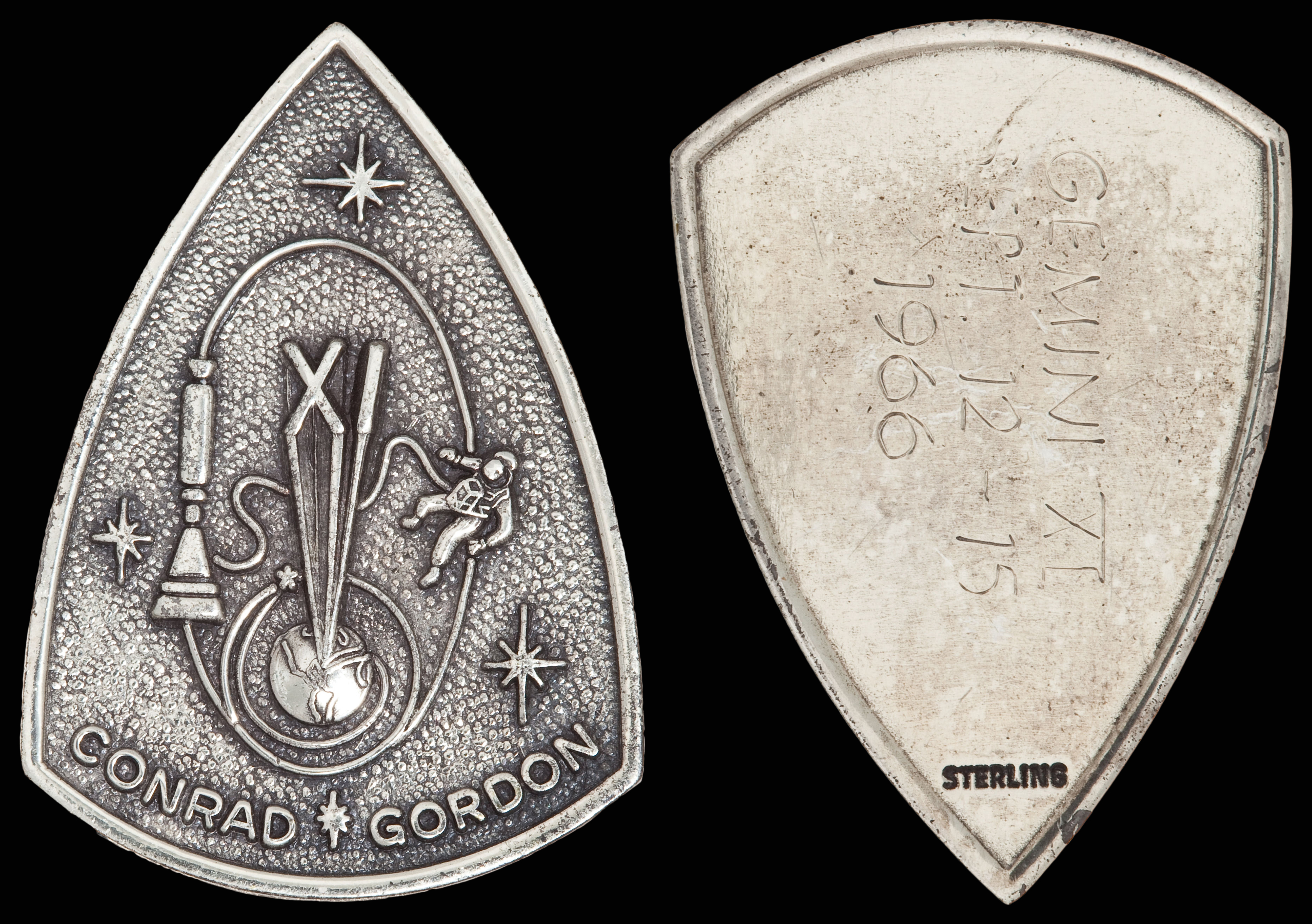
Gemini 11
Pete Conrad wanted to go to the Moon in a Gemini capsule. It was not as far-fetched as it sounds. As early as 1961, NASA engineers and McDonnell Aircraft had drawn up proposals to boost Gemini spacecraft on circumlunar trajectories using Centaur rockets, and Conrad lobbied hard for his Gemini 11 mission to make the trip. NASA administrator James Webb killed the idea, telling Congress that any extra funds would be better spent on Apollo. What Conrad got instead, on September 12, 1966, was the consolation prize of a lifetime: the highest orbit any human had ever reached, a first-orbit docking that proved a technique essential for the Moon landing, and the first experiment in creating artificial gravity. Gemini 11 did more in three days than most missions accomplish in ten.
Ninety-Four Minutes to Contact
The mission's first objective was its most urgent. Conrad and pilot Dick Gordon had to launch from Cape Kennedy, find the Agena Target Vehicle already orbiting overhead, and dock with it on their very first orbit - a maneuver called direct-ascent rendezvous. No crew had attempted it before. The technique mattered because it simulated what a lunar module would need to do after lifting off from the Moon's surface: find the command module quickly, with no second chances and limited fuel.
They made contact approximately 94 minutes after liftoff, relying almost entirely on the onboard computer and radar with minimal ground assistance. The rendezvous was so efficient, and the docking so clean, that the crew went on to dock and undock four separate times during the mission, still retaining enough maneuvering fuel for an unplanned fifth rendezvous. The demonstration proved that direct-ascent rendezvous was not merely possible but practical - a validation that would echo through the Apollo program's lunar operations.
Eight Hundred and Fifty Miles Up
With the Gemini capsule firmly docked to the Agena, Conrad fired the Agena's rocket engine and pushed both spacecraft into a wildly elliptical orbit. At its peak, the combined vehicle reached an apogee of 1,374 kilometers - roughly 850 miles above Earth. No crewed spacecraft had ever flown so high. The record would stand for decades, unchallenged until the Polaris Dawn mission in 2024.
At that altitude, the curvature of the Earth filled the spacecraft windows with a view usually reserved for robotic probes. A photograph taken during the 27th revolution shows the Arabian Peninsula and northeast Africa in a single frame, shot with a modified Hasselblad camera at 340 nautical miles. Conrad and Gordon did not linger at peak altitude. They followed the elliptical path twice, then used the Agena engine again to return to a near-circular orbit at 184 miles, conserving fuel and positioning themselves for the remaining experiments. The high orbit was, as one historian noted, the only remnant of Conrad's lunar Gemini dream - but what a remnant it was.
Gordon's Rough Day Outside
Dick Gordon performed two spacewalks during Gemini 11, totaling 2 hours and 41 minutes of extravehicular activity. The first, on September 13, lasted 33 minutes and was considerably harder than anyone had anticipated. Gordon's primary task was to attach a 100-foot tether between the Gemini capsule and the Agena vehicle, a job that required him to straddle the nose of the Gemini while working without adequate handholds or footholds. He exerted himself so intensely that sweat fogged his visor, partially blinding him. Conrad ordered him back inside early.
The second EVA, on September 14, was a stand-up exercise lasting two hours and eight minutes. Gordon opened his hatch and stood in the seat, his upper body exposed to space while his legs remained inside the capsule. This time the work was calmer, focused on photography and observation. The contrast between the two spacewalks underscored a lesson NASA was still learning: extravehicular activity demanded proper restraints and pacing. Every difficult EVA in the Gemini program fed directly into the design of handholds, footholds, and work stations that would make Apollo's lunar surface operations feasible.
Gravity on a String
After Gordon's tether work, Conrad and Gordon attempted something no one had tried in orbit: creating artificial gravity. With the Gemini capsule connected to the Agena by Gordon's 100-foot tether, Conrad fired his thrusters to set both vehicles spinning slowly around their common center of mass. The rotation generated a small but measurable gravitational force - not enough to walk on, but enough to demonstrate the principle.
The experiment also tested passive attitude stabilization, proving that two tethered spacecraft could maintain a predictable orientation without constant thruster corrections. This was more than a novelty. Long-duration spaceflight, whether to Mars or a space station, would eventually need some form of artificial gravity to counteract the bone loss and muscle atrophy caused by weightlessness. Gemini 11's tether experiment was the first physical proof that rotation-based gravity worked outside a physics textbook.
The Machine Lands Itself
Gemini 11 ended with another first: the first totally automatic, computer-controlled reentry performed by a U.S. spacecraft. On September 15, 1966, the guidance computer flew the capsule down through the atmosphere and deposited it in the Atlantic Ocean just 2.8 miles from the recovery ship USS Guam, missing the planned splashdown point by only 1.5 miles. For a spacecraft entering the atmosphere at nearly 18,000 miles per hour, this was extraordinary precision.
Conrad and Gordon, both Navy men, had designed their mission patch in Navy blue and gold. Stars on the emblem marked each milestone: the first-orbit rendezvous, the docking, the record apogee, and Gordon's spacewalk. The scale was, the patch noted, greatly exaggerated - their maximum altitude of 850 miles was roughly the distance from St. Louis to Cape Kennedy. But Gemini 11's achievements were not exaggerated at all. Direct-ascent rendezvous, record altitude, artificial gravity, autonomous reentry - each proved a concept that Apollo and every crewed program after it would depend on. The spacecraft now sits in the California Science Center in Los Angeles, a compact capsule that once held two Navy pilots and the highest ambitions of the space race.
From the Air
Gemini 11's splashdown coordinates were approximately 24.25°N, 70.00°W in the Atlantic Ocean, recovered by USS Guam. The mission launched from Cape Kennedy (now Cape Canaveral Space Force Station, ICAO: n/a) in Florida. The splashdown zone lies in open Atlantic waters east of the Bahamas, roughly between Great Inagua Island and the Turks and Caicos. Nearby airports include Providenciales (MBPV) in the Turks and Caicos and Lynden Pindling International (MYNN) in Nassau. The spacecraft reached a record apogee of 1,374 km (850 mi) during the mission. The Gemini 11 capsule is now displayed at the California Science Center in Los Angeles (near KLAX).