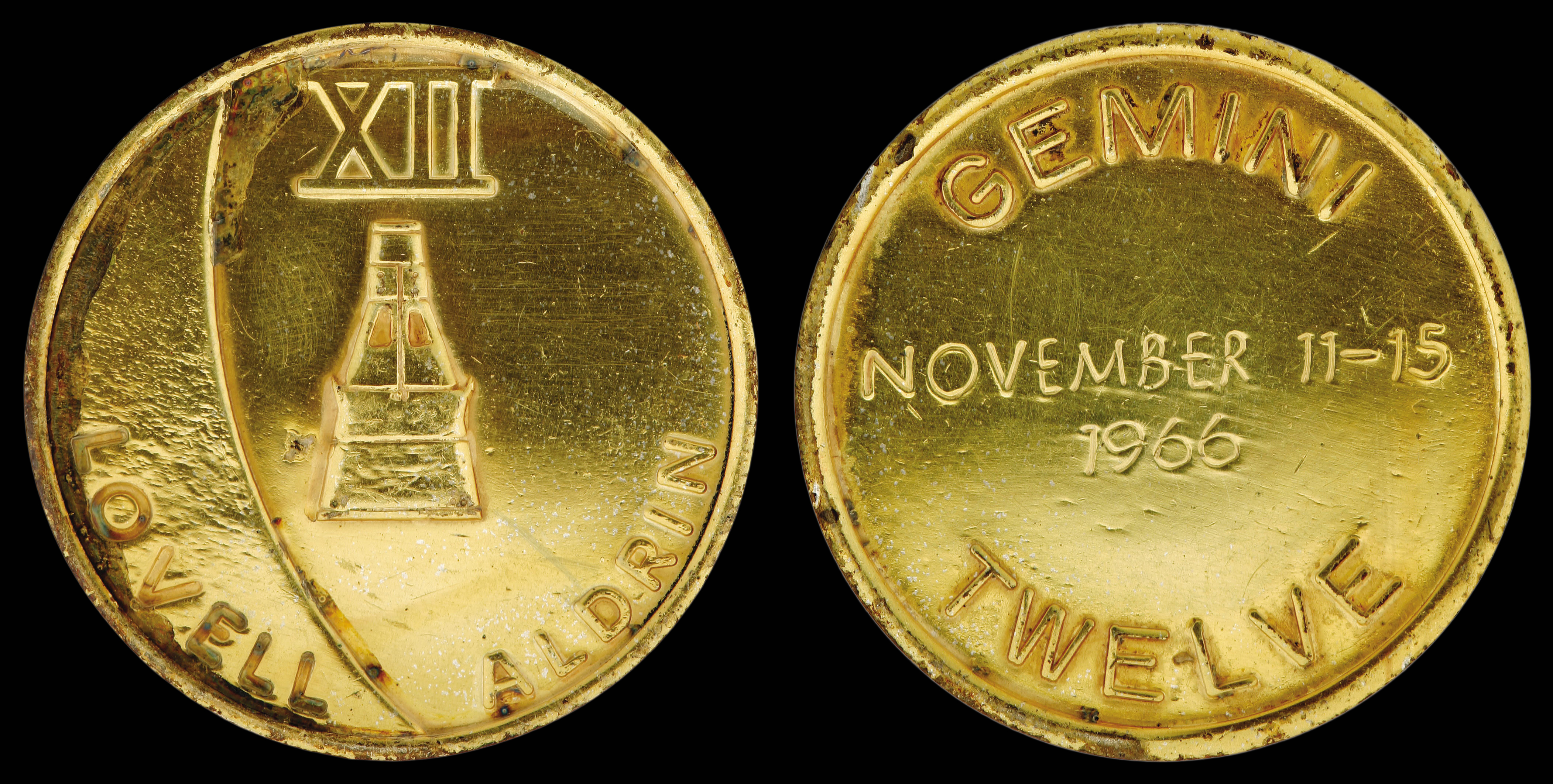
Gemini 12
Before Buzz Aldrin walked on the Moon, he had to prove he could walk in space. On November 11, 1966, Aldrin and commander Jim Lovell launched from Cape Kennedy aboard Gemini XII, the final mission of NASA's Gemini program. The stakes were deceptively simple: could an astronaut perform useful work outside a spacecraft without exhausting himself in minutes? Previous spacewalkers had fogged their visors with sweat, fumbled with tools, and tumbled helplessly against their tethers. If Aldrin couldn't solve the problem, Apollo had no path to the Moon. He solved it by doing something no astronaut had done before: he practiced underwater.
The Spacewalk Problem
By late 1966, extravehicular activity had become NASA's most embarrassing failure. Ed White's triumphant first American spacewalk on Gemini IV had made it look easy, but every EVA since had been a near-disaster. Gene Cernan on Gemini IX nearly died of heat exhaustion, his heart rate spiking to 180 beats per minute while his visor fogged so badly he could barely see. Michael Collins on Gemini X fared better but still struggled with basic tasks. Dick Gordon on Gemini XI was so spent after attaching a tether that he had to be pulled back inside. The problem was fundamental: in zero gravity, every push of a wrench pushed the astronaut in the opposite direction. Without handholds and footholds, the simplest tasks became wrestling matches against Newton's third law. Gemini XII was the program's last chance to crack the problem before its funding ended.
A PhD in the Cockpit
Aldrin was an unusual astronaut. He held a doctorate from MIT in orbital mechanics, earning him the nickname "Dr. Rendezvous" from colleagues who meant it as both compliment and gentle ribbing. Where other astronauts relied on instinct and stick-and-rudder skill, Aldrin approached spaceflight as an engineering problem. When the Agena target vehicle's radar failed during Gemini XII's rendezvous, he pulled out a hand-held sextant and a set of charts he had personally calculated, guiding Lovell to a successful docking using techniques closer to celestial navigation than jet-age flying. It was the kind of improvisation that looked calm from the outside but rested on years of obsessive preparation. That same methodical temperament would define his approach to the spacewalk challenge.
Learning to Float
The breakthrough came in a swimming pool. Before Gemini XII, astronauts trained for spacewalks on air-bearing platforms or in brief parabolic flights that offered only 30 seconds of weightlessness at a time. Aldrin pushed for extended underwater training in a neutral buoyancy tank, where the water's resistance could simulate the slow, deliberate movements that zero gravity demanded. He spent hours submerged, practicing with tools, learning where to place his feet, developing a choreography for every task he would perform in orbit. Neutral buoyancy experimentation had actually begun years earlier at NASA's Langley Research Center and at aerospace companies, but Aldrin helped prove its value for EVA training in a way that made it standard practice. The approach worked. Over three EVAs totaling five hours and 30 minutes across November 12 through 14, Aldrin moved with a control no previous spacewalker had shown. He bolted and unbolted connectors. He attached tethers. His heart rate stayed below 130. He even stopped to rest, something no astronaut had managed in the frantic exhaustion of earlier spacewalks.
The Last Gemini
Gemini XII carried 14 scientific experiments aloft, from frog egg growth under zero gravity to ultraviolet astronomical photography. Lovell and Aldrin even photographed a solar eclipse from orbit on November 12, capturing the Moon's shadow sweeping across the South Atlantic. But the mission's true payload was confidence. The spacecraft splashed down on November 15 just 4.8 kilometers from its target in the western Atlantic, guided by an automatic reentry system that proved computers could steer a capsule home. Both astronauts emerged slightly dehydrated from a faulty water supply system, and Lovell had picked up a case of pinkeye, but they were otherwise healthy. The mission patch told the story in symbols: orange and black for the originally planned Halloween-season launch, a clock face with the spacecraft pointing at twelve, and a crescent Moon on the left, marking the destination that Gemini had finally made reachable.
From Gemini to the Moon
The Gemini XII capsule traveled an unlikely path after splashdown. It spent years at the Museum of Transport and Technology in Auckland, New Zealand, before returning to the United States for permanent display at the Adler Planetarium in Chicago. Lovell and Aldrin reunited with the spacecraft on November 9, 2006, nearly 40 years after their mission, for the opening of the planetarium's "Shoot for the Moon" exhibit. By then, both men had gone further. Lovell commanded the harrowing Apollo 13 mission in 1970. Aldrin walked on the Moon during Apollo 11 in July 1969, applying the lessons of his Gemini spacewalks to the lunar surface. The ten crewed Gemini flights, launched in just 20 months, had answered every question Apollo needed answered: rendezvous, docking, long-duration flight, and finally, thanks to Gemini XII, the ability to work in the emptiness between spacecraft and stars.
From the Air
Gemini XII splashed down at approximately 24.58°N, 69.95°W in the western Atlantic Ocean, roughly 600 nautical miles southeast of Bermuda. The splashdown point lies in open ocean with no nearby land features visible from altitude. Bermuda's L.F. Wade International Airport (TXKF) is the closest major airfield. The area is frequently traversed by transatlantic flights at cruising altitude. Clear weather common but tropical weather systems possible June through November. The coordinates represent the recovery point, not a permanent landmark.