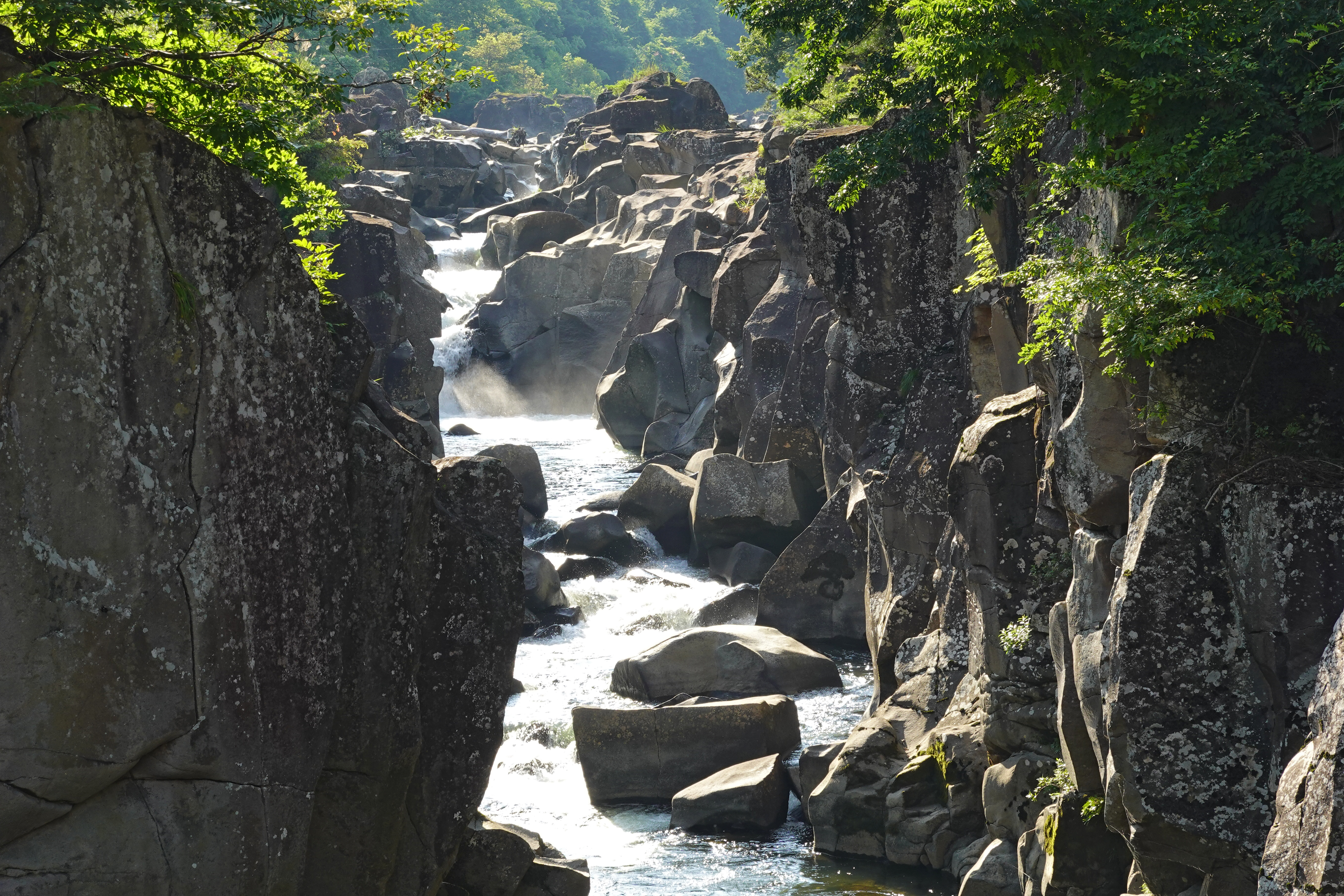
Genbikei
You place your coins in a wooden basket, bang a mallet against a board, and wait. Across the gorge, someone in a small shop pulls a rope. The basket zips back over the chasm, and a moment later it returns -- loaded with three sticks of freshly made dango and a cup of green tea, sailing above the rapids of the Iwai River as if gravity were merely a suggestion. This is Genbikei, a two-kilometer ravine in the city of Ichinoseki, Iwate Prefecture, where volcanic geology produced one of Japan's most dramatic gorges and human ingenuity produced one of its most delightful snack delivery systems. The gorge has been a designated National Place of Scenic Beauty and Natural Monument since 1927, but the flying dango has been the real draw since 1878.
Sculpted by Fire and Water
Genbikei's geology reads like a collaboration between violence and patience. The gorge was carved from a thick seam of dacite tuff -- volcanic rock deposited by ancient eruptions of Mount Kurikoma in the mountains of southwestern Iwate. Over millennia, the Iwai River has eroded this tuff into a two-kilometer gallery of strange rock formations, waterfalls, churning rapids, and potholes drilled into the riverbed by the relentless grinding of stones caught in the current. Unlike its sister gorge Geibikei to the east, which cuts through limestone in broad, calm strokes, Genbikei is narrow and wild. The water here is fast, the rocks sculpted into impossible shapes, and the overall effect is one of contained fury -- a river that has spent thousands of years arguing with stone and winning.
Praised by Warlords and Emperors
Genbikei has been drawing admirers since at least the early Edo period, when the first daimyō of Sendai Domain, Date Masamune, praised the ravine for its scenic beauty. Date Masamune was not a man given to easy sentiment -- he was a one-eyed warlord who unified much of the Tōhoku region through force -- so his admiration carried weight. Centuries later, in August 1877, Emperor Meiji visited Genbikei during his travels through the Tōhoku region, adding imperial endorsement to the gorge's growing reputation. The novelist Kōda Rohan subsequently wrote a travelogue about the area that drew waves of visitors from across Japan. By 1927, Genbikei had earned its official designation as a National Place of Scenic Beauty and Natural Monument, recognition that formalized what warlords and emperors had already confirmed with their feet.
The Kakko Dango Express
The flying dango -- known locally as Kakko Dango, named after the cuckoo bird -- has been Genbikei's signature attraction since 1878, when the founder of the shop decided that selling snacks was not enough; he wanted to deliver an experience. The system is elegantly simple: a rope stretches from the dango shop on one side of the gorge to a viewing platform on the other. Visitors place their payment in a wooden basket and strike a wooden board to signal their order. The basket is pulled back across the ravine, loaded with three sticks of dango in different flavors -- mitarashi with sweet soy sauce, red bean, and black sesame -- along with a cup of tea, and sent flying back over the rapids. The shop is now run by the founder's grandson, who maintains the tradition with the same rope-and-basket mechanics his grandfather devised. The gorge is accessible by bus from Ichinoseki Station on the Tohoku Shinkansen, making it one of the easiest scenic wonders in northern Japan to reach.
From the Air
Located at 38.94N, 141.05E in the city of Ichinoseki, southwestern Iwate Prefecture. The gorge follows the Iwai River and may be visible from lower altitudes as a narrow cleft through volcanic terrain in the foothills of the Kurikoma Mountains. Nearest major airport: Hanamaki Airport (RJSI), approximately 70km north. Sendai Airport (RJSS) lies approximately 110km south. Ichinoseki Station on the Tohoku Shinkansen is the closest rail hub. The surrounding terrain is hilly with mixed forest. Clear conditions recommended for viewing; the gorge is narrow and can be difficult to spot from higher altitudes.