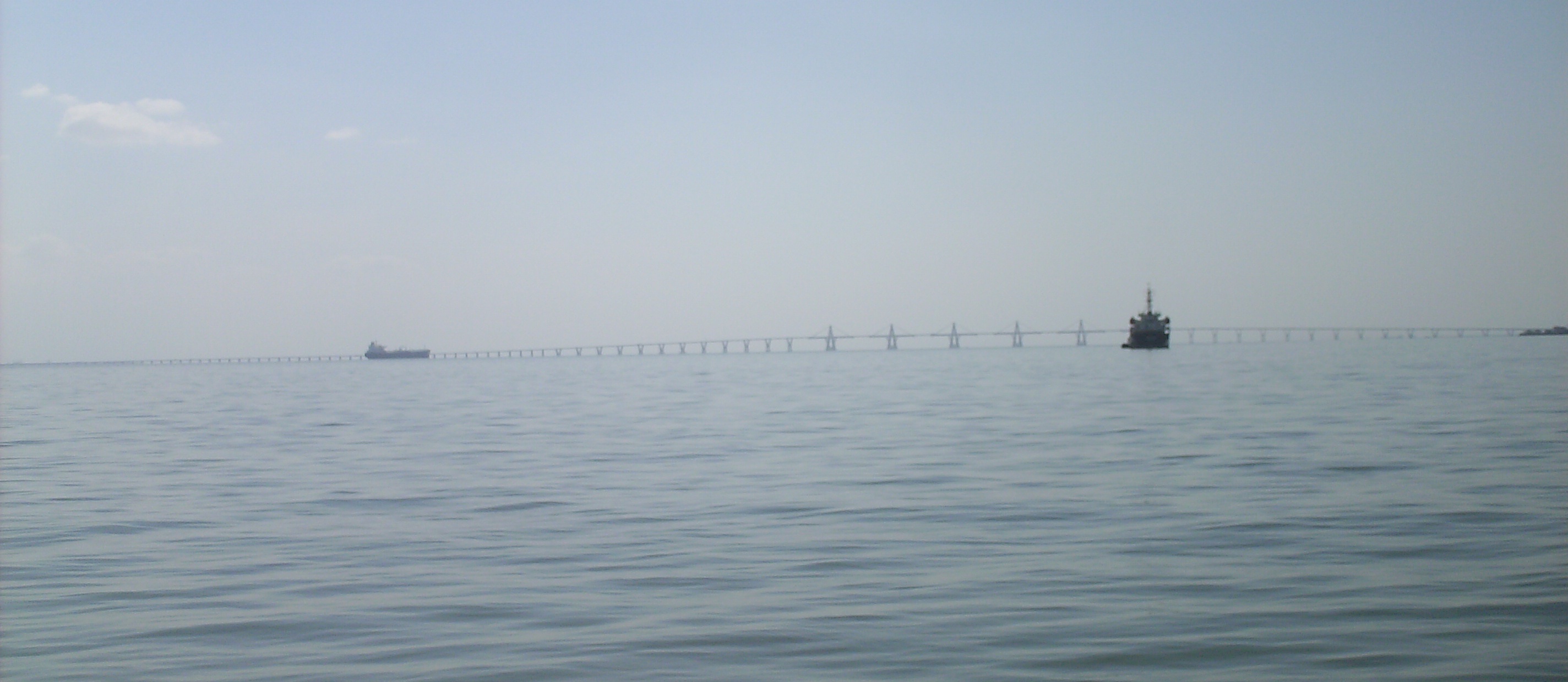
General Rafael Urdaneta Bridge
Twelve engineering firms submitted designs. Only one proposed building the bridge entirely out of concrete. In 1957, Venezuelan civil engineers Juan Francisco Otaola Pavan and Oscar Benedetti, working with Italian designer Riccardo Morandi, won the competition to span the Tablazo Strait at the outlet of Lake Maracaibo with a cable-stayed bridge unlike anything the country had attempted. Otaola insisted that at least 50 percent of the workforce and contracting companies be Venezuelan. When the General Rafael Urdaneta Bridge opened in 1962, it stretched 8.678 kilometers from shore to shore, connecting the city of Maracaibo to the rest of Venezuela for the first time by road. It remains one of the longest concrete cable-stayed bridges in the world.
Concrete Over Water
The bridge is built of reinforced and prestressed concrete, a deliberate choice that set it apart from the eleven other competition entries. Five main spans, each 235 meters long, are suspended from towers rising 92 meters above the water, providing 46 meters of clearance for ship traffic below. The decision to use concrete rather than steel was partly economic: prestressed concrete was expected to be cheaper to maintain over time. But it was also strategic. Otaola and Benedetti saw the project as an opportunity to develop Venezuelan expertise in advanced concrete construction, technology the country would need as its oil-fueled infrastructure boom accelerated. Morandi's design, elegant in its simplicity, used inclined stays radiating from single towers, a signature approach he would repeat in other bridges around the world.
The Tanker and the Tower
On April 6, 1964, barely two years after the bridge opened, the oil tanker Esso Maracaibo collided with the structure. The impact caused a section of the bridge to collapse, killing seven people. The accident exposed the vulnerability of a bridge that served as the sole road link between Maracaibo and the rest of the country. Repairs were made, and the bridge continued to carry traffic, but proposals for a second crossing began circulating as early as 1982. Studies conducted since 2000 have estimated the cost of a companion bridge at approximately $440 million, to be financed largely through tolls. As of yet, no second bridge has been built, and the General Rafael Urdaneta Bridge continues to bear the full burden of vehicular connection across the strait.
A Designer's Shadow
On August 14, 2018, a stayed pier collapsed on the Ponte Morandi in Genoa, Italy, killing 43 people. That bridge had also been designed by Riccardo Morandi. The catastrophe in Genoa immediately raised concerns about the structural integrity of every Morandi-designed bridge still in service, including the one over Lake Maracaibo. The two structures share fundamental design principles: concrete cable-stayed construction with inclined stays anchored to single towers. Venezuelan engineers and officials have since scrutinized the Lake Maracaibo bridge with heightened attention. The Genoa collapse served as a reminder that innovative engineering carries long-term responsibilities, and that the same design genius that solved one problem can, decades later, create another.
Maracaibo's Lifeline
The bridge is named after General Rafael Urdaneta, a hero of Venezuelan independence who was born in Maracaibo. Before its construction, the city was geographically isolated, reachable from the rest of Venezuela only by boat or air across Lake Maracaibo, one of the largest lakes in South America. The bridge transformed Maracaibo from an island city into a connected one, enabling the movement of goods, people, and oil industry infrastructure that fueled the region's growth. Crossing it today, the lake stretches to the horizon on both sides, and the towers rise from the water like sentinels. For the people of Zulia state, it is not merely a piece of infrastructure. It is the link that made their participation in the national life of Venezuela physically possible.
From the Air
Coordinates: 10.57N, 71.58W, spanning the Tablazo Strait at the outlet of Lake Maracaibo in western Venezuela. The bridge is 8.678 km long and highly visible from the air, running roughly north-south across the strait with five prominent cable-stayed towers rising 92 meters. Lake Maracaibo extends to the south, one of the largest bodies of water in South America. Nearest airport is La Chinita International (SVMC/MAR) in Maracaibo, approximately 20 km to the southwest. The bridge carries heavy road traffic and is a major visual landmark for pilots navigating the Maracaibo basin.