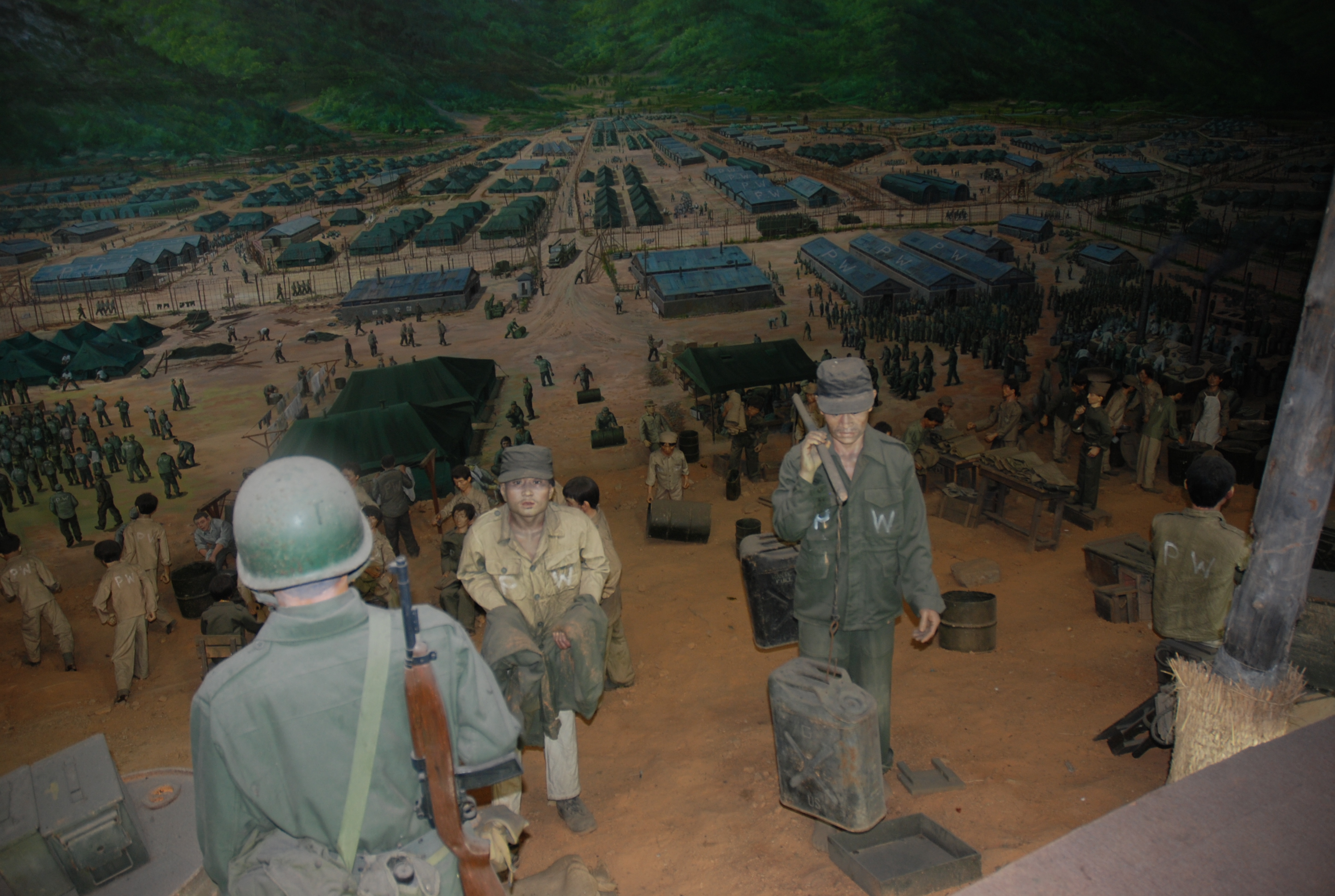
Geoje POW Camp
In May 1952, Communist prisoners at Geoje Island seized Brigadier General Francis Dodd, the camp's own commanding officer, and held him hostage for 78 hours. The incident made headlines around the world and exposed a truth that military planners had not anticipated: for committed ideologues, capture was not the end of the fight but the beginning of a different kind of warfare. On this island off South Korea's southeastern coast, the Korean War's most volatile chapter played out not on a battlefield but behind barbed wire.
A Camp Born of Desperation
As the Korean War ground through its first year, United Nations forces found themselves holding an ever-growing population of prisoners. Temporary battlefield cemeteries and detention camps near Taejon, Kumchon, and other frontline towns had to be abandoned as North Korean forces pushed south toward Busan. Geoje Island, separated from the mainland by a narrow strait, seemed like an ideal solution. Construction began in early 1951 on a sprawling complex that would eventually hold tens of thousands of prisoners -- North Korean soldiers, Chinese volunteers, and South Korean civilians accused of collaboration. At its peak, the camp housed so many detainees that the compounds became dangerously overcrowded, with guards outnumbered and intelligence about what was happening inside the wire almost nonexistent.
War Behind the Wire
What the UN Command had not expected was that Communist prisoners would treat captivity as another theater of operations. Loyalist prisoners organized themselves along military lines, enforcing discipline, conducting political indoctrination, and punishing anyone who cooperated with their captors. The compounds became miniature states within the camp, with their own hierarchies and rules. Soft treatment, camp administrators learned bitterly, only emboldened the most committed organizers. When the UN began screening prisoners to determine who wished to be repatriated and who preferred to remain in the South, the compounds erupted. Riots broke out. Prisoners killed fellow detainees suspected of disloyalty. The seizure of General Dodd in May 1952 forced the UN into humiliating negotiations, and the propaganda damage rippled from Panmunjom to Parliament. The incident raised doubts internationally about whether the UN's entire voluntary repatriation program had been compromised.
The Long Way Home
The Korean Armistice Agreement, signed on 27 July 1953, set the machinery of repatriation in motion. Operation Little Switch, in April and May of that year, returned 6,670 sick and injured Chinese and North Korean prisoners. Operation Big Switch then repatriated roughly 83,000 prisoners to the North and 22,000 to the South. But the numbers tell only part of the story. Seventy-six North Korean and twelve Chinese POWs declined both options entirely, choosing instead to resettle in India, Argentina, and Brazil -- men who had been so transformed by the experience of captivity that neither side of the 38th parallel held any appeal. Their choices underscored how deeply the war had fractured not just nations but individual lives.
Memory Reclaimed
Geoje Camp closed with the armistice, and for decades the site sat quietly on its island hillside. In 1997, a memorial park was established on part of the old camp grounds. Visitors today walk through recreated prisoner barracks, peer into dioramas depicting daily life behind the wire, and examine military hardware from the era. The Hungnam Evacuation Memorial Tower stands nearby, honoring the massive 1950 evacuation that brought 100,000 Korean refugees south by sea. The camp's story has also entered Korean popular culture: the 2018 film Swing Kids imagines a group of POWs forming a tap-dancing troupe under an American officer's leadership, and Chinese-American author Ha Jin set his novel War Trash partly within these walls. The site serves as a reminder that wars produce not only battlefields but also the morally complex spaces where captors and captives alike discover the limits of control.
From the Air
Located at 34.88N, 128.62E on Geoje Island off South Korea's southeastern coast. The island is visible from altitude as a large landmass in the Korea Strait south of Busan. Nearest major airport is Gimhae International (RKPK) approximately 50 nm to the northeast. The memorial park sits on the island's interior hillside. Best viewed at 3,000-5,000 ft in clear weather.