George Flavel
His widow put it plainly. In a 1922 interview, Mary Christina Flavel said of her late husband: "He was not only an able navigator, but he was fearless and was willing to put out in any sort of weather to assist vessels in need of help." That fearlessness was the foundation of one of the great fortunes of nineteenth-century Oregon. Captain George Flavel arrived in Astoria in 1851, became one of the state's first licensed bar pilots, and built a business guiding ships across the Columbia River Bar -- a stretch of water so dangerous it earned the name Graveyard of the Pacific. By the time he died in 1893, his net worth stood at $1.9 million, making him one of Oregon's first millionaires. His funeral procession was one of the largest Astoria had ever seen.
From Ireland to the River's Mouth
George Flavel was born in 1823, though even that basic fact carries some uncertainty. Some sources place his birth in Portadown, County Armagh, Ireland; others say Norfolk, Virginia, where he lived as a young man. What is certain is that he was of Irish descent and that the California Gold Rush pulled him west in 1849. He worked as a tugboat captain between Sacramento and San Francisco before hearing about opportunities farther north. In 1851, he arrived in Astoria -- then a small settlement still trading on the legacy of John Jacob Astor's American Fur Company -- as captain of the brig John Petty. He looked at the treacherous bar where the Columbia met the Pacific and saw not danger but a business opportunity. If ships needed pilots to cross safely, the pilot who controlled that service controlled the port.
King of the Bar
The Columbia River Bar is one of the most perilous navigational passages in the world. Shifting sandbars, powerful tidal currents, and Pacific swells collide at the river's mouth, and hundreds of ships have wrecked there over the centuries. Flavel made himself indispensable. He built a pilot boat operation that dominated the bar, becoming the man ship captains depended on to bring their vessels safely into the river. His monopoly was not gentle -- Flavel was aggressive, competitive, and willing to undercut rivals -- but his skill was genuine. He could read the bar's moods the way a farmer reads weather, and captains trusted him with their ships and their lives. The piloting business made him wealthy, but Flavel diversified aggressively: he operated a wharf in Astoria, managed a coal import business from Australia, and in 1886 became president of the First National Bank of Astoria, a position he held until his death.
The House on the Hill
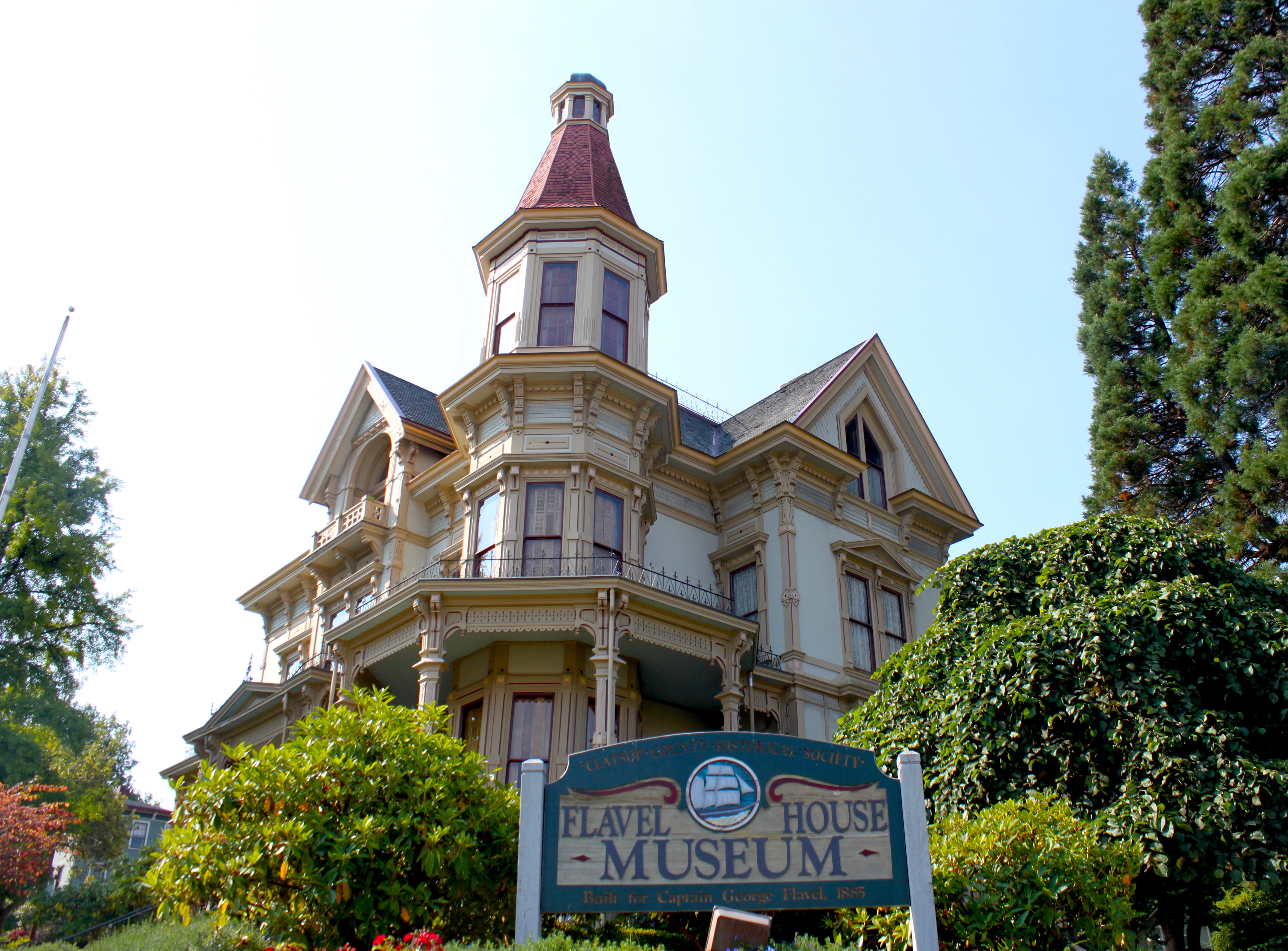
Flavel's most visible legacy stands at the corner of 8th and Duane Streets in downtown Astoria. The Captain George Flavel House is a Queen Anne Victorian mansion that announces its owner's wealth with every turret, bay window, and carved detail. Built in the 1880s, it was the finest residence in a town full of prosperous merchants and cannery owners. After Flavel's death, the house passed through the family. His great-granddaughter Patricia Jean Flavel eventually inherited it from her aunt Nellie Flavel, and around 1934 she donated the property to the Clatsop County Historical Society. Patricia Jean lived to be 101, dying in 2014. Today the house operates as a museum, its rooms restored to reflect the era when a bar pilot's courage and cunning could build an empire at the edge of the continent.
A Pilot's Resting Place
Flavel died on July 3, 1893, at age sixty-nine. His estate was substantial enough to generate legal disputes that reached the Oregon Supreme Court. In 1897, his body was relocated to Ocean View Cemetery in nearby Warrenton, where he rests within sight of the river that made his fortune. Astoria itself has changed enormously since Flavel's time -- the canneries are gone, the fur trade is a memory, and the town now draws tourists rather than sailing ships. But the Columbia River Bar remains as dangerous as ever, and licensed bar pilots still guide vessels across it, carrying on the profession Flavel helped establish. The mansion stands, the river runs, and the bar keeps demanding respect from anyone who tries to cross it.
From the Air
George Flavel's legacy is centered in Astoria, Oregon, at approximately 46.19°N, 123.83°W. The Flavel House Museum is visible in downtown Astoria near 8th and Duane Streets. From 1,500-3,000 feet AGL, the compact Victorian downtown, the Columbia River waterfront, and the river bar where Flavel built his fortune are all visible. The Columbia River Bar itself -- the Graveyard of the Pacific -- is dramatically apparent from the air, with visible breakers and shifting sandbars at the river mouth. Nearby airports: Astoria Regional Airport (KAST) is 4 miles southwest. Expect coastal fog, especially fall through spring.