George Washington's Crossing of the Delaware River
The password was "Victory or Death." It was not a slogan dreamed up for morale - it was the literal situation facing George Washington and his Continental Army on the night of December 25, 1776. After months of devastating defeats across New York and New Jersey, with enlistments expiring and soldiers deserting by the day, Washington staked everything on a single audacious operation: a nighttime crossing of the ice-choked Delaware River in the teeth of a nor'easter, followed by a surprise attack on the Hessian garrison at Trenton. The plan was so reckless that two of the three planned supporting crossings never made it across. Washington's column pressed on alone.
A Revolution on the Brink
By December 1776, the American cause looked finished. The Continental Army had been driven from Long Island, Manhattan, and then chased entirely across New Jersey by British and Hessian forces. Washington's troops were starving, poorly equipped, and shrinking fast - enlistments for many soldiers expired on New Year's Day. The British, satisfied with their campaign season, settled into winter quarters across a chain of New Jersey outposts from New Brunswick to Burlington, with Hessian troops garrisoned at Trenton under Colonel Johann Rall. Washington, camped on the Pennsylvania side of the Delaware, had ordered every boat for miles seized or destroyed to prevent a British crossing. But he knew that time was his true enemy. Without a victory to rally the cause, the army - and the revolution itself - would simply dissolve when the calendar turned.
Christmas Night on the River
At 4 p.m. on December 25, Washington's 2,400 troops assembled at McConkey's Ferry in Bucks County, Pennsylvania. They carried three days' rations and fresh musket flints. Even officers and musicians were ordered to carry weapons. The crossing fell to Henry Knox, Washington's chief of artillery, who had to ferry not only soldiers - most of whom could not swim - but also horses and eighteen cannons across a river clogged with jagged ice floes. The boats were a motley collection: massive Durham boats designed for hauling iron ore, flat-bottomed ferries, and whatever else could float. Manning them were John Glover's Marblehead Regiment, seasoned Massachusetts fishermen, joined by Philadelphia dockworkers and local boatmen who knew the Delaware's currents. Knox wrote that the crossing was accomplished "with almost infinite difficulty." As night fell, drizzle turned to rain, then sleet, then driving snow. "It blew a hurricane," one soldier recalled. The artillery did not finish crossing until 3 a.m. The troops were ready to march at 4.
The Blow That Changed Everything
Washington split his force into two columns for the nine-mile march to Trenton. He personally led one along Pennington Road with General Greene; General Sullivan took the other along River Road. Meanwhile, the Hessians had spent the preceding days exhausted by constant skirmishing and false alarms. On Christmas Eve, Colonel Rall dined at the home of Trenton's postmaster Abraham Hunt, who played the gracious Loyalist host while plying Rall and his officers with food and drink deep into the night. When Washington's troops struck at dawn on December 26, the Hessians were caught completely off guard. The battle was swift and decisive: 22 Hessians were killed and 98 wounded, with Colonel Rall himself mortally wounded. Nearly 1,000 prisoners were taken, along with muskets, cannons, gunpowder, and drums. American losses were remarkably light - three killed and six wounded. Within days, the British pulled back to New Brunswick, and the Continental Army established winter quarters at Morristown.
Victory Painted and Remembered
Emmanuel Leutze's 1851 painting "Washington Crossing the Delaware" cemented the crossing in the American imagination - Washington standing heroically in the prow of a boat, flag streaming behind him. The painting is more inspirational than accurate, but its emotional truth endures. Both sides of the river where the crossing took place are now preserved as national historic landmarks. Washington Crossing Historic Park in Pennsylvania and Washington Crossing State Park in New Jersey flank the river, connected by the Washington Crossing Bridge. Every Christmas Day, reenactors replicate the crossing using replica Durham boats. The image of Washington on the Delaware has appeared on the 1999 New Jersey State Quarter and the reverse of the 2021 quarter. In 1970, the Vietnam Veterans Against the War invoked the crossing's spirit when they marched from Morristown to Valley Forge in a three-day protest they called Operation RAW.
The River That Turned a War
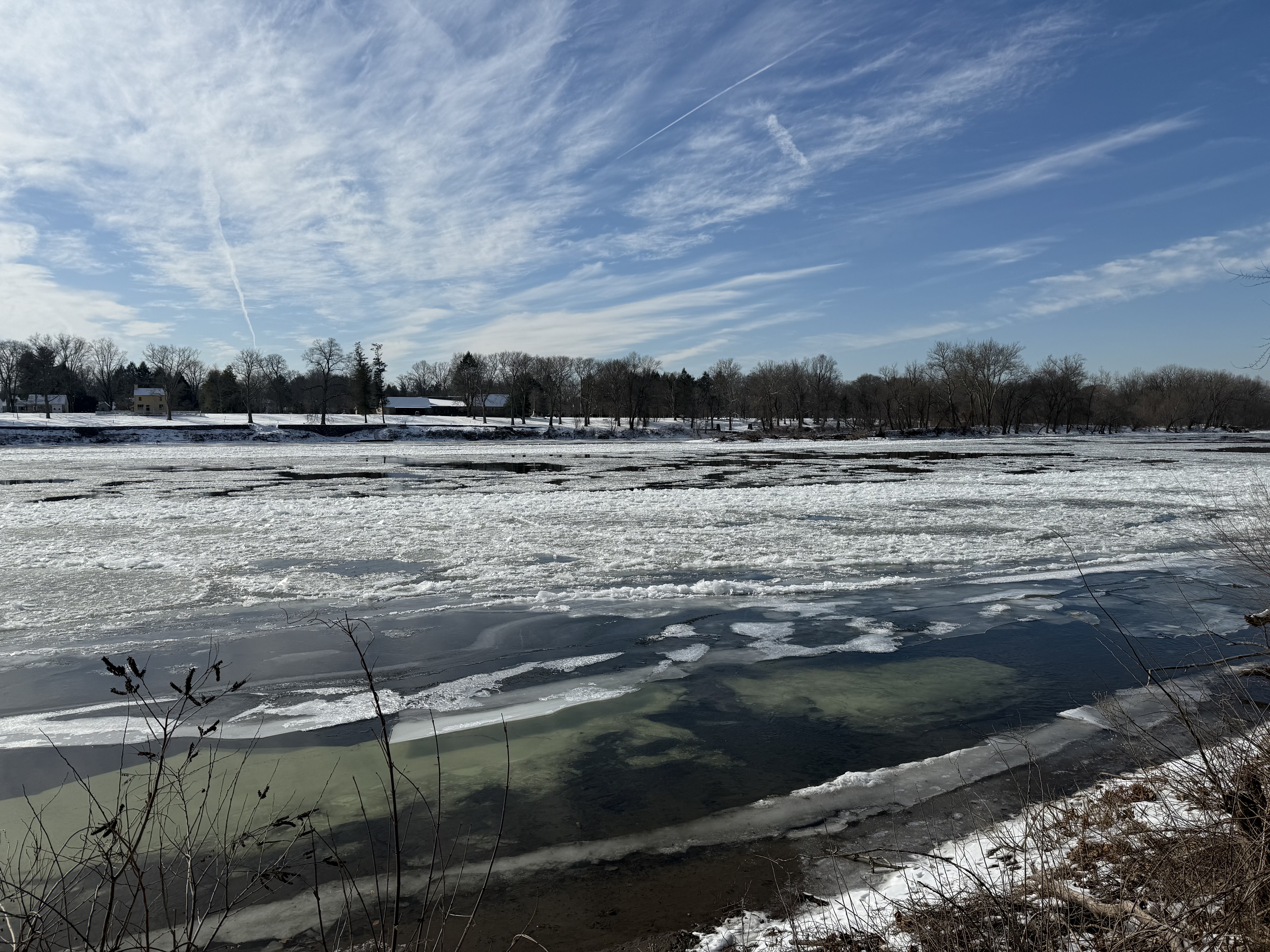
The Delaware River at the crossing point is deceptively tranquil in summer - a broad, gentle waterway flowing between wooded Pennsylvania hills and the flat New Jersey shore. In late December, it transforms. Ice collects along the banks and drifts in sheets across the current. Standing on either shore, it is easy to imagine the terror of that Christmas night: the dark water, the grinding ice, the sleet driving sideways, the knowledge that failure meant the end of everything. Washington crossed this river three times in ten days - once for the attack on Trenton, once to return with prisoners, and once more to defeat British reinforcements and push on to Princeton. Those ten days reversed the momentum of the entire war. A revolution that had been losing on every front suddenly had proof that it could win.
From the Air
Located at 40.30N, 74.87W along the Delaware River, at the border of Bucks County, Pennsylvania and Mercer County, New Jersey. The crossing site is between present-day Washington Crossing, PA and Washington Crossing, NJ. Look for the Washington Crossing Bridge spanning the river, with the historic parks on both banks. Recommended viewing altitude: 2,000-3,000 feet for best perspective of the river and surrounding terrain. Nearby airports: Trenton-Mercer Airport (KTTN) approximately 8 nm southeast; Doylestown Airport (KDYL) approximately 12 nm northwest. The river runs roughly northeast to southwest at this point, with the McConkey's Ferry crossing site visible on the Pennsylvania bank.