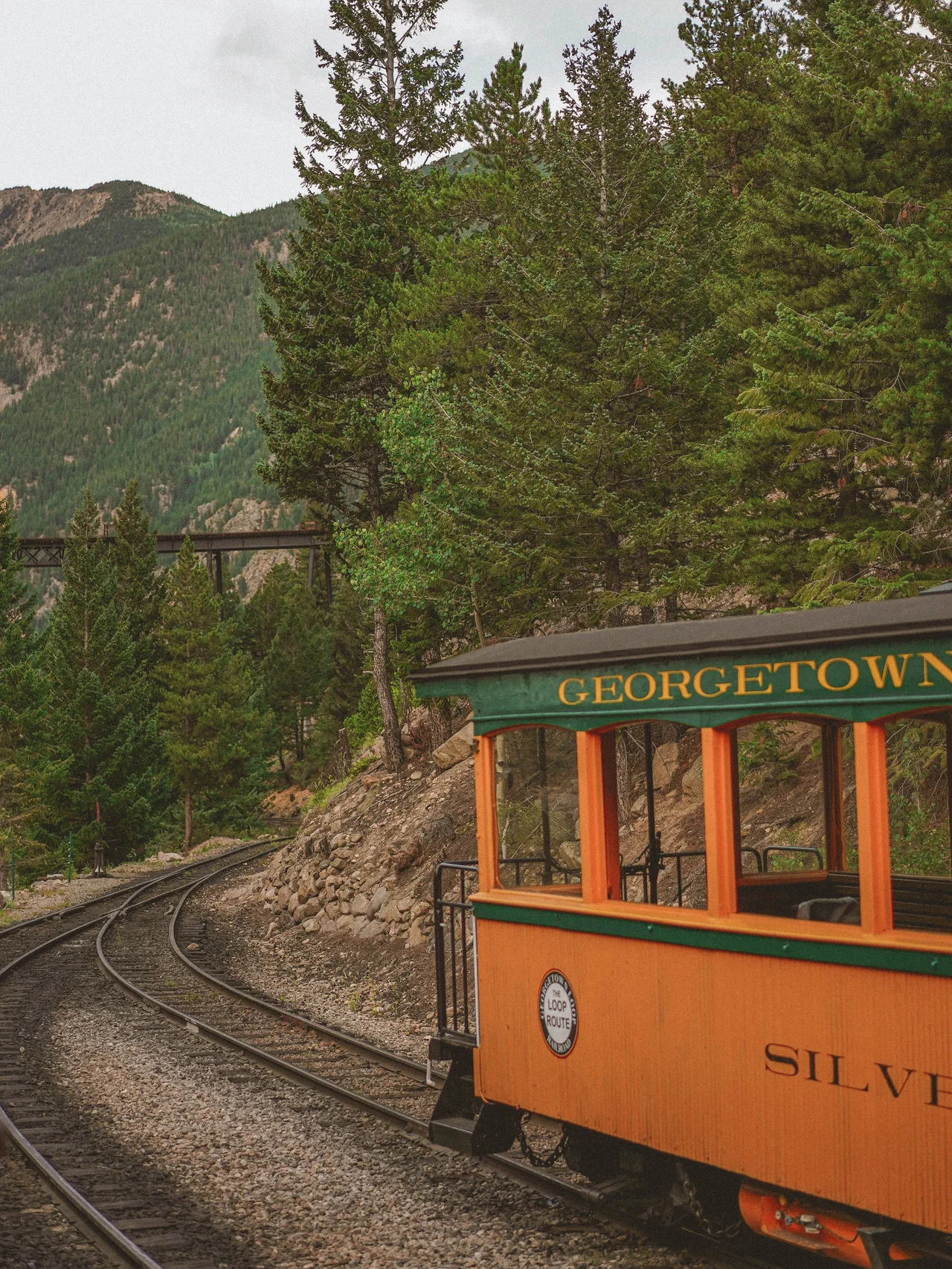

Georgetown Loop Railroad
The bridge was built backwards. In the winter of 1883-84, chief engineer Robert B. Stanton discovered that workers had installed the entire Devil's Gate High Bridge with its support columns flip-flopped, north for south. Crews tore apart what they had built and reassembled it in the dead of winter, a six-week job that cost the Union Pacific dearly. When the bridge finally opened on February 28, 1884, rising nearly 100 feet above Clear Creek and looping 75 feet over the lower track, it had cost $254,700. And it led to nowhere useful. The Georgetown Loop Railroad, meant to haul silver riches from Leadville, instead became famous for something the engineers never intended: the spectacle itself.
The Problem of Elevation
Georgetown and Silver Plume lie just two miles apart in the steep, narrow canyon of Clear Creek, west of Denver in the Rocky Mountains. But those two miles gain more than 600 feet in elevation, far too steep for any locomotive of the 1880s. Union Pacific engineer Jacob B. Blickensderfer devised a solution: a corkscrew route that traveled nearly four miles to connect them, reducing the average grade to 3 percent. His plan required three hairpin turns, four bridges across Clear Creek, and a 30-degree horseshoe curve. The crowning achievement was Devil's Gate High Bridge, resting on four iron towers ranging from 33 to 78 feet tall, with sixteen granite piers at the base. The bridge stretched 300 feet across the valley, its iron girders reaching 95.6 feet above the creek below.
A Railroad to Nowhere
The Georgetown, Breckenridge and Leadville Railway was incorporated in 1881 with grand ambitions. The silver boom of the 1880s promised fortunes to anyone who could haul ore from the mines efficiently. But after all that expense and engineering, the line only extended four miles past Silver Plume, halting at Bakerville. The Union Pacific had found an easier route into Leadville through South Park. The Loop portion, completed in 1884, was the crowning segment of a truncated dream. In 1893, the Colorado and Southern Railway took over operations, running passengers and freight until 1938. Between 1906 and 1918, tourists could transfer to the Argentine Central Railway at Silver Plume and continue to the summit of Mount McClellan, but that connection too eventually closed.
Postcard Famous
What saved the Georgetown Loop from obscurity was photographer William Henry Jackson. His images of the completed loop, taken in March 1884, became among the most famous postcard views of Colorado. The Loop's construction coincided with a growing craze for railroad excursions, and tourists who might never visit a silver mine gladly paid to experience the engineering marvel itself. The narrow gauge steam engines climbed through horseshoe curves while passengers gasped at the drop below. When the Colorado and Southern closed the line in 1939, the high bridge was dismantled and sold for scrap iron. For four decades, the Loop existed only in photographs and memory.
A Century Later
In 1959, the centennial year of the discovery of gold in Georgetown, the Colorado Historical Society began preserving the site. Interest in restoration gained momentum through the 1970s. The Union Pacific donated track and ties, and construction along the old grade began in 1973. In 1982, the Boettcher Foundation contributed $1 million to reconstruct the high bridge. Workers built it to the same specifications as the original, with modifications for heavier modern engines and safety standards. On June 1, 1984, exactly one century after the original construction, Governor Richard D. Lamm dedicated the new Devil's Gate High Bridge. The Georgetown Loop was whole again.
Riding the Loop Today
The restored Georgetown Loop Railroad climbs approximately 640 feet between Georgetown and Silver Plume using three miles of track. Passengers board at depots in Silver Plume or Devil's Gate, the latter located about three-quarters of a mile southwest of downtown Georgetown, where modern development blocked the original route. Historic narrow gauge steam locomotives pull the cars through the same horseshoe curves and across the same dramatic trestle that tourists marveled at in 1884. An optional walking tour takes visitors 500 feet into the Lebanon Silver Mine, a tunnel bored in the 1870s, where guides point out veins that once yielded silver. The railroad that was meant to haul ore now carries something more valuable: the chance to experience a vanished era of American engineering and ambition.
From the Air
The Georgetown Loop Railroad sits at coordinates 39.69N, 105.72W in Clear Creek County, Colorado, at approximately 8,500 to 9,100 feet elevation. The route runs adjacent to Interstate 70, visible from the highway. The nearest major airport is Denver International (KDEN), about 50 miles east. From altitude, look for the distinctive loop where the track crosses over itself at Devil's Gate, the narrow canyon of Clear Creek, and the historic mining towns of Georgetown and Silver Plume. The high bridge crossing is the most prominent feature, a thin line arcing high above the creek.
Nearby Stories
- Climax Mine 1.6 km away
- Pike's Peak Gold Rush 10 km away
- Columbine Mine Massacre 16 km away
- Colorado Trail 21 km away
- Green Mountain Reservoir 30 km away
- Castlewood Canyon State Park 33 km away
- Rocky Mountain National Park 48 km away
- Hanna Mine Disasters 221 km away