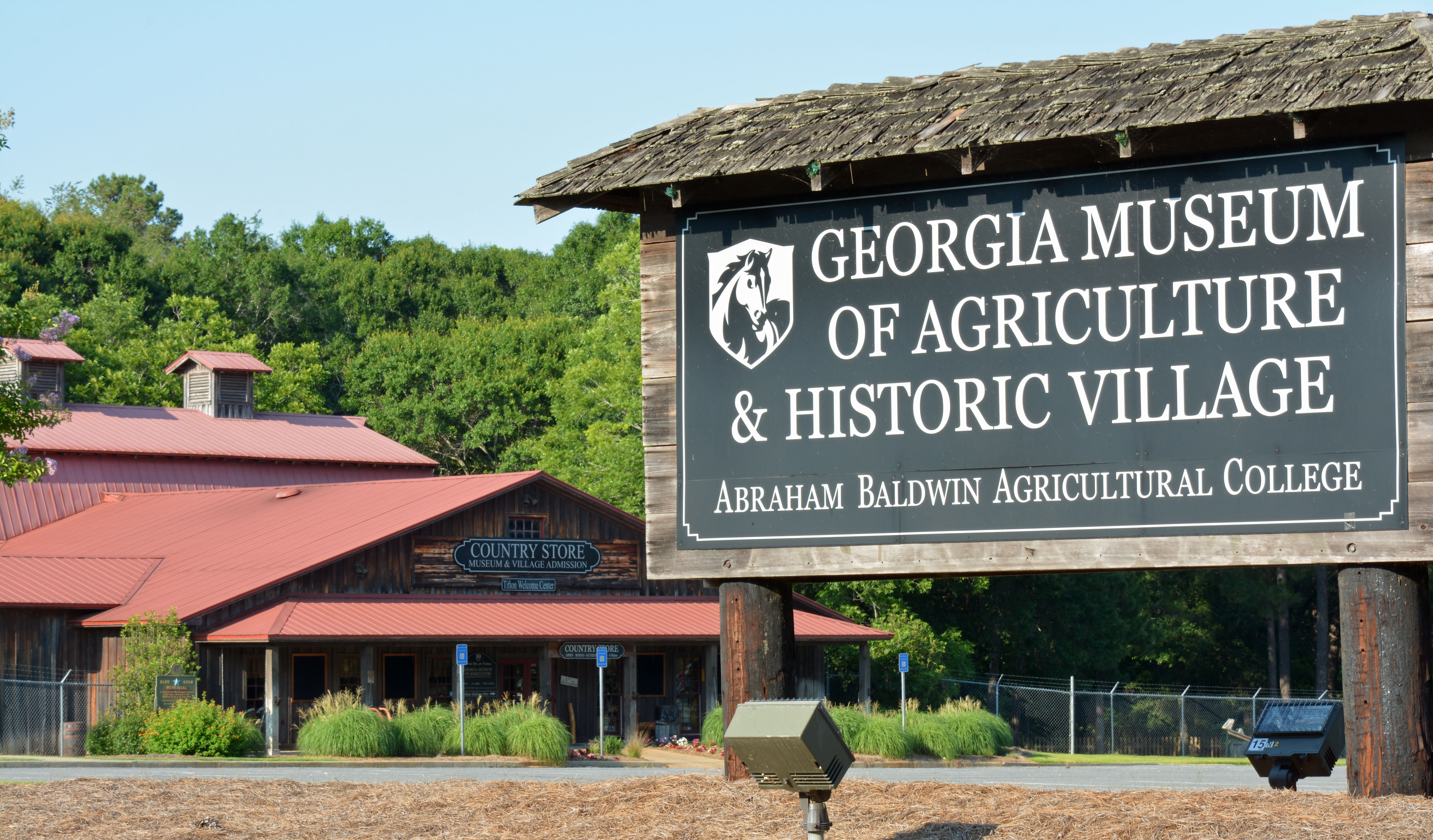
Georgia Museum of Agriculture & Historic Village
The whistle of a 1917 steam locomotive cuts through the humid South Georgia air every Saturday, and for a moment the twenty-first century falls away entirely. The Vulcan, a squat narrow-gauge engine built by the Vulcan Iron Works for dam construction in North Carolina, now hauls visitors through the Georgia Museum of Agriculture and Historic Village in Tifton, the only steam-powered train in regular operation in the state. Formerly known as the Agrirama, this 95-acre living history museum opened on July 4, 1976, and has spent the decades since reassembling a vanished world, one weathered board at a time.
A Town Rebuilt From Scattered Pieces
Over 35 historic structures have been physically relocated to the museum grounds, dismantled from their original sites across South Georgia and painstakingly restored. Together they form five distinct areas: a traditional farm community of the 1870s, an 1890s progressive farmstead, an industrial sites complex, a rural town, and a national peanut complex. The effect is not a single preserved place but a composite portrait of an entire era, a region's worth of architectural memory concentrated on one site off Interstate 75 at Exit 63B. Costumed interpreters move through these spaces demonstrating the skills and rhythms of daily life in nineteenth-century Georgia, from splitting rails to grinding grain. The museum operates as a facility of Abraham Baldwin Agricultural College, connecting its preservation mission to the agricultural education that still defines this part of the state.
The Gin That Changed Everything
Among the museum's most significant demonstrations is a reconstructed cotton gin designed to show the ginning technologies of the 1890s. This was the pivotal decade when the older mid-nineteenth-century gins were giving way to the system gin invented by Robert S. Munger, a revolution in processing that mechanized nearly every step from seed cotton to baled fiber. The museum's gin contains equipment manufactured by Lummus of Columbus, Georgia, a company that began building cotton gins in the era the museum depicts and continued doing so for over a century, relocating to Savannah in 1999. Each year the museum fires up the gin for public demonstrations, filling the air with the roar of machinery and drifting cotton lint, making visceral what history books can only describe. Alongside the gin stands a turpentine still, a reminder that South Georgia's economy rested on more than cotton alone. Longleaf pine forests once blanketed this region, and the naval stores industry that extracted turpentine and rosin from their resin was a major economic force well into the twentieth century.
Iron Horse on Narrow Rails
The Vulcan steam locomotive is the museum's most charismatic resident. Built in 1917 as a small industrial workhorse, it spent its early career hauling materials during the construction of Lake James and its hydroelectric dam on the Catawba River in Bridgewater, North Carolina. Decades later, restored and relocated to Tifton, it became the centerpiece of the museum's narrow-gauge railway. The 36-inch gauge track winds through the property, giving riders a sense of the small industrial railways that once threaded through Georgia's farms and forests. When boiler troubles sidelined the Vulcan in 1993, a dedicated group of volunteers spent five years on a meticulous restoration, returning the locomotive to service in 1998. That volunteer effort speaks to something essential about the museum: it survives on the commitment of people who believe that remembering how things were made and grown is worth the trouble of keeping old machines running.
Where Peanuts Get Their Due
The national peanut complex at the museum acknowledges a crop that reshaped South Georgia agriculture. After the boll weevil devastated cotton in the early twentieth century, farmers turned increasingly to peanuts, and the sandy soils of the Coastal Plain proved ideal. Today Georgia leads the nation in peanut production, and the museum traces that story from field to processing plant. Combined with the Museum of Agriculture Center, which houses exhibits on the broader arc of Georgia farming from Native American cultivation through mechanized modernity, the complex makes a case that agriculture is not a backdrop to Southern history but its central narrative. Tifton itself, home to a major University of Georgia agricultural research station, remains a working laboratory for the crops and techniques the museum preserves in amber.
From the Air
Located at 31.465N, 83.535W in Tifton, Georgia, just east of Interstate 75. The museum's 95-acre site is visible from low altitude as a cluster of historic structures surrounded by open farmland typical of South Georgia's Coastal Plain. Henry Tift Myers Airport (KTMA) lies approximately 2 nautical miles southeast of Tifton's center. Southwest Georgia Regional Airport (KABY) in Albany is 45 miles to the southwest. The flat terrain and agricultural landscape make the museum complex stand out among surrounding fields. Approach from the east along I-75 for the clearest view of the site layout.
Sources
- Georgia Museum of Agriculture & Historic Village
- Vulcan Steam Locomotive - Steam Giants
- Georgia Museum of Agriculture - New Georgia Encyclopedia
- Georgia Museum of Agriculture - ABAC Official Site
- Robert S. Munger - Wikipedia
- Lummus Cotton Gin Company - Historic Columbus
- Georgia Peanut Production - USDA ERS