Georgia O'Keeffe Museum
Georgia O'Keeffe saw something in New Mexico that other artists had missed. Not the turquoise jewelry or the pueblo villages, but the bones. Sun-bleached skulls picked up from the desert floor, held against the sky until the blue showed through the eye sockets. She painted them obsessively -- along with the flowers, the clouds, the red hills near Abiquiu -- turning the landscape north of Santa Fe into some of the most recognizable images in American art. Eleven years after her death in 1986, a museum opened on a quiet street in downtown Santa Fe to house the largest collection of her work anywhere in the world.
From Wisconsin Prairie to Desert Light
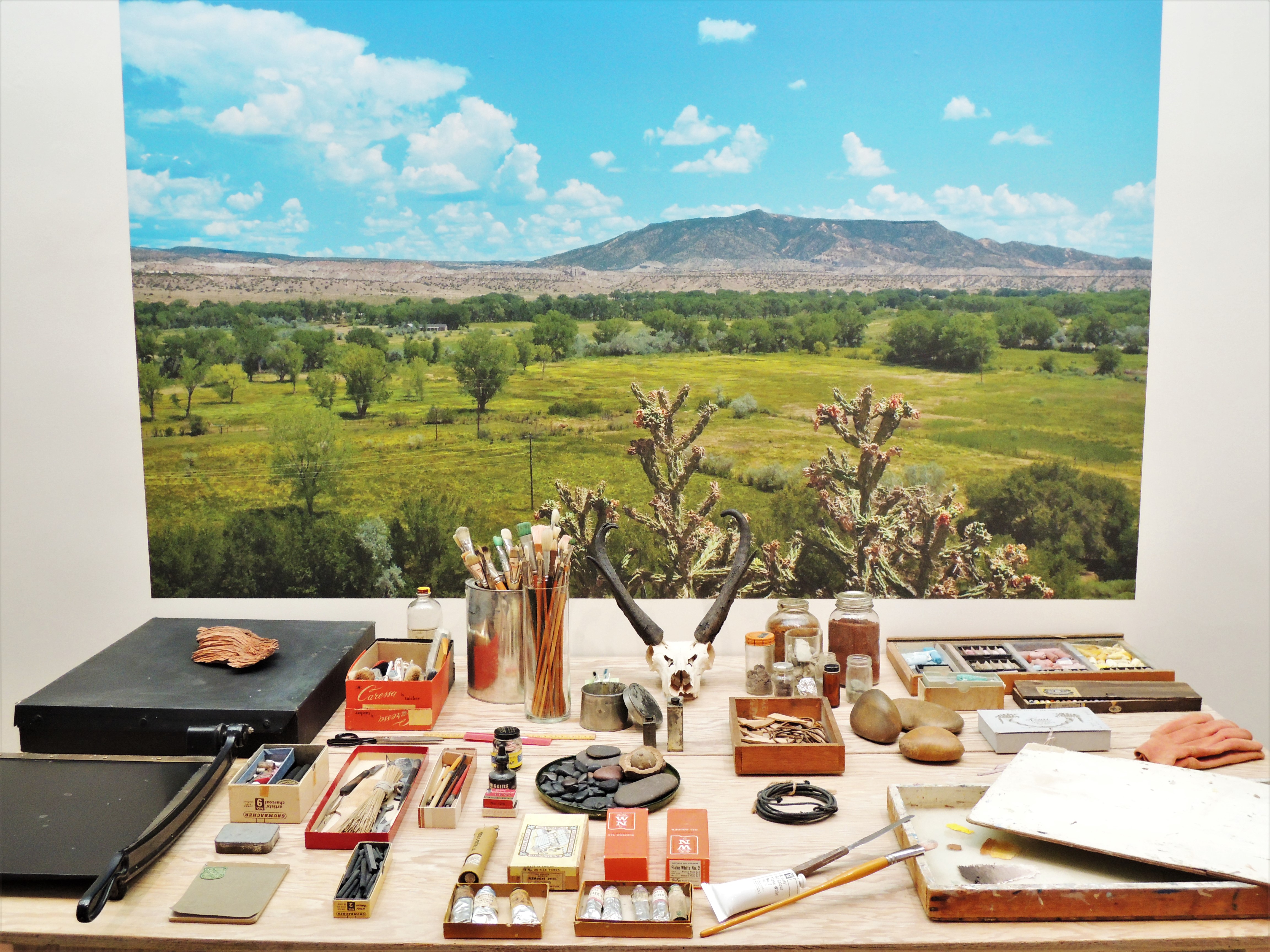
O'Keeffe first visited New Mexico in 1929 and never fully left. Born on a Wisconsin dairy farm in 1887, she had already upended the New York art world with her large-format flower paintings and bold abstractions when photographer Alfred Stieglitz -- her husband and champion -- introduced her work to Manhattan galleries. But it was the landscape around Taos and Abiquiu that claimed her imagination. She began splitting her time between New York and New Mexico, and after Stieglitz died in 1946, she moved permanently to a small adobe compound in Abiquiu. From its rooftop, she could see the Pedernal mesa she painted again and again. 'It's my private mountain,' she once said. 'God told me if I painted it enough, I could have it.'
A Museum Built for Light
The Georgia O'Keeffe Museum opened on July 17, 1997, designed by architect Richard Gluckman, whose previous projects included gallery spaces at the Whitney Museum of American Art and the Andy Warhol Museum in Pittsburgh. Gluckman's Santa Fe building is deliberately understated -- clean walls, controlled natural light, spaces scaled to let O'Keeffe's work command attention without competing with its container. The collection began with 140 paintings, watercolors, pastels, and sculptures. It has since grown to nearly 1,200 objects, making it the world's largest repository of O'Keeffe's art and personal materials, including items from her historic homes.
Beyond the Gallery Walls
The museum extends well beyond its Santa Fe galleries. About 50 miles north, in the village of Abiquiu, visitors can tour Georgia O'Keeffe's Home and Studio -- the adobe compound where she lived from the late 1940s until the end of her life. The property includes the garden she tended, now cultivated annually by local students. Nearby, the Ghost Ranch landscape that inspired many of her most iconic paintings remains largely unchanged -- the same red and yellow cliffs, the same vast sky. The museum also maintains a research center in the historic A.M. Bergere house in Santa Fe, housing a library and archive that supports scholarship on O'Keeffe, her contemporaries, and the broader American modernist movement.
The Desert's Lasting Canvas
O'Keeffe's influence on how Americans see the Southwest is difficult to overstate. Before her, the desert was scenery. After her, it became a subject with its own emotional vocabulary -- austere, luminous, elemental. The museum keeps that vision alive through rotating exhibitions that place her work alongside contemporaries and successors, from Ansel Adams to Annie Leibovitz. The building itself has become a cultural landmark within Santa Fe's gallery district, appearing in popular culture from Breaking Bad to the post-apocalyptic series Pluribus. But its real power is simpler than any cameo: stand in front of one of O'Keeffe's massive flower paintings or her stark desert crosses, and the New Mexico light filtering through Gluckman's careful windows makes you feel as though you are seeing the landscape through her eyes.
From the Air
The Georgia O'Keeffe Museum is located at 35.689N, 105.941W in downtown Santa Fe, one block northwest of the Plaza. Not individually distinguishable from the air, but located within the compact historic downtown area. Georgia O'Keeffe's Abiquiu Home and Studio is approximately 50 miles north-northwest, near the red cliffs of Ghost Ranch visible from altitude. Santa Fe Regional Airport (KSAF) is the nearest facility. The Pedernal mesa, a frequent subject of O'Keeffe's paintings, is a distinctive flat-topped peak visible northwest of Abiquiu.