Georgian Airways Flight 834
Ten minutes. That was how long it took for visibility at Kinshasa's N'Djili Airport to collapse from eight kilometers to five hundred meters on the afternoon of April 4, 2011. Georgian Airways Flight 834, a Bombardier CRJ100 carrying 33 people on a United Nations charter from Kisangani, was already on approach when the squall line swallowed the airfield. What happened next would become the deadliest aviation disaster in UN history, a tragedy compounded by failures that stretched from the cockpit to the control tower to the regulatory offices of two nations thousands of kilometers apart.
Into the Storm
The flight departed Kisangani at 12:18 p.m. local time with 29 passengers and 4 crew members. The weather briefing for Kinshasa had been unremarkable, predicting no significant developments for the next two hours. But equatorial weather moves on its own schedule. By the time the CRJ100 neared its destination, a fast-moving squall line was bearing down on the airport from the northeast, dragging severe thunderstorms and microbursts in its wake. The crew's onboard weather radar painted the storm in magenta, the color that means turn away. First Officer Suliko Tsutskiridze, just 22 years old with 495 total flight hours, expressed shock at the sheer size of the system. The crew diverted around the weather cell but pressed toward Kinshasa, hoping the storm would pass. N'Djili Airport had no weather radar of its own, and the air traffic controller on duty kept broadcasting 'NOSIG' -- no significant change -- even as the sky darkened and winds surged.
A Decision That Could Not Be Undone
Captain Alexei Hovhanesyan was 27 years old and had been promoted to captain on the CRJ100 just three months earlier, in December 2010. He had 2,811 flight hours total but only 217 as captain. When the first officer spotted the runway through a gap in the clouds on the right side of the aircraft, he urged the captain to turn. 'There's nothing there,' he said, meaning the weather looked clearer in that direction. Hovhanesyan eventually saw the runway too, and they committed to landing. Investigators would later call this decision inappropriate. The crew had sufficient information from their radar and from the tower's warning of 'thunderstorm over the station' to divert. But they kept hoping conditions would improve, a cognitive trap the investigation described as 'situation overload' -- too many variables degrading their ability to judge correctly.
The Microburst
As the crew initiated a go-around, the squall line unleashed a microburst directly in their path. The aircraft, already low, was slammed downward. The nose pitched to only 8 degrees instead of the required 10. The landing gear remained extended, creating drag when every fraction of lift mattered. The investigation raised a haunting possibility: Captain Hovhanesyan, who had spent years as a first officer on Boeing 737s, may not have pressed the TOGA button at all. On a 737, the button sits forward near the thrust lever and is pushed with the index finger. On the CRJ100, it sits on the side and requires a sideways thumb press. Muscle memory from one aircraft can betray a pilot in another. Without the TOGA activation, the flight director never displayed the 10-degree pitch reference. The CRJ100 struck the ground short of the runway. The undercarriage sheared off, the fuselage flipped, the tail separated. The wreckage slid 400 meters before coming to rest.
Thirty-Two Lives
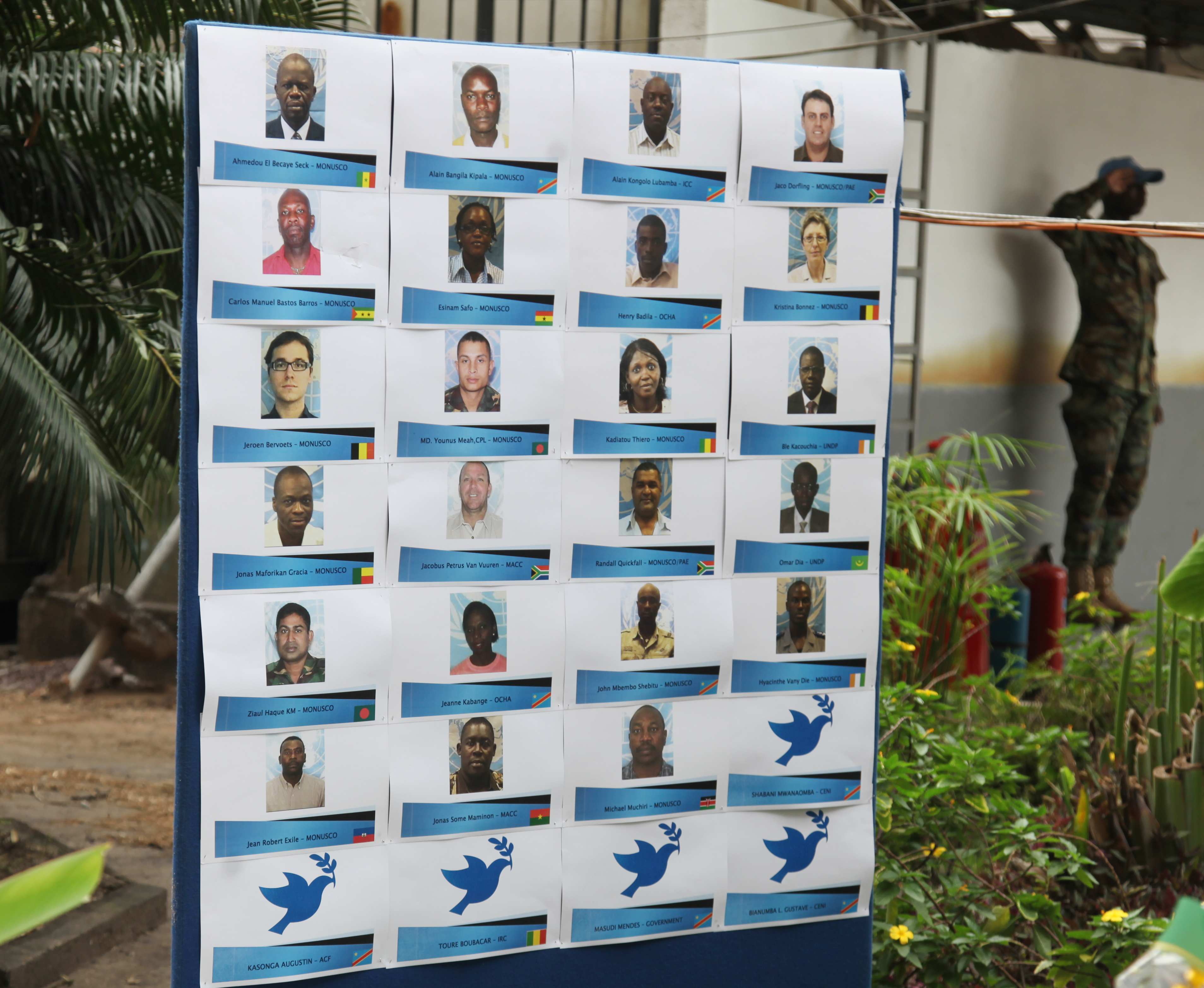
Nine people were pulled alive from the wreckage. Most died of their injuries within hours. The sole survivor, Francis Mwamba, suffered a spinal fracture and was evacuated to South Africa. The 32 dead came from 14 nationalities and represented the breadth of the UN's work in the Congo: MONUSCO peacekeepers, staff from the World Food Programme, the UN Development Programme, the Office for the Coordination of Humanitarian Affairs. Among the passengers were employees of the International Criminal Court and the International Rescue Committee, as well as Mendes Masudi, an adviser to the DRC's Foreign Minister. UN Secretary-General Ban Ki-moon ordered flags flown at half-mast at every UN office worldwide. A wreath-laying ceremony was held at headquarters in New York. The Security Council, the United Kingdom, and the United States issued formal condolences.
Failures Layered on Failures
The investigation revealed a cascade of systemic breakdowns. Georgian Airways had required Hovhanesyan to complete only a single simulator session before his upgrade to captain -- where most airlines mandate eight to ten. The Georgian Civil Aviation Administration had approved this training syllabus without objection. The crew had operated in the DRC for an extended period with no oversight from their airline, from MONUSCO, or from Congolese aviation authorities, breeding a culture of procedural shortcuts. Meanwhile, N'Djili's air traffic control lacked weather radar, was slow to respond to the crew's requests for updated conditions, and failed to close the airport when visibility dropped below minimums. The final weather report reached the cockpit approximately one second before impact. Thirteen recommendations followed, calling for better meteorological equipment, effective airline oversight, and revised training standards. The Georgian CAA disputed several findings but conceded that more severe-weather training was needed.
From the Air
Located at 4.32S, 15.30E at Kinshasa's N'Djili International Airport (ICAO: FZAA). The crash site is adjacent to Runway 24 at the airport. Best observed from 3,000-5,000 feet AGL. The airport sits on the eastern outskirts of Kinshasa along the Congo River. Brazzaville's Maya-Maya Airport (FCBB) lies just across the river to the northwest.