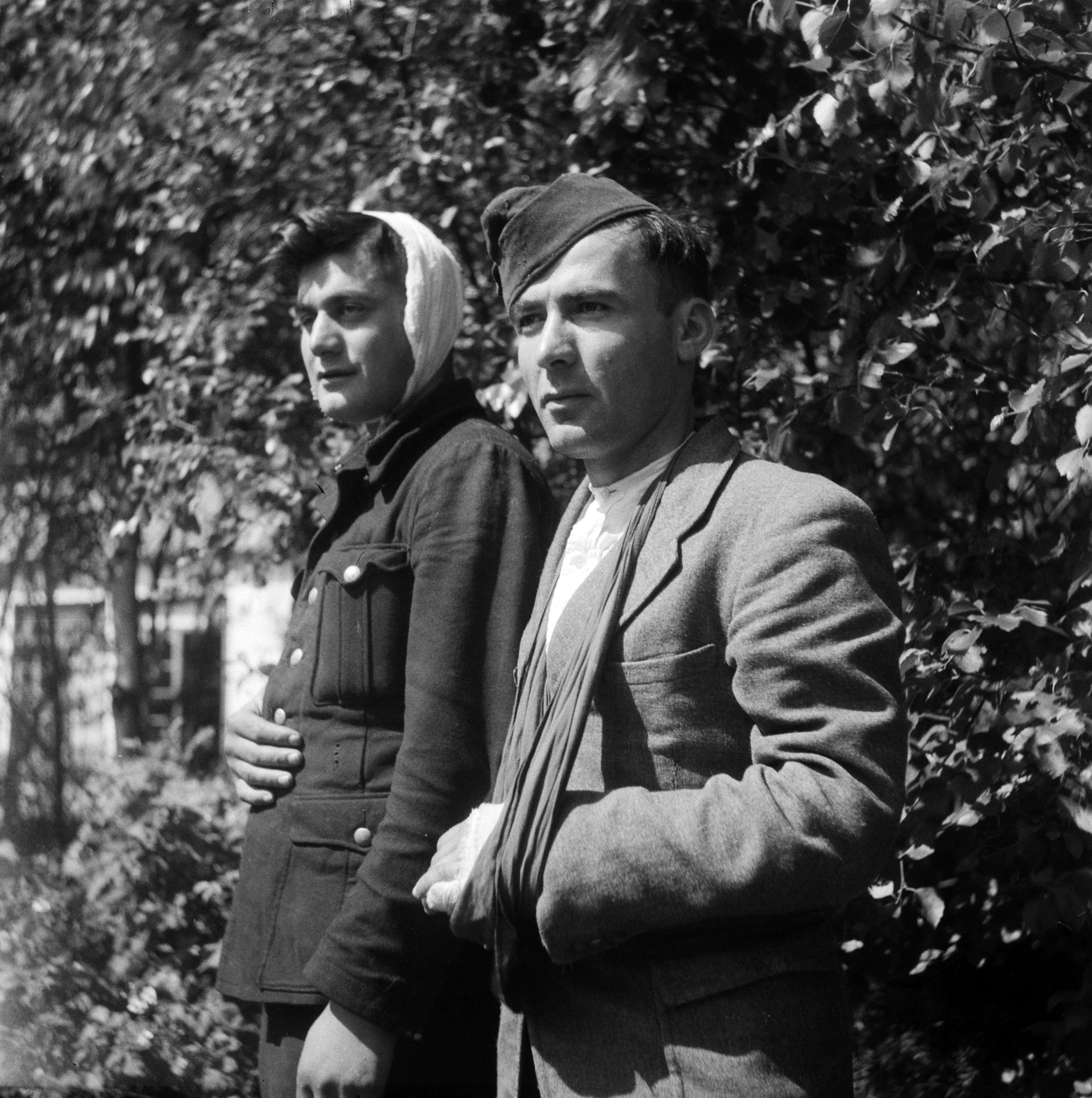
Georgian Uprising on Texel
Shalva Loladze understood the arithmetic. If the Red Army caught him in a German uniform, he would be shot, or worse, sent east. If the Germans caught him plotting against them, he would be shot tomorrow. The Allies were not coming to Texel, this flat sliver of an island off the Dutch coast where his battalion had been posted in February 1945. So on the night of 5 April, the Georgian second lieutenant ordered his men to take the long knives they had hidden and walk quietly into the rooms where their German officers slept. Before dawn, around two hundred Germans were dead in their beds and on their rounds. The war in Europe had six weeks left. For the eight hundred Georgians of the 882nd Infantry Battalion Königin Tamara, those six weeks would be the longest of their lives.
The Impossible Bargain
They had been Red Army soldiers from the Georgian Soviet Socialist Republic, captured on the Eastern Front and herded into camps where starvation and disease were doing the work that bullets had not. The German offer came as it came to so many Soviet prisoners: serve in a Wehrmacht auxiliary unit, eat regularly, perhaps see Georgia free again when the swastika reached the Caucasus. The alternative was to die slowly behind barbed wire. The men who chose the uniform did not become Nazis; they became survivors making a survivor's calculation. By 1945 the calculation had curdled. Germany was finished, and the Yalta Conference had handed Stalin the right to demand every Soviet citizen back, collaborators first. The Georgians on Texel knew exactly what waited for them on the docks at Odesa: a tribunal, a sentence, and a gulag if they were lucky.
Night of the Bayonets
The plan was conceived with the Dutch resistance, who supplied intelligence and would shelter the rebels when the rising came. The timing depended on an Allied landing that any sensible map could have told them would never come; Texel had been bypassed months earlier, militarily irrelevant since Normandy. When Loladze gave the order on the night of 5 April, his men moved barracks by barracks, killing the Germans they had slept beside for two months. By morning the Georgians held most of the island, and the Dutch flag flew over Den Burg for the first time in five years. But Loladze had not taken the heavy coastal batteries. Their German crews, the only enemy soldiers still alive on Texel, began shelling the villages where the rebels were hiding.
Five Weeks Without End
Two thousand riflemen of the 163rd Marine-Schützenregiment landed from the mainland and began working the island from south to north. They burned dozens of farms; the damage would later be reckoned at ten million guilders. The Georgians fought from windbreaks and dunes, from the lighthouse at Eierland and the polders below it. Texelaars hid them in attics, in haystacks, in cellars beneath kitchen floors. About one hundred and twenty islanders died in the crossfire and the reprisals, ordinary farmers and fishermen whose only role in any of this was to live on a piece of land that strangers had decided to fight over. Major Klaus Breitner, the German battalion commander who had escaped the first night, ordered captured mutineers to strip off their uniforms, dig their own graves, and stand at the edge.
After the War Ended
On 5 May 1945 the German forces in the Netherlands surrendered. On 8 May, Germany surrendered everywhere. On Texel the killing continued, because the German garrison refused to acknowledge the surrender while armed Georgians were still on the island, and the Georgians could not surrender to men who were executing them on capture. The Second World War in Europe had officially ended, and yet two armies kept fighting in the dunes for twelve more days. Canadian troops under Lieutenant Colonel Kirk finally landed unopposed on 17 May, disarmed 1,535 Germans over two days, and on 20 May the last shots stopped. The final count: 565 Georgians dead, around 812 Germans, and 120 Dutch civilians. Five Georgians out of every eight who had landed on Texel were now buried in its sand.
The Reckoning at the Hogeberg
SMERSH, Stalin's military counterintelligence, arrived to collect the 228 Georgians still alive. Most went home to Soviet justice; many vanished into camps. Allied testimonies of their heroism reportedly spared 236 of them from the worst, though the records are uneven and the personal cost is unknowable. The dead Georgians rest at the Hogeberg near Oudeschild, in a cemetery the Texelaars built and still tend. The Germans were eventually moved to Ysselsteyn in Limburg. In May 2005 Mikheil Saakashvili, then president of an independent Georgia his grandfathers' grandfathers had imagined and never seen, came to the Hogeberg with his Dutch-born wife and stood at the graves. Eugeny Artemidze, one of the main organizers of the uprising, lived until 22 June 2010 and died on the anniversary of the day he had first gone to war, sixty-nine years earlier. Grisha Baindurashvili, the last survivor, died in his village near Tbilisi in 2021, aged 102.
From the Air
53.05 N, 4.80 E. Texel is the southernmost of the Frisian Islands, a flat 25-kilometer-long sand spit between the Wadden Sea and the open North Sea. Recommended viewing altitude 3,000-5,000 feet. The Eierland lighthouse at the north tip and the harbor at Oudeschild on the east coast are the clearest landmarks; the Georgian cemetery sits on the Hogeberg ridge just inland. Nearest airports: Texel International (EHTX) on the island, De Kooy (EHKD) on the adjacent mainland, and Amsterdam Schiphol (EHAM) 80 km south. Coastal North Sea visibility is best in late spring and early autumn.