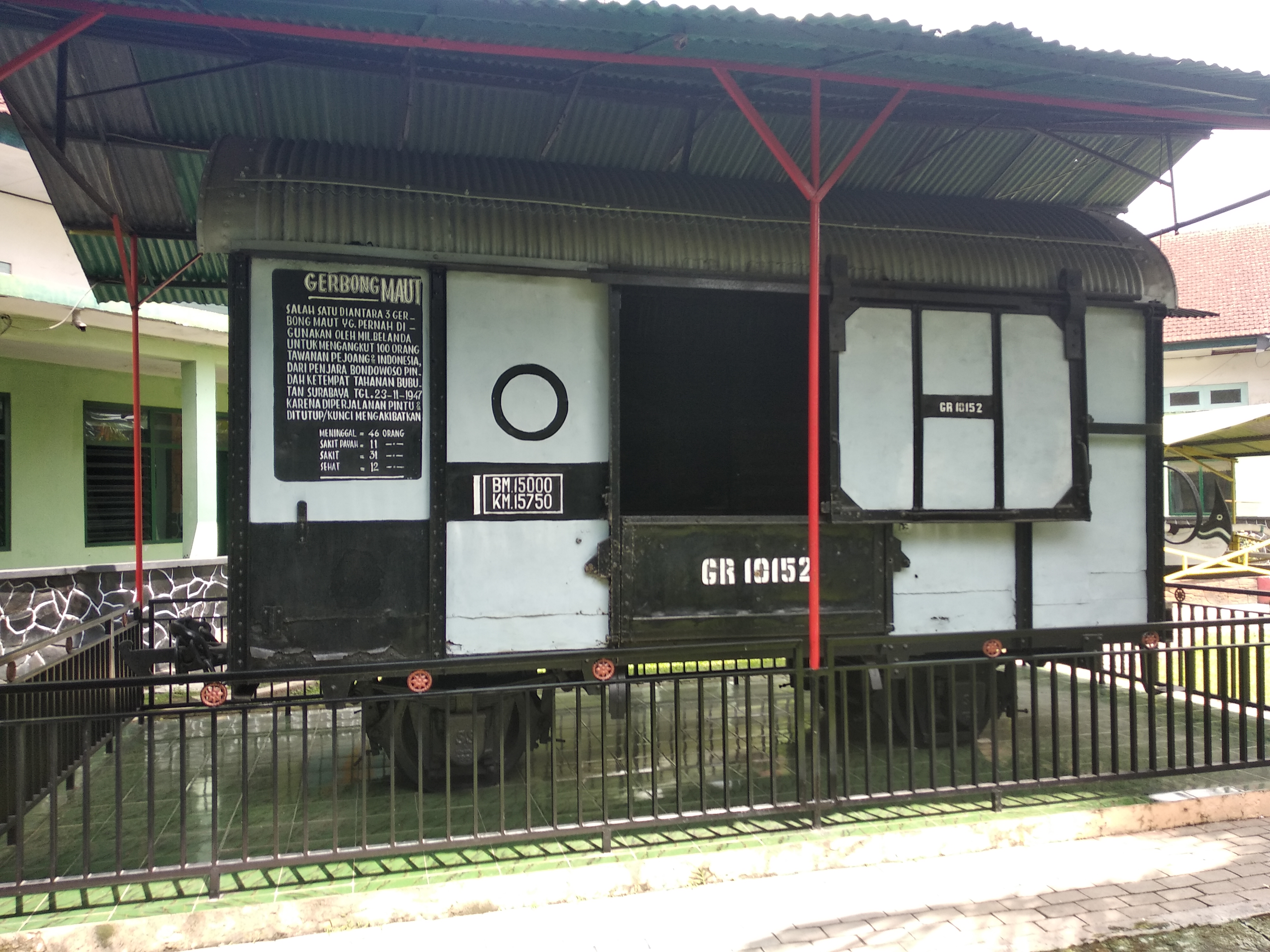
The Sealed Train: Bondowoso's Forgotten Atrocity
No one aboard the train could see the East Javanese countryside sliding past. The three railway cars -- timber walls, corrugated iron roofs -- had been sealed shut on 23 November 1947 at Bondowoso station. Inside were one hundred men, arrested on suspicion of being revolutionaries during the guerrilla war against Dutch colonial rule. Their destination was Kalisosok Prison in Surabaya, roughly 250 kilometers to the northwest. The reason given for the transfer was overcrowding at the local jail. What followed was sixteen hours of suffocation, heat, and death that would become one of the Indonesian National Revolution's most notorious atrocities -- known today as the Gerbong Maut, the Death Train.
A Revolution in the Countryside
Indonesia's struggle for independence from the Netherlands was not confined to grand battlefields or diplomatic halls. In East Java, it played out in villages, rice paddies, and small towns like Bondowoso, a quiet regency seat nestled between volcanic highlands and tobacco plantations. After Indonesia declared independence in August 1945, the Dutch launched military campaigns -- euphemistically called "police actions" -- to reassert control over the archipelago. Bondowoso became a flashpoint. Guerrilla fighters harassed Dutch positions, and the colonial authorities responded with sweeping arrests. One hundred men, many of them civilians caught in the dragnet, were rounded up and detained. The Dutch decided to ship them to Surabaya.
Sixteen Hours Without Air
The three railway cars were never designed to carry human cargo in sealed conditions. Built of timber and corrugated iron, they trapped heat like ovens under the tropical sun. As the train lurched westward through the Javanese lowlands, oxygen inside the cars dwindled. Survivors later testified that when the train stopped at sidings along the route, the prisoners pounded on the walls and screamed for water. Guards told them only bullets were available. Nothing would be provided until they reached Surabaya. The journey stretched across sixteen agonizing hours. Men collapsed from heat exhaustion and asphyxiation. Some died standing up, pressed too tightly against their neighbors to fall. When the doors were finally opened in Surabaya, the scale of the disaster was laid bare: in the first car, all the men were alive, though several were gravely ill. In the second car, eight had died. In the third and last car, not a single person had survived.
Counting the Dead
Of the one hundred men loaded onto the train at Bondowoso, only twelve emerged unharmed. The exact death toll has been difficult to establish with certainty, though dozens perished from heat stress and oxygen deprivation. The incident became part of a broader pattern of Dutch military violence during the Indonesian National Revolution, alongside events like the Rawagede massacre and the South Sulawesi campaign. For decades, the Dutch government resisted acknowledging atrocities committed during the colonial period. The Gerbong Maut remained a wound that Bondowoso's residents carried forward through generations, a local tragedy with national significance.
What Remains in Bondowoso
Today, a monument stands in the center of Bondowoso, between the alun-alun -- the traditional Javanese town square -- and the regency government office. It consists of two elements: a replica railway car and a statue representing the hundred prisoners. The monument is modest by national standards, but its placement at the heart of the town ensures that no one passes through Bondowoso without encountering this history. The original railway car from the incident is preserved at the Brawijaya Army Museum in Malang, about 100 kilometers to the southwest. Standing before it -- a rusted shell of timber and iron barely large enough for livestock, let alone dozens of men -- the horror of what happened becomes visceral in a way that written accounts cannot fully convey.
A View from Above
From the air, Bondowoso appears as a compact grid of streets and red-tiled roofs set against the deep green of Java's agricultural lowlands. The Ijen volcanic plateau rises to the east, its sulfurous crater lake a popular destination for hikers. To the west, the route the death train followed traces through towns and sugar-cane fields toward Surabaya. The monument in Bondowoso's center is not visible from altitude, but the railway line that carried the sealed cars still runs through the town. The landscape is disarmingly beautiful -- volcanic peaks, terraced hillsides, the haze of tropical humidity softening every edge. Nothing about the view suggests the violence that once moved along these rails.
From the Air
Located at 7.97°S, 112.62°E in East Java, Indonesia. Bondowoso sits in a valley between the Ijen volcanic plateau to the east and the lowlands stretching toward Surabaya to the northwest. The town's grid layout and central alun-alun are identifiable from lower altitudes. The railway line running through town is the historical route of the death train. Nearest airports: Abdul Rachman Saleh (WARA) near Malang, approximately 100 km southwest; Juanda International Airport (WARR) in Surabaya, approximately 200 km northwest. Best viewed at 5,000-10,000 feet for town detail. The Ijen crater to the east is a prominent visual landmark.