German Auxiliary Cruiser Thor: The Wolf in Merchant's Clothing
On the morning of November 30, 1942, an explosion ripped through the German tanker Uckermark in Yokohama harbor. The blast was so violent that Uckermark's bridge was hurled through the air and landed on the ship moored alongside -- the commerce raider Thor, which had spent the previous two and a half years stalking the Atlantic and Indian Oceans under false flags, fighting off Royal Navy warships, and sinking merchant vessels from the Equator to the Antarctic Circle. Fire spread across the water. Thor, the Australian liner Nankin (rechristened Leuthen after Thor had captured it), and the Japanese freighter Unkai Maru 3 all burned. Thirteen of Thor's crew died. The ship that had survived gun battles with three armed merchant cruisers was destroyed at anchor, by accident, in a friendly port.
A Cargo Ship Goes to War
Thor began life as the Santa Cruz, a cargo vessel built by Deutsche Werft in Hamburg in 1938 for the Oldenburg Portuguese Line. In the winter of 1939-1940, the Kriegsmarine requisitioned her and had Deutsche Werft convert her into an auxiliary warship. Commissioned on March 15, 1940, she carried six guns, four 20mm anti-aircraft weapons, four torpedo tubes, provisions for 400 mines, and two Arado 196 seaplanes. Her crew numbered 284 men. The conversion followed a strategy rooted in World War I experience: disguised commerce raiders could force the Allies to divert enormous resources into convoy protection and anti-raider patrols while costing the Kriegsmarine comparatively little. Thor was designated HSK 4 by the German Navy, Ship 10 by their numbering system, and Raider E by the British -- who would learn her identity only slowly, by piecing together survivor reports, ship disappearances, and wireless intercepts.
Dueling Cruisers in the South Atlantic
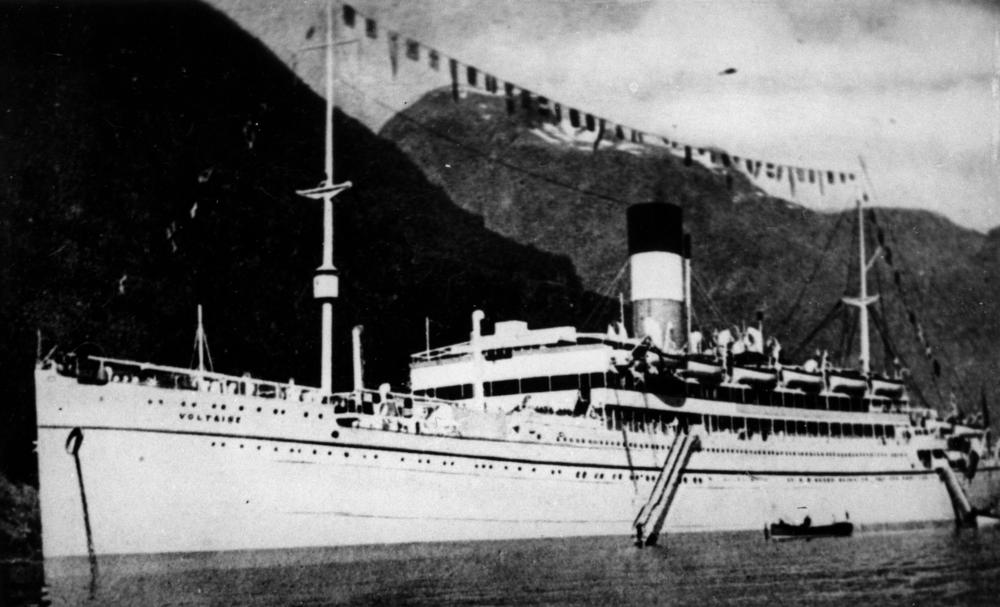
Captain Otto Kahler took Thor to sea on June 6, 1940, disguised as the Soviet freighter Orsk. By July, operating west of the Azores under another false identity -- the Yugoslav vessel Vir -- Thor had sunk six ships totaling 35,201 gross register tons in just over two weeks. On July 28, off Argentina, Thor encountered HMS Alcantara, an armed merchant cruiser carrying eight 6-inch guns. Kahler knew he was outgunned but not outmatched: Thor scored three early hits, flooding Alcantara's engine room and forcing her to slow. Thor escaped under a smokescreen. On December 5, southeast of Rio de Janeiro, Thor fought a second armed merchant cruiser, HMS Carnarvon Castle, which mounted eight 6-inch guns. In a half-hour engagement, Thor landed five hits and started three fires without being struck once. Carnarvon Castle limped to Montevideo with six dead and 32 wounded. On April 4, 1941, west of the Cape Verde islands, Thor engaged a third armed cruiser, HMS Voltaire. The first salvo knocked out Voltaire's generator and wireless cabin. The obsolete British guns overheated and fell silent. Voltaire sank, and Kahler spent five hours rescuing 197 survivors from shark-filled waters.
Radar, Seaplanes, and the Hunt Continues
Thor returned to Germany on April 23, 1941, after 329 days at sea, having sunk or captured twelve ships of 96,547 GRT. Refitted with newer guns and radar -- the first installed on any commerce raider -- Thor sailed again on November 30, 1941, under new captain Gunther Gumprich. The second cruise pushed south to the Antarctic Circle in search of whaling fleets, then north into the Indian Ocean. The Arado seaplane proved devastating: it would locate targets, strafe their bridges, and drag a grappling wire across radio aerials to prevent distress calls before Thor closed in with its guns. On May 10, 1942, west of Australia, Thor chased the 7,130 GRT Australian liner Nankin carrying 350 passengers and crew. Nankin fought back with her stern gun while armed passengers fired at the Arado, but Thor eventually punched a hole in the hull and the ship surrendered. A prize crew repaired Nankin and sailed her to a Japanese-held port. Among the cargo were secret papers from New Zealand's Combined Intelligence Centre revealing that the Allies were reading some Japanese radio codes.
Fire on the Water
Thor reached Yokohama on October 9, 1942, having sunk or captured ten ships of 55,587 GRT on its second voyage. Combined with the first cruise, Thor's total stood at 22 ships of 152,134 GRT -- a staggering haul for a converted cargo vessel. Gumprich pushed the Japanese authorities to expedite the refit, and work was nearly complete when the tanker Uckermark docked alongside on November 30. The explosion that destroyed both ships also killed 53 of Uckermark's crew and an unknown number of Chinese and Japanese dockworkers. Gumprich survived and took command of another raider, Michel, in May 1943. He continued the commerce war into the Indian and Pacific Oceans until October 16, 1943, when the American submarine USS Tarpon torpedoed Michel in bright moonlight in a calm sea. Gumprich was last seen on the bridge, directing the evacuation of the wounded. He went down with the ship. In total, nine German auxiliary cruisers made eleven voyages between 1940 and 1943, sinking or capturing 138 ships of 857,533 GRT -- a campaign the German Naval War Staff itself found surprisingly effective.
From the Air
Thor's final resting place is Yokohama harbor, at approximately 35.40°N, 139.65°E, in the Port of Yokohama on Tokyo Bay's western shore. The harbor area is a major industrial and shipping zone best viewed at 2,000-4,000 feet AGL. The port infrastructure, container terminals, and Yokohama Bay Bridge are visible landmarks. Tokyo Haneda Airport (RJTT) is approximately 12 nautical miles to the north-northeast. Yokohama Chinatown and the Minato Mirai 21 district are recognizable along the waterfront.