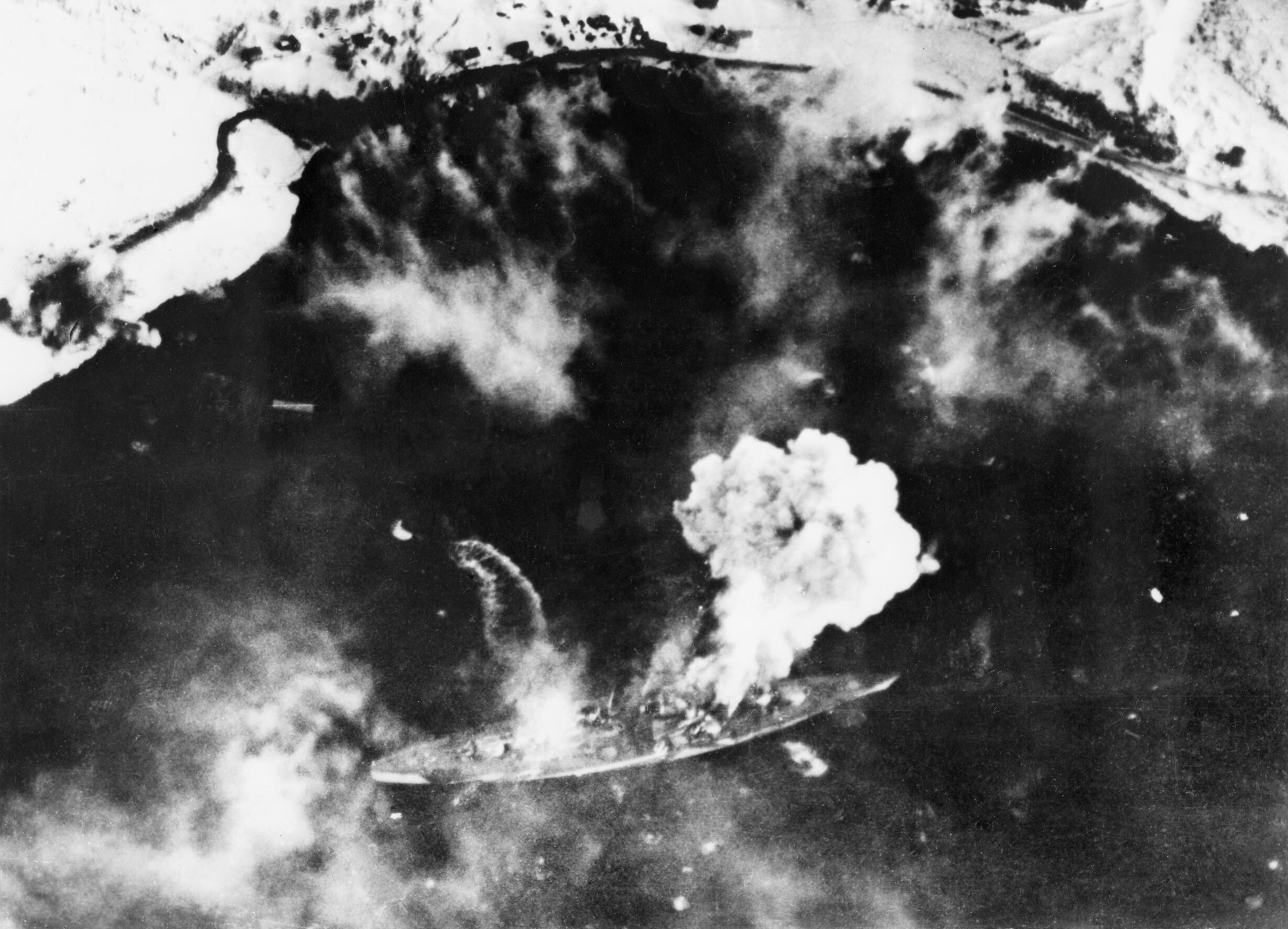
German Battleship Tirpitz
Ludovic Kennedy called her an invalid who "lived an invalid's life and died a cripple's death." The German battleship Tirpitz -- named for the architect of the Imperial German Navy, Grand Admiral Alfred von Tirpitz -- was the heaviest battleship ever built by a European navy, displacing over 50,000 tonnes fully loaded. She fired her main guns at an enemy surface target exactly once, during a bombardment of a weather station on Spitzbergen. Yet for three years, her mere presence in the Norwegian fjords forced Britain to keep a powerful fleet in northern waters, diverting warships that were desperately needed elsewhere. Tirpitz was the ultimate fleet in being: a weapon whose power lay not in what she did, but in what she might do.
The Lonely Queen of the North
Commissioned in February 1941, Tirpitz was the sister ship of Bismarck, armed with eight 38-centimeter guns in four twin turrets and capable of 30.8 knots. After Bismarck was sunk in May 1941, Hitler forbade Tirpitz from attempting an Atlantic sortie. Instead, she was sent to Norway in January 1942, where she would spend the rest of her career. Moored in Faettenfjord near Trondheim, she was hidden against cliffs, draped in cut trees for camouflage, and shrouded in artificial fog generated from chlorosulfuric acid whenever reconnaissance aircraft appeared. Her crew called her the Lonely Queen of the North. Life aboard was monotonous -- fuel shortages curtailed training, anti-aircraft drills consumed most working hours, and sports were organized simply to keep 2,000 men from going mad. She attempted two sorties against Allied convoys in 1942. The first, against convoys PQ 12 and QP 8 in March, accomplished nothing. The second, targeting Convoy PQ 17 in July, was aborted after the Germans realized they had been detected -- but the British Admiralty's panicked order for the convoy to scatter led to the destruction of 24 of 35 merchant ships by U-boats and aircraft.
Death by a Thousand Cuts
The Allies threw everything they had at Tirpitz. RAF heavy bombers attacked her repeatedly at Faettenfjord in early 1942, scoring no hits but losing aircraft to her anti-aircraft defenses. In September 1943, British X-Craft midget submarines penetrated Kaafjord's defenses during Operation Source. Two managed to lay four-tonne mines beneath the battleship. The detonations ruptured fuel tanks, buckled bulkheads, and threw turret Dora from its bearings -- damage so severe that there was no crane in Norway powerful enough to lift the turret back into place. The repair crew's work to restore the ship over the following months was later called "one of the most notable feats of naval engineering during the Second World War." In April 1944, Operation Tungsten sent 40 dive bombers from British carriers in two waves, scoring fifteen direct hits that killed 122 men and knocked out the starboard turbine. A series of follow-up carrier strikes through the summer -- Operations Planet, Brawn, Tiger Claw, Mascot, and four rounds of Goodwood -- achieved almost nothing. One 1,600-pound bomb penetrated two armored decks but its fuze was damaged and it failed to explode.
Tallboys Over Tromso
In September 1944, the RAF's No. 5 Group took over with Lancaster bombers carrying the 12,000-pound Tallboy bomb, designed to penetrate the heaviest armor. Operation Paravane on 15 September scored a single devastating hit on the bow that flooded the forward section and rendered Tirpitz unseaworthy. She could manage only 8 knots. Judging her beyond repair as a fighting ship, the German command decided to use her as a stationary gun battery and moved her to an anchorage off Hakoya Island near Tromso. A sandbank was built beneath her hull to prevent capsizing, and dredging operations began to reduce the water depth. They were only half finished when Operation Catechism struck on 12 November 1944. Thirty-two Lancasters from Nos. 9 and 617 Squadrons dropped 29 Tallboys. Two punched through the armored deck, and several near misses blew away the protective sandbank. The amidships hit caused catastrophic flooding. Within minutes, Tirpitz listed to port, and at 9:50 a.m. the magazine for turret Caesar exploded, hurling the turret roof into a group of men swimming for shore. By 9:52, the battleship had capsized. Between 950 and 1,204 men died.
What Remains
Salvage operations on the wreck lasted from 1948 to 1957, conducted by a joint German-Norwegian company. The bronze propellers were removed by German personnel before the war ended, melted down for the metal. Most of the hull was broken up in place and sold as scrap. Fragments of Tirpitz were scattered across Norway and beyond -- pieces of her armor plate ended up as souvenirs, paperweights, and museum exhibits. Today, the Tirpitz Museum near Kaafjord preserves the history of the battleship's years in the Norwegian fjords. Scientists studying tree rings near her anchorages have found that the artificial fog screens, made from chlorosulfuric acid, damaged the surrounding forests so severely that the effects remain visible in the growth patterns of trees decades later. The Lonely Queen left her mark on the landscape even after she was gone.
From the Air
The Tirpitz capsizing site is off Hakoya Island near Tromso at approximately 69.65N, 18.81E. Tromso Airport Langnes (ENTC) is about 5 km away. Kaafjord (Alta), where the battleship spent much of 1943-1944, is at approximately 69.95N, 23.14E near Alta Airport (ENAT). At low altitude (1,000-3,000 ft), the outline of the Hakoya anchorage is still visible. The fjord system around Tromso provides dramatic terrain for understanding why the Germans chose these locations for concealment.