
German Colonization of Valdivia, Osorno and Llanquihue
In a German household near Valdivia in the late 1800s, the language of command had quietly flipped. The Chilean servants spoke German with the family they worked for, then switched to Mapudungun, the Mapuche tongue, when dealing with indigenous customers. Spanish, the official language of the country, had become almost an afterthought in this corner of it. That inversion is the strangest measure of what happened here: between 1850 and 1875, roughly six thousand German immigrants settled the region around Valdivia, Osorno, and Llanquihue, and for a time they reshaped not just the economy but the very sounds of the place.
The Men Who Sold a Frontier
The colonization began with a vision and a sales pitch. Bernhard Eunom Philippi, a German expatriate, had been lobbying the Chilean government since 1842 to bring his countrymen to the empty-looking forests of the south. Chile, eager to populate a frontier it barely controlled, eventually agreed, though it rewarded Philippi awkwardly by posting him as governor of distant Magallanes, where he was killed by indigenous people in 1852. The work passed to Vicente Pérez Rosales, who sailed to Europe, gathered German families, and returned to settle them along the shores of Lake Llanquihue. Many of these emigrants were fleeing the failed German revolutions of 1848, trading political defeat at home for raw land at the end of the earth.
Brewers, Builders, and Carl Anwandter
The most celebrated of the new arrivals was Carl Anwandter, who reached Valdivia in 1850 after taking part in Prussia's 1848 uprising. He is remembered for a sentence that became almost a creed for the immigrants, a pledge to become honorable Chileans, and for something more tangible: in 1851 he founded Chile's first beer brewery. The Germans came as artisans, farmers, and merchants, and they brought a culture of wage labor, craft, and industry that the region had lacked. Their churches, schools, and steep-roofed houses still define the look of towns like Frutillar and Puerto Varas, and Puerto Montt itself grew rapidly as a colonization port from 1853.
The Cost in Forest and People
The land was not as empty as the brochures implied, and clearing it was brutal. To open ground for settlers who had no livelihood but farming, vast tracts of ancient forest were deliberately burned. In 1851, on Pérez Rosales's orders, a man named Pichi Juan set fire to the woods of Chan Chan between Osorno and La Unión; another notorious blaze consumed the slow-growing Fitzroya forests between Puerto Varas and Puerto Montt during a drought in 1863. The smoke clearing also obscured a harder truth: this was Huilliche and Mapuche territory, and the colonization that enriched the newcomers came at the expense of indigenous communities whose claims to the land would echo through Chilean courts for more than a century.
A Language That Stuck
The deepest German legacy turned out to be spoken. A local dialect, Lagunen-deutsch, grew from the speech of Bavaria, Baden, and the Rhineland, and German seeded itself into the everyday Spanish of the south. Across a swath of country reaching all the way to the Aysén Region, the word for blackberry became murra rather than the standard mora, the rolled rr mimicking a guttural German sound that Spanish speakers found hard to manage. Children played marbles in a game they called bochas, from the German bocciaspiel, instead of the bolitas used to the north. Most German Chileans now grow up speaking Spanish first, with German as a second or third tongue, but the borrowed words remain, fossils of a remarkable encounter.
From the Air
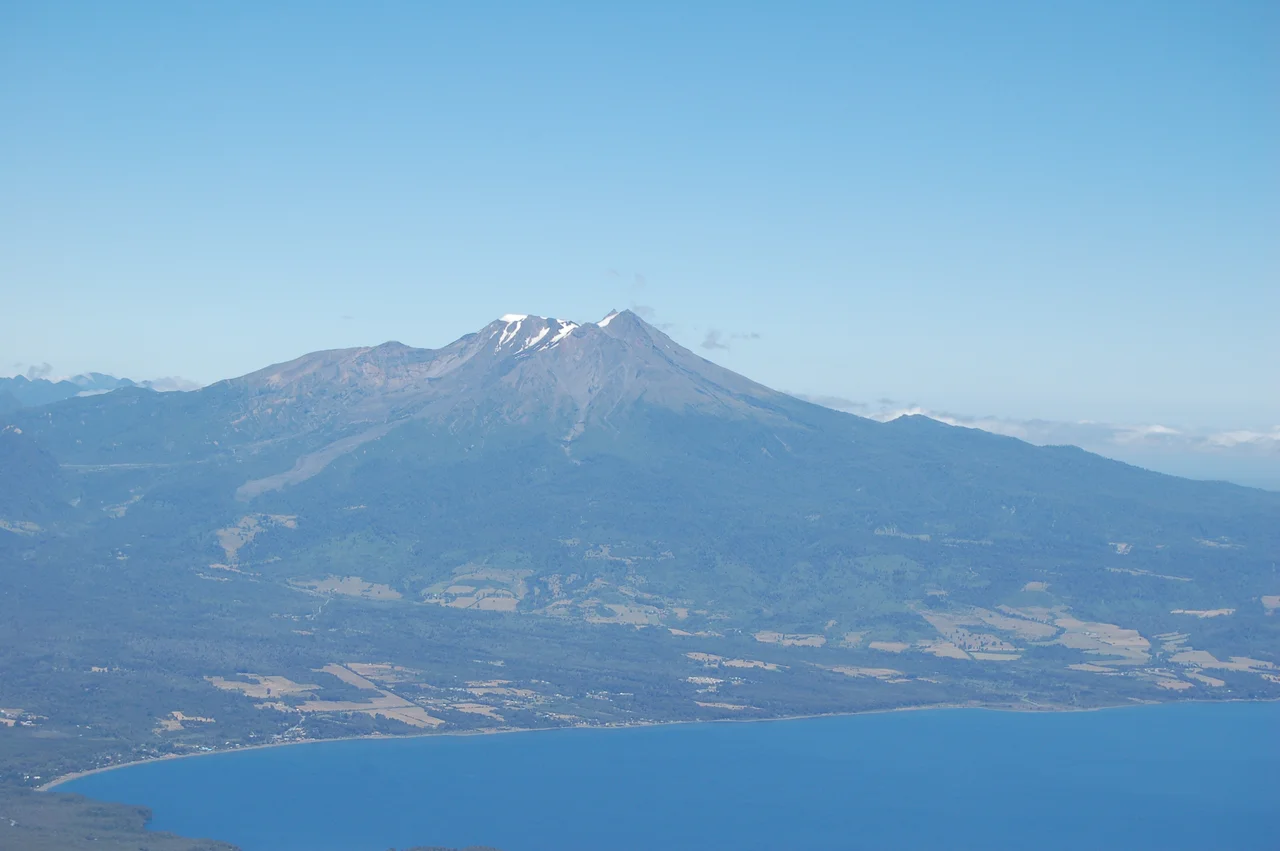
The German colonization zone spans the Chilean Lake District, anchored by Valdivia (about 39.81°S, 73.25°W), Osorno (40.57°S, 73.13°W), and the shores of Lake Llanquihue near Puerto Varas and Puerto Montt (41.32°S, 72.98°W). From the air the legacy is legible in the orderly farmland carved from former rainforest, the lakeside towns, and the volcano-framed expanse of Lake Llanquihue with the cone of Osorno volcano rising beyond it. Recommended viewing altitude 4,000-7,000 ft to trace the chain of settlements from Valdivia south to Llanquihue. Nearest airports are Pichoy / Valdivia (SCVD) in the north and El Tepual / Puerto Montt (SCTE) at the southern end of the corridor. The maritime climate brings frequent cloud and rain; clear days offer dramatic views of the Andean volcanoes that overlook the colonized lakes.
Nearby Stories
- Riñihuazo 24 km away
- Lago Ranco 35 km away
- Villarrica 57 km away
- Sinking of Janequeo and Leucotón 91 km away
- La Imperial 95 km away
- Puyehue-Cordón Caulle 115 km away
- Isla Mocha 131 km away
- Battle of Agüi 224 km away