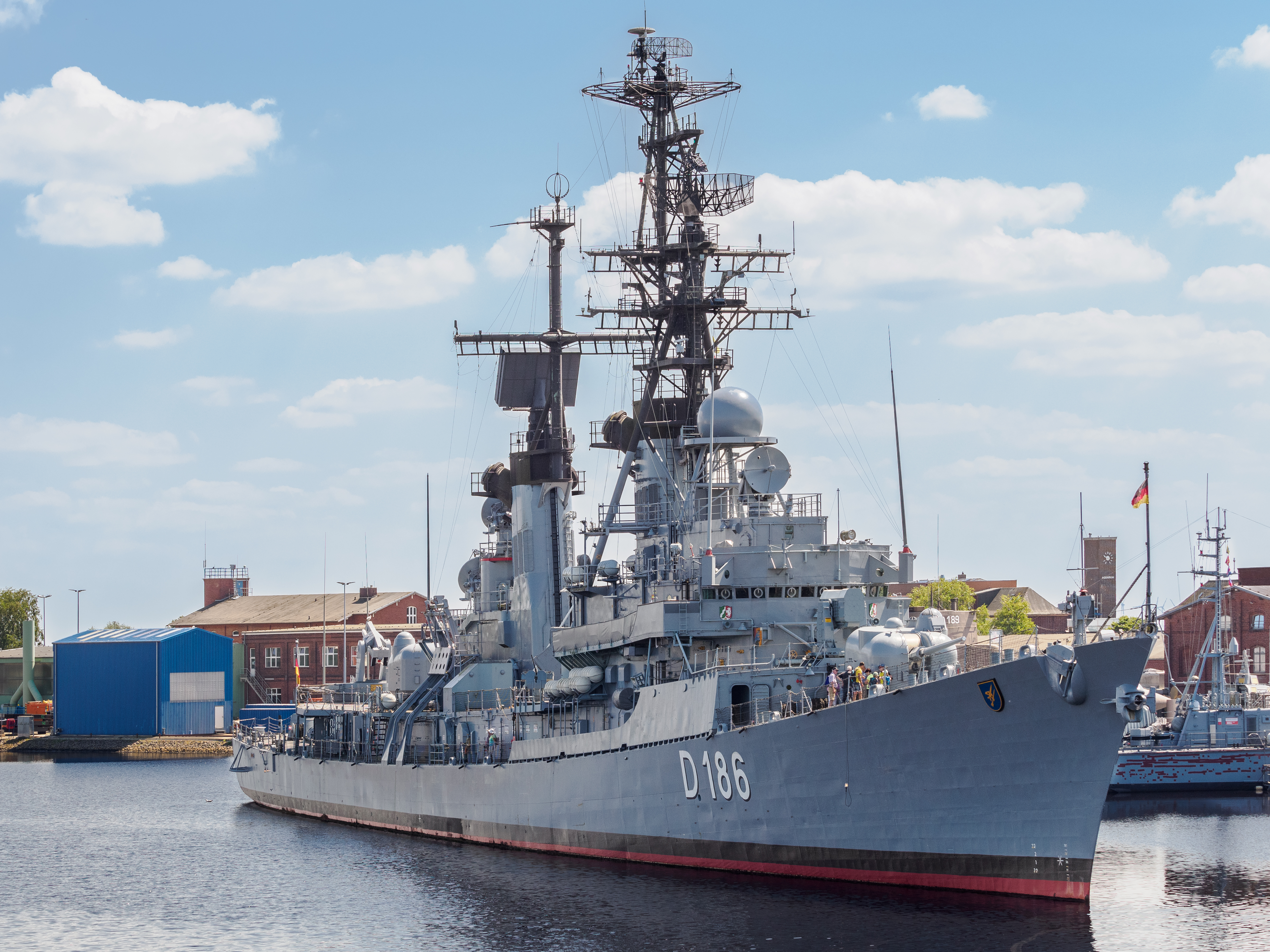
German destroyer Mölders
She is the last of her kind. The Charles F. Adams class produced 29 ships - 23 for the U.S. Navy, three for Australia, and three for the West German Bundesmarine. All have been scrapped, sunk as targets, or rusted away. All except *Mölders*, tied permanently to a pier at the Deutsches Marinemuseum in Wilhelmshaven, walked through by tourists and naval cadets. The ship outlived her class. She also outlived something else: the unquestioned right of her own namesake to be honored by the Bundeswehr.
An American Hull, a German Flag
*Mölders* was an American destroyer with a German accent. Bath Iron Works in Maine laid down her keel on 12 April 1966 as hull DDG-29, and she was launched on 13 April 1967, christened by Anne-Marie Mölders, the mother of her namesake. The Charles F. Adams class was a stretched Forrest Sherman hull rebuilt around the Tartar surface-to-air missile system - a fast, lean answer to the Cold War problem of defending carrier battle groups from Soviet aircraft. At 134.4 meters and 4,526 tonnes fully loaded, *Mölders* carried 333 sailors, 40 missiles for the single-arm Mk 13 launcher, two 5-inch guns, ASROC for submarines, and triple Mk 32 torpedo tubes. The Germans modified three of these hulls into the Lütjens class. *Mölders* was the second.
Thirty-Three Years on the Watch
Commissioned on 23 February 1969 into the 1. Zerstörergeschwader at Kiel, *Mölders* spent the next three decades doing what Cold War destroyers did - escort exercises, NATO deployments, port visits, the steady grinding work of deterrence. Over 33 years in commission, 14,000 sailors served aboard her under 16 different commanders. She logged 675,054.6 nautical miles - more than 31 times around the Earth at the equator. By the time she was decommissioned on 28 May 2003 in Wilhelmshaven, the Soviet Union she had been built to deter was a dozen years gone.
The Name That Asked Too Much
Werner Mölders was a Luftwaffe fighter ace, one of the first pilots to reach 100 aerial victories. He died in 1941, age 28, when the plane he was a passenger in crashed in fog. The Bundeswehr named the destroyer for him in 1967, and named a fighter wing - Jagdgeschwader 74 - for him too. But Mölders had also flown with the Condor Legion in the Spanish Civil War, supporting Franco's nationalists. In 1998, the Bundestag declared the Condor Legion an instrument of the Nazi regime. After years of internal debate, the Air Force quietly stripped the name from JG 74 in 2005. The destroyer, by then already a museum ship, kept hers. The question of who deserves to be remembered, and how, did not arrive with a tidy answer.
Permanent Mooring
Today *Mölders* sits at the Deutsches Marinemuseum in Wilhelmshaven, the sole surviving Charles F. Adams-class destroyer anywhere in the world. She never actually served from Wilhelmshaven during her active career, but this is where her retirement found her. Visitors can climb through the bridge, peer down passageways narrow enough to make a tall person stoop, and stand below the Tartar launcher that was once the ship's reason for being. The museum doesn't shy away from the controversy attached to her name - the exhibit text explains who Mölders was, what he did, and why the question of honoring him is more complicated than the bow plaque suggests.
From the Air
Berthed at the Deutsches Marinemuseum, Wilhelmshaven, at 53.51°N, 8.14°E - on the western side of the Jade Bight harbor area. Visible from low altitude alongside the museum quay. Nearest airport: Wilhelmshaven-Mariensiel (EDWI), 5 km west. Bremen (EDDW) and Hamburg (EDDH) provide regional access. The harbor basin and naval base are restricted airspace - check NOTAMs.