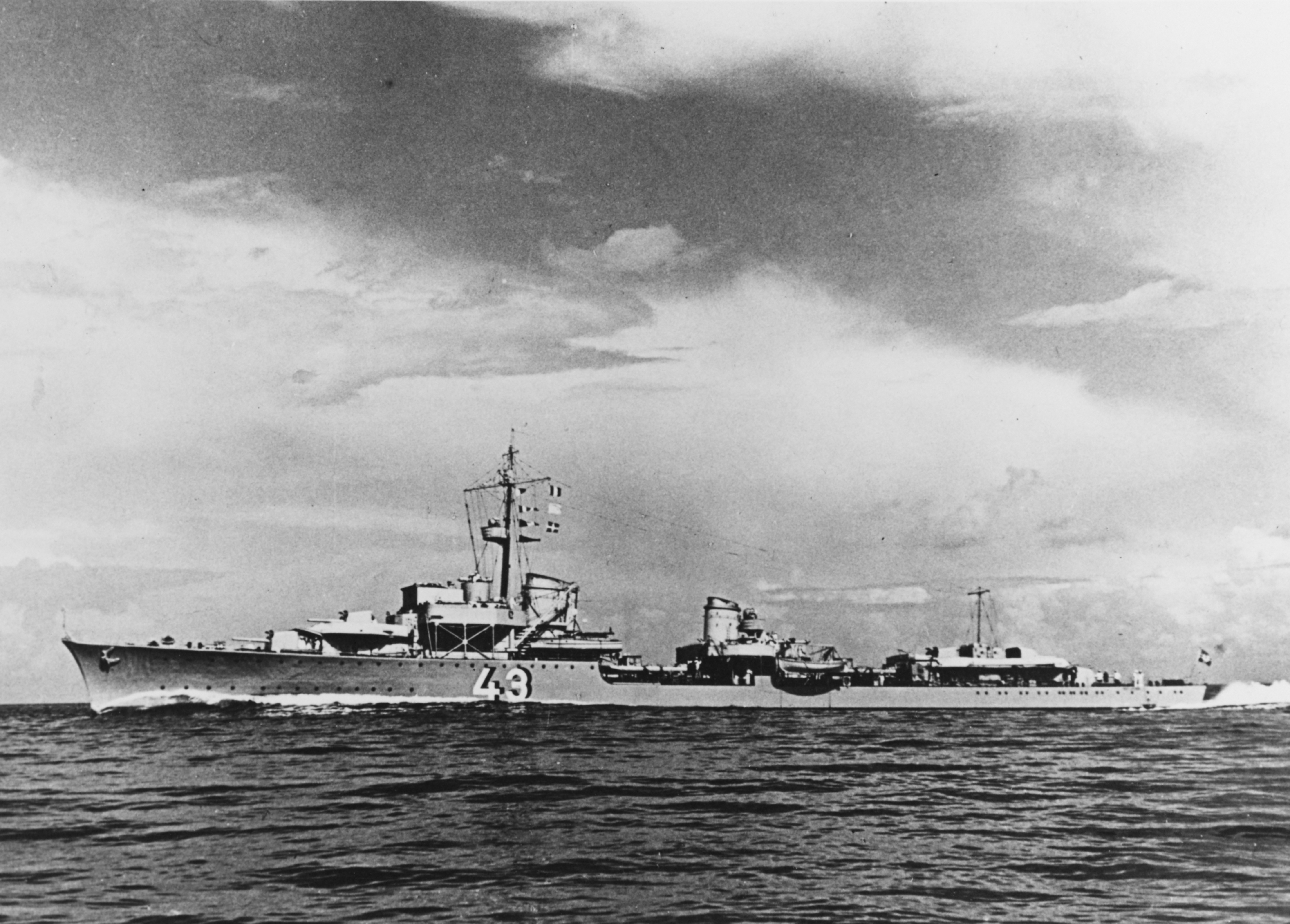
German destroyer Z21 Wilhelm Heidkamp
The man the destroyer was named for knew something about sacrifice in the engine spaces. Machinist's Mate Wilhelm Heidkamp had been in charge of the pumps aboard the battlecruiser Seydlitz during the Battle of Dogger Bank on 24 January 1915. When a British shell ignited fires in the aft gun turrets, Heidkamp -- badly burned -- turned the valves to flood the magazines, saving the ship at terrible personal cost. Twenty-four years later, the destroyer bearing his name would meet her own end in a magazine explosion, this time with no one able to reach the valves in time.
Mines in the Thames
Z21 Wilhelm Heidkamp was one of six Type 1936 destroyers built for the Kriegsmarine, completed just months before the war began. She served as a flagship from the start, and her first significant missions were among the war's most insidious: laying magnetic mines in British waters. On the night of 17-18 October 1939, she led a destroyer force that planted a minefield off the River Humber, sinking seven ships before the British even knew the mines were there. A month later, now flagship of the Commander of Destroyers under Captain Friedrich Bonte, she escorted a force that laid 288 magnetic mines in the Thames Estuary. The British lost a destroyer and thirteen merchant ships totaling 48,728 GRT. Less than a week after that, she returned to the Thames Estuary with 180 more mines that claimed another destroyer, a fishing trawler, and seven merchant ships. These were silent, patient weapons -- each field a delayed-action ambush that could kill weeks after the German destroyers had returned to port.
Hunting in the North Sea
Between minelaying operations, Z21 Wilhelm Heidkamp participated in fleet sorties that hinted at the Kriegsmarine's broader ambitions. In February 1940, she escorted the battleships Scharnhorst and Gneisenau and the heavy cruiser Admiral Hipper during Operation Nordmark, a sweep of the North Sea as far north as the Shetland Islands. The operation was launched in retaliation for the Altmark Incident, in which the Royal Navy had boarded the German tanker Altmark in neutral Norwegian waters to free captured British sailors. No enemy ships were found, but the sortie demonstrated that the Kriegsmarine could project force well beyond the confined waters of the North Sea and Baltic.
Operation Weserübung
On 6 April 1940, Z21 Wilhelm Heidkamp sailed from Bremerhaven as flagship of Group 1, ten destroyers carrying the 139th Mountain Regiment and the headquarters of the 3rd Mountain Division to seize Narvik. When the old Norwegian coastal defense ship Eidsvold refused to surrender on 9 April, Z21 Wilhelm Heidkamp torpedoed her. Two torpedoes struck before Eidsvold's guns could fire, detonating her magazine and killing 175 of her 183 crew in seconds. It was efficient and devastating -- and it haunted the Norwegians for the rest of the war. After landing her troops, Z21 Wilhelm Heidkamp refueled from the tanker Jan Wellem. Commodore Bonte wanted to patrol the fjord overnight, but General Dietl, the army commander, asked the flagship to remain in harbour to maintain communications. Bonte agreed. It was a decision that would cost him his life.
A Torpedo at Dawn
Shortly after dawn on 10 April, Z21 Wilhelm Heidkamp was moored behind the tanker Jan Wellem in Narvik harbour when five British destroyers of the 2nd Destroyer Flotilla appeared out of a snowstorm. HMS Hardy fired first. A torpedo from her opening salvo struck Z21 Wilhelm Heidkamp's stern and detonated the aft magazine. The explosion was catastrophic -- it threw the ship's aft guns into the air and killed 81 men, including Commodore Bonte. The blast tore away the stern, plunging it below water, but the forward section remained afloat. Lieutenant Commander Hans Erdmenger, the ship's captain, managed to moor the stricken vessel to a nearby Swedish freighter, keeping her from sinking immediately. Before Z21 Wilhelm Heidkamp capsized the following day, her crew transferred her remaining torpedoes to the surviving German destroyers -- weapons that would be desperately needed in the days ahead.
Sailors Turned Soldiers
Z21 Wilhelm Heidkamp's survivors joined the crews of the other destroyed German warships in an improvised unit that fought alongside the mountain troops during the two-month land battle for Narvik. These were sailors, not infantry, unsuited to combat in the steep, snow-covered mountains above the fjords. But there was no alternative. They manned the 10.5cm anti-aircraft guns and light weapons salvaged from the wrecked ships and conducted defensive operations as Norwegian, French, British, and Polish forces pressed in from three directions. The wreck of Z21 Wilhelm Heidkamp eventually settled in 12 meters of water near Narvik. She was among three German destroyers raised in 1964 and moved to Framnesodden to clear the shipping lane. Today her remains rest on the seabed where divers can visit them -- a steel tomb for the 81 men who died when a single torpedo found the magazine.
From the Air
Z21 Wilhelm Heidkamp was sunk in Narvik harbour at approximately 68.42°N, 17.40°E. The wreck was later moved to Framnesodden, near the harbour entrance, where it rests in 12 meters of water. Narvik sits at the head of the Ofotfjord, which is clearly visible from altitude. Fly at 2,000-5,000 feet for good views of the harbour and fjord. Nearest airport is Harstad/Narvik Airport, Evenes (ENEV), approximately 60 km west. The harbour area where the First Battle of Narvik took place is compact and easily viewed from overhead. Weather is frequently overcast.