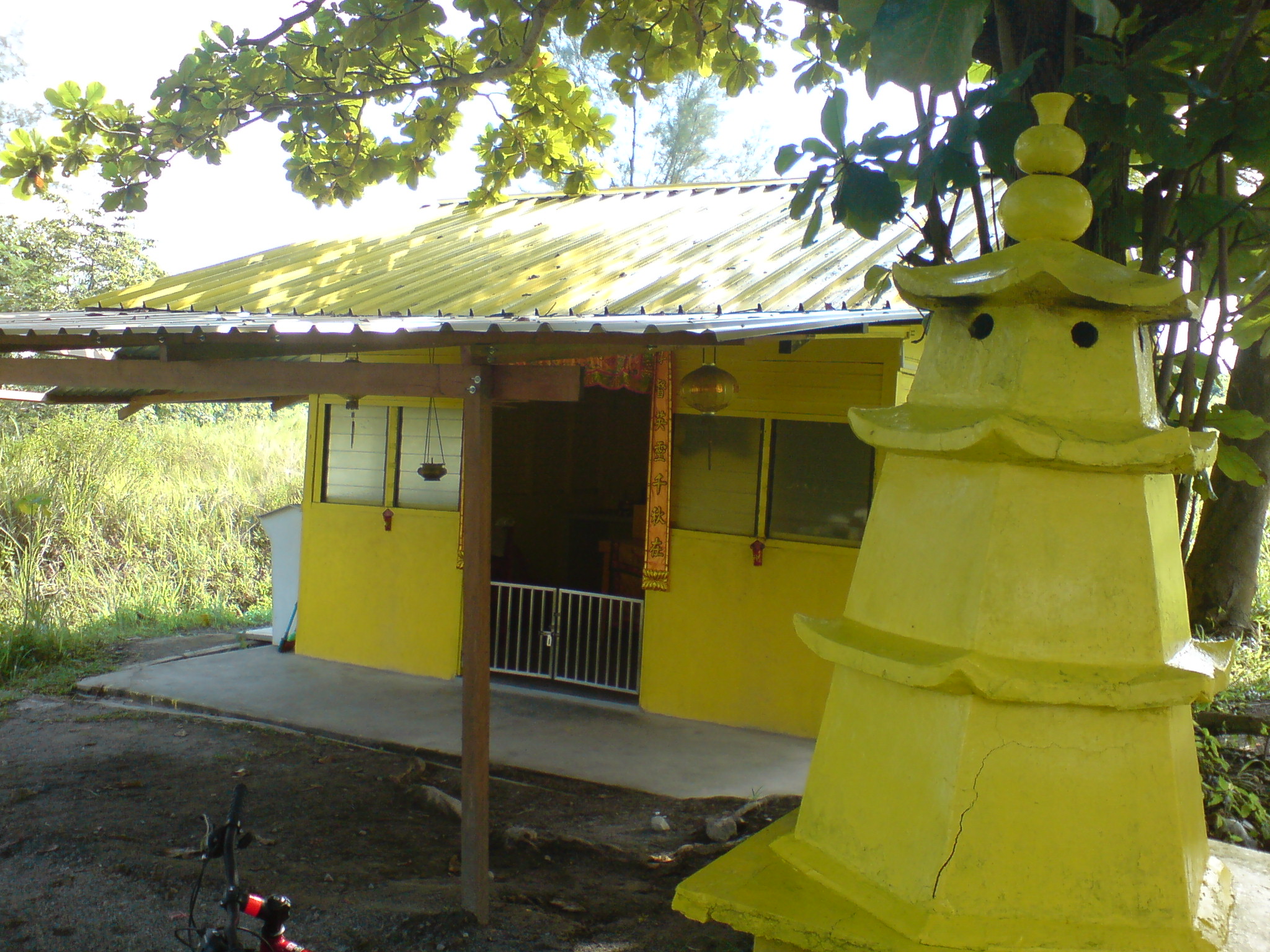
German Girl Shrine
Nobody knows her name. She was eighteen years old, German, Roman Catholic, and she died on Pulau Ubin in 1914 after falling from a cliff while fleeing British soldiers who had come to round up enemy nationals at the outbreak of World War I. Boyanese plantation workers found her body first, covered it with sand, and offered prayers; Chinese quarry workers later moved her remains into an urn, added a crucifix and coins, and built a makeshift shrine on the hillside. More than a century later, visitors still climb the trail to that spot, now a small yellow structure resembling a Chinese temple, where they leave offerings of nail polish, perfume, and Barbie dolls for the spirit of a girl whose story has become one of Singapore's most enduring folk legends.
Coffee Plantations and a World War
In the 1910s, Pulau Ubin was a granite island off Singapore's northeastern coast, home to quarrying operations and a handful of farming families. Among them were two German families, the Brandts and the Muhlingans, who ran coffee plantations. When Britain declared war on Germany in August 1914, colonial authorities in Singapore moved to detain German nationals across the Crown Colony. On Pulau Ubin, British soldiers arrived to arrest the island's German residents. The teenage girl, whose family connection to the Brandts or Muhlingans remains uncertain, fled into the forested hills rather than submit to detention. She fell from a cliff and died. Whether it was an accident or a deliberate act of desperation, nobody recorded. The workers who found her gave her the only burial they could manage.
From Grave to Shrine
The makeshift urn and its rough shelter stood on the hillside for decades as the quarries around it blasted granite from the island's bedrock. Word spread that the spirit of the German girl brought luck, particularly to gamblers. People began visiting the site to pray and leave offerings before heading to the betting shops. In 1974, a quarrying company constructed a more permanent structure over the grave: a small yellow building in the style of a Chinese temple. It is believed the girl's remains were exhumed at this time and placed in a new urn within the shrine. A German Catholic teenager, buried by Chinese workers, now venerated in a Chinese-style temple by Singaporean gamblers. The layers of cultural exchange are as improbable as the story itself.
An Island Emptied
Quarrying defined Pulau Ubin for most of the twentieth century, but the industry declined through the 1970s and 1980s. The last quarry closed in 1999. The island's population, once around 2,000, dwindled to fewer than 100 residents. Where blasting once shook the hillsides, nature reclaimed the abandoned pits. Pulau Ubin became something rare in hyper-developed Singapore: a place that felt wild. Forests grew back. Wildlife returned. The Singapore government designated much of the island as a nature area, and Ketam Mountain Bike Park was established on trails that wound past the old quarry sites. The German Girl Shrine, once surrounded by industrial activity, now sits within the bike park, reachable by a short hike through secondary forest.
Barbie Dolls and Shifting Stories
The shrine's offerings tell their own story. Where earlier visitors left incense and joss paper, modern pilgrims bring items they think a young woman would appreciate: lipstick, eye shadow, bottles of perfume, and rows of Barbie dolls still in their packaging. The effect is startling: a dim interior lined with plastic dolls and cosmetics, all addressed to a girl who died before such things existed. Researcher William Gibson, investigating the shrine's history, discovered something unexpected. The earliest known photograph of the structure appeared in a 1985 article in the Malay newspaper Berita Minggu, which described it not as the grave of a German girl but as the burial site of a Javanese princess. The German girl narrative only appeared in media in 1987, from interviews with longtime islander Chia Yeng Keng. Which story came first, or whether both contain fragments of truth, remains unclear.
The Pull of an Unknown Girl
Books have spread the legend further. Chua Ee Kiam's Pulau Ubin: Ours to Treasure in 2000, Jonathan Lim's Between Gods and Ghosts in 2005, and Neil Humphreys' Final Notes from a Great Island in 2006 all feature the shrine. Singapore's National Heritage Board includes it on the Pulau Ubin Heritage Trail. What draws people here is hard to pin down. Perhaps it is the strangeness of the cultural collision: a European death mourned in a Chinese folk tradition on a Malay island. Perhaps it is the anonymity. She has no name, no photograph, no confirmed family. She exists entirely as a story others have built around her, layer by layer, for more than a hundred years. The shrine endures because the mystery endures, and because people keep climbing the hill with offerings for a girl they will never know.
From the Air
Located at 1.41N, 103.95E on Pulau Ubin, a small island off the northeastern coast of Singapore accessible only by bumboat from Changi Point. The island is roughly 10 km long and 2 km wide, covered in secondary forest with visible abandoned quarry pits. The shrine sits within Ketam Mountain Bike Park on the island's interior hills. Singapore Changi Airport (WSSS) is approximately 5 km to the southwest across the strait. Seletar Airport (WSSL) is about 8 km to the west. Best viewed at 1,500-3,000 ft AGL. Pulau Ubin's green forested profile contrasts sharply with Singapore's urban mainland visible to the south.