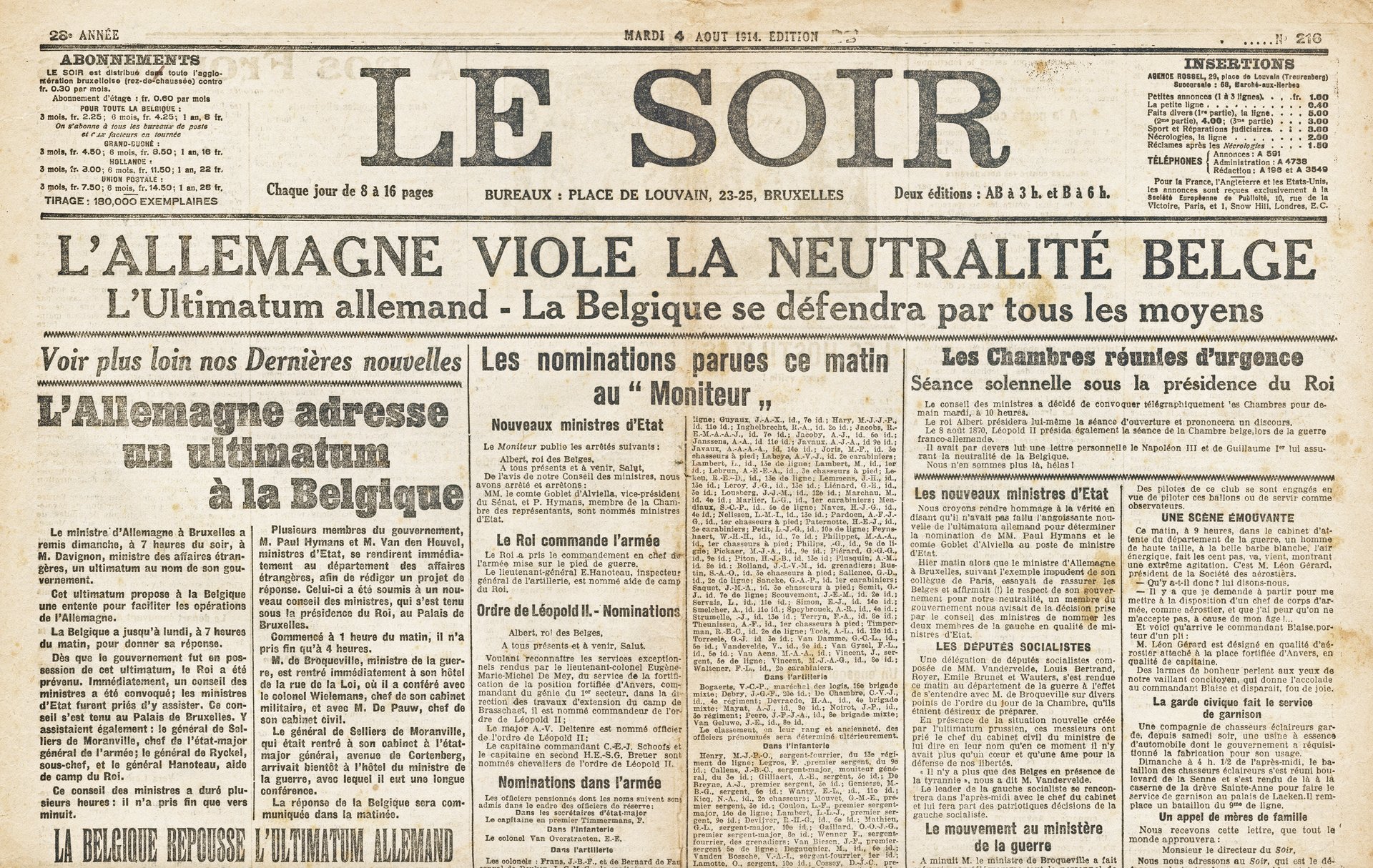
German Invasion of Belgium (1914)
The ultimatum arrived in Brussels on August 2, 1914, with twelve hours to reply. Germany demanded passage through Belgium for an army of more than a million men, promising compensation if the country complied and devastation if it refused. King Albert and his cabinet met through the night. Belgium had been neutral by treaty since 1839, guaranteed by all the great powers - including Germany. The army had perhaps 117,000 trained soldiers against a force ten times larger. The rational answer was yes. They said no. "A small country has rights as well as a great country," Albert told the German envoy. On the morning of August 4, German troops crossed the frontier and marched on Liege. The British declared war that night, citing the violation of Belgian neutrality. The Belgian refusal had not stopped the German army - nothing could have - but it had pulled the British Empire into the war and put a name to what was happening on a small country's soil.
Liege Holds
Liege was supposed to fall in two days. It was the eastern hinge of Belgium's defenses, a ring of twelve modern forts encircling a city the German staff had planned to take by coup de main before the bulk of the invasion army arrived. The forts held for eleven days. General Gerard Leman commanded the defense, and when the Germans finally brought up their 420mm Big Bertha siege guns - shells the size of small cars, fired in arcs that turned reinforced concrete into rubble - the forts collapsed one after another. Leman was found unconscious in the wreckage of Fort Loncin, pinned beneath fallen masonry, and taken prisoner. The Schlieffen Plan depended on speed. The Liege delay was small in the grand calculation - perhaps four days, perhaps less - but it was the first indication that the war the German general staff had planned was not the war it was going to fight.
The Rape of Belgium
What happened next was deliberate policy. The German army, anxious about delays and obsessed with the specter of francs-tireurs - civilian snipers, a paranoid legacy of the Franco-Prussian War - adopted what its commanders called schrecklichkeit, frightfulness. The goal was to terrorize Belgian civilians into compliance. The reality was a string of massacres along the line of march. At Tamines on August 22, German troops shot 383 civilians against a church wall. At Dinant on August 23, more than 670 men, women, and children were rounded up in the town square and killed; the youngest victim was a three-week-old infant in his mother's arms. Andenne was burned and 262 of its people executed. At Aarschot, the burgomaster and his teenage son were among 156 shot on the orders of a German officer who believed - wrongly - that civilians had fired on his troops. In total, German forces killed roughly 6,500 Belgian civilians between August and October of 1914. The dead were ordinary people: shopkeepers, schoolchildren, farmers, priests. Their names fill memorials in towns most outsiders have never heard of.
Louvain Burns
On the night of August 25, German troops in Leuven - Louvain in French - panicked when a Belgian sortie from Antwerp drove back their forward outposts. A horse running loose in the dark triggered shooting among the sentries, and the German command convinced itself that civilians were responsible. The reprisal lasted five days. The city was systematically burned, block by block, by soldiers carrying incendiary pellets. The university library - part of the institution founded in 1425 as the oldest university in the Low Countries - held some 300,000 books and a thousand medieval manuscripts. It was set on fire and lost entirely. Two hundred and forty-eight residents of Louvain were killed; the surviving population was expelled at gunpoint and forced to march to the train station while their homes burned behind them. The destruction of the library was widely reported in the international press. For neutral countries still deciding what to make of the war, Louvain became a symbol that the rules had changed. American newspapers ran the story for weeks. The destruction was not collateral damage. It was a message.
The Yser Line
By October, the Belgian army had been pushed across nearly the entire country. Antwerp - the National Redoubt, the last fortified position - fell on October 9 after super-heavy German artillery destroyed its outer ring of forts. The Belgian field army escaped westward along a thin corridor next to the Dutch border, retreating to the last unconquered strip of national territory: a wedge of polders behind the Yser river, between Nieuwpoort and Diksmuide. King Albert ordered them to make their stand there. They were exhausted and short of artillery ammunition; the water table was so high that trenches filled instantly. On October 25, with German troops crossing the river in force, the Belgian command made a desperate calculation. They opened the sluice gates at Nieuwpoort and let in the sea. Salt water flooded the land between the river and the rail embankment, drowning the German advance and creating a barrier of marsh and mud that would not be crossed for the next four years. Belgium had lost almost everything - but it had not surrendered.
What Remained
The occupation that followed lasted until November 1918. A German military government ran the country through the existing Belgian administrative system; food shortages led to American-led relief efforts directed by Herbert Hoover. The 1914 atrocities became central to Allied propaganda - and after the war, some accounts were dismissed as exaggeration. But the work of historians like John Horne and Alan Kramer, drawing on German military records, eventually established that the killings had been real, systematic, and ordered. Six thousand civilians dead is not a story of two armies; it is the story of thousands of individual deaths in town squares and gardens and cellars across a country that simply happened to lie between Germany and France. The Belgian decision in August 1914 - to refuse, to fight, to flood the land rather than yield it - did not save the people who would die in those five months. It saved something else, something harder to name. The thin strip of unconquered ground behind the Yser, held for four years by a refugee government and an army that had lost almost everything, was the proof that a small country had meant what it said.
From the Air
The 1914 invasion swept across the entire eastern half of Belgium. Key sites visible from cruising altitude include Liege (the first major battle, easily picked out by the Meuse river bend), Louvain/Leuven east of Brussels (the burned city), Dinant on the Meuse, and the Yser front along the North Sea coast between Nieuwpoort and Diksmuide. From 35,000 feet on a clear day, the entire 1914 battlefield fits within a single window view. Brussels Airport (EBBR) sits roughly in the center of the campaign area; Liege Airport (EBLG) lies near the opening battles; Ostend-Bruges Airport (EBOS) is just north of the Yser line. The flooded plain behind the Yser is now drained farmland, but the river itself and the elevated rail embankment that anchored the Belgian last stand are still visible.