German South West Africa
Adolf Luderitz was a Bremen merchant with a scheme. In 1882, he asked Chancellor Otto von Bismarck for protection over a trading station he planned to build on the desolate southwestern coast of Africa. His employee, Heinrich Vogelsang, purchased land from a local chief, and by August 7, 1884, the German flag flew over what Bismarck's government would call Deutsch-Sudwestafrika. It was Germany's first colonial foothold in Africa, and it would become the site of the twentieth century's first genocide.
Missionaries, Merchants, and the Flag
European contact with the region began centuries before German claims. Portuguese explorer Diogo Cao landed at Cape Cross in 1486. The London Missionary Society established a small mission in 1805, then transferred operations to the German Rhenish Missionary Society in 1840. Missionaries Franz Heinrich Kleinschmidt and Carl Hugo Hahn arrived in 1842 and began founding churches throughout the territory. Their impact on Ovambo, Herero, and Nama culture was profound -- and complicated. They brought literacy and Christianity, but also the cultural assumptions of European superiority that would later underwrite colonial rule. Meanwhile, merchants and farmers were establishing outposts, and in 1885, the Deutsche Kolonialgesellschaft fur Sudwest-Afrika received monopoly rights to exploit the territory's mineral deposits. Private capital, not public money, would develop the colony -- Bismarck's preference.
The Catastrophe of 1904
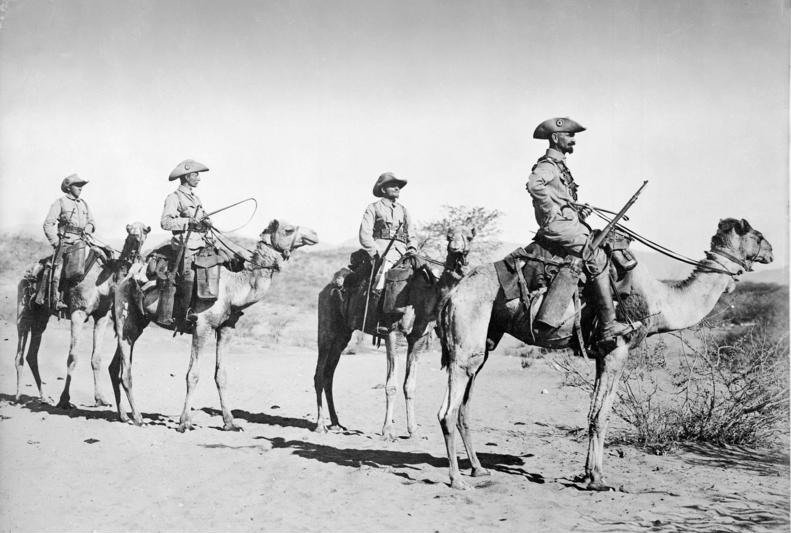
Relations between German settlers and the indigenous Herero and Nama peoples deteriorated through the 1890s, punctuated by uprisings and punitive expeditions. The Germans seized property under European legal frameworks that had no legitimacy in traditional systems of communal ownership. When the Herero rose in rebellion in January 1904, they attacked remote farms and killed approximately 150 German settlers. The colonial Schutztruppe of just 766 troops was initially overwhelmed. Germany dispatched 14,000 reinforcements under Lieutenant General Lothar von Trotha, who issued an extermination order: the Herero were denied the right of being German subjects and ordered to leave the country or be killed. After the Battle of Waterberg, the defeated Herero fled into the waterless Omaheke Desert. German forces guarded every water source and shot Herero men on sight. Thousands died of thirst. Between 25,000 and 100,000 Herero and more than 10,000 Nama perished. Survivors were interned in concentration camps and used as forced laborers in mines and on railways.
Colony to Mandate
World War I ended German control. News of the war reached Windhoek by radio telegraphy on August 2, 1914, relayed through stations in Togoland. South African troops attacked on September 13, and by July 9, 1915, the last German commander, Victor Franke, surrendered near Khorab. The territory became a League of Nations mandate under South African administration -- which imposed its own system of racial oppression. Apartheid policies followed naturally from the colonial infrastructure the Germans had built: the pass laws, the forced labor, the racial segregation. South West Africa remained under South African control through decades of Cold War conflict and the Angolan civil war before finally achieving independence as Namibia on March 21, 1990, governed by the liberation movement SWAPO.
German Ghosts
The German colonial period lasted only thirty-one years, but its traces remain visible across Namibia. About 30,000 people of German descent still live in the country. The Namibian Broadcasting Corporation operates a German-language radio station and broadcasts television news in German. The daily newspaper Allgemeine Zeitung, founded in 1916, continues publishing. Lutheranism is the predominant Christian denomination. German place names mark the map. Over 2,100 kilometers of railways built by the Germans -- using forced Herero and Nama labor -- still form the backbone of the Trans-Namib network. In May 2021, after five years of negotiations, Germany formally recognized the genocide and established a 1.1 billion euro compensation fund. The recognition came 117 years after von Trotha's extermination order, a delay that tells its own story about how long it can take for imperial powers to reckon with what they have done.
From the Air
German South West Africa encompassed the territory of present-day Namibia, centered roughly at 22.00S, 17.00E. Windhoek, the capital, is served by Hosea Kutako International Airport (FYWH). Key historical sites visible from altitude include Waterberg Plateau (Battle of Waterberg, 1904) to the northeast, the coastal town of Luderitz (FYLZ) where German colonization began, and Swakopmund along the Skeleton Coast. The Caprivi Strip extends northeast as a narrow panhandle -- acquired through the 1890 Heligoland-Zanzibar Treaty. The landscape transitions from the Namib Desert in the west through central highlands to the Kalahari in the east.