German submarine U-179
The patrol lasted exactly one month. On September 8, 1942, German submarine U-179 slipped out of Kiel harbor and headed north into the Atlantic, passing between Iceland and the Faroe Islands before turning south for the long run to Cape Town. She carried sixty-one men, twenty-four torpedoes, and enough fuel to cover nearly 13,000 nautical miles on the surface. On October 8, she made her first and only kill. Hours later, British depth charges sent her to the bottom. None of her crew survived.
Built for Distance
U-179 was a Type IXD2, the largest and longest-ranged U-boat class in the Kriegsmarine's arsenal. At nearly 88 meters long with a surface displacement of 1,610 tonnes, she was considerably bigger than the Type VII boats that hunted in the North Atlantic wolf packs. Her design reflected a different mission: solo raiding in distant waters where Allied defenses were thinner and targets less prepared. Four diesel engines, two MAN supercharged nine-cylinders for combat speed and two MWM six-cylinders for economical cruising, gave her a surface range of 12,750 nautical miles at 10 knots. Submerged, she could manage 121 nautical miles at 2 knots on her Siemens-Schuckert electric motors. She was ordered on May 28, 1940, laid down at the DeSchiMAG AG Weser yard in Bremen in January 1941, and commissioned on March 7, 1942, under Korvettenkapitan Ernst Sobe.
South to the Cape
By late 1942, the German navy was extending its submarine campaign into the Indian Ocean and the waters around southern Africa, where shipping lanes were less heavily patrolled than in the North Atlantic. U-179's route from Kiel took her through the GIUK Gap, the stretch of open ocean between Greenland, Iceland, and the United Kingdom that every Atlantic-bound U-boat had to transit. Once past that gauntlet, she turned south along the African coast, threading through waters where the Allies had fewer escort vessels and less effective air cover. The voyage itself was an endurance test: weeks of diesel-driven surface running through increasingly warm seas, watchstanders scanning for aircraft, the crew settling into the monotony that made sudden violence all the more jarring.
One Kill, One Hour
On October 8, 1942, U-179 found a target west-southwest of Cape Town: an unescorted merchant vessel. Sobe attacked and sank her, his boat's only confirmed kill. Of the merchant ship's ninety-nine crewmen, all but one survived the sinking. The survivors even managed to rescue a cat from the wreckage, a detail that survives in the record as a small act of humanity amid industrial-scale destruction. But the attack had revealed U-179's position. Within hours, a British destroyer closed on the submarine and attacked with depth charges. The explosions ruptured the pressure hull at a depth from which there was no recovery. U-179 sank with all sixty-one men aboard. She had been on her first war patrol, had fired her weapons once, and was gone.
A Memorial in Kiel
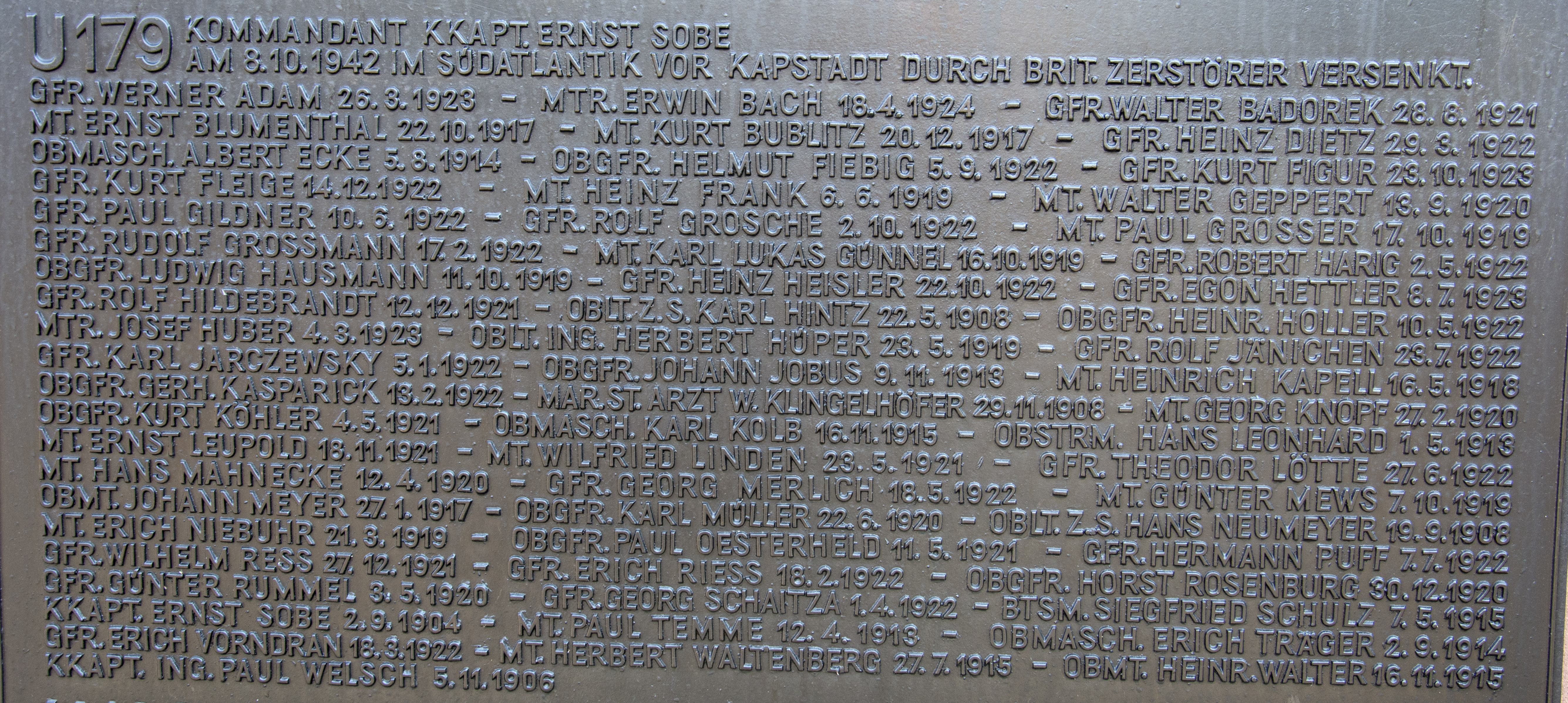
U-179 lies somewhere on the seabed west-southwest of Cape Town, her exact position known only approximately. The sixty-one men who died aboard her are commemorated at the U-Boat Memorial in Kiel, where a plaque bears the submarine's designation alongside thousands of other German submariners who did not return. The memorial does not distinguish between those who served willingly and those who had little choice, between conviction and conscription. What remains is a set of facts: a ship built in Bremen, a crew assembled in the Baltic, a voyage of thousands of miles through contested waters, and a final engagement that lasted less time than it takes to describe. The waters off Cape Town claimed many ships during the war. U-179 was unusual only in how briefly she operated before joining them.
From the Air
Wreck site located approximately at 33.47S, 17.08E, west-southwest of Cape Town, South Africa. Cape Town International Airport (FACT) is the nearest major airport, approximately 60 km to the east. The wreck lies in deep Atlantic waters off the Western Cape coast. Table Mountain and the Cape Peninsula are prominent visual landmarks to the east. The shipping lanes around the Cape of Good Hope pass over or near the wreck site. Best context at 5,000-10,000 ft AGL when flying the coastal route south of Cape Town.