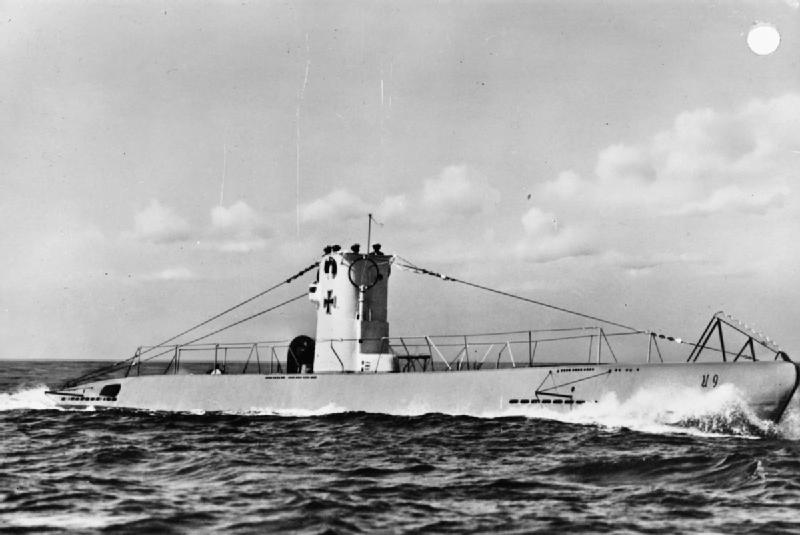
German submarine U-8 (1935)
On 5 May 1945, in the Raeder Lock at Wilhelmshaven, U-8's crew opened the seacocks and let the Atlantic come in. The boat settled onto the bottom of her own berth and stayed there. Across northern German harbors that same week, some 230 other U-boats were going down the same way - Operation Regenbogen, the Kriegsmarine's last act before surrender. U-8 had never sunk a ship. She had launched no torpedoes in anger. For her entire 10-year career she had been a school - a steel classroom in which thousands of future U-boat crewmen learned the trade that would kill thirty thousand of them.
A Boat the Treaty Forbade
Germany was not allowed to have submarines. The Treaty of Versailles, signed in 1919, was specific about that. U-8 was ordered anyway, on 20 July 1934 - a deliberate violation, undertaken with the quiet confidence that no one was going to stop it. By the time her keel was laid in March 1935, the Anglo-German Naval Agreement was nearly final; within weeks of her launch on 16 July 1935, that treaty would grant Germany parity with the British Empire in submarines. The clandestine became official. U-8 entered the world as proof that the post-Versailles order had already failed.
A Small Boat for a Small War, Once
Type IIB boats were nicknamed *Einbäume* - dugout canoes - and the joke had some truth in it. U-8 was 42.7 meters long, displaced 279 tonnes on the surface, and carried a complement of just twenty-five men. She had three torpedo tubes at the bow, five torpedoes or twelve mines, and a single 2 cm anti-aircraft gun. Two diesel engines pushed her to 12 knots surfaced; electric motors gave her 7 knots submerged. She could dive to about 80 meters - shallow by later wartime standards. By 1939 she and her sisters were too small and too short-ranged for the Atlantic battle Karl Dönitz wanted to fight. So the Kriegsmarine turned them into teachers.
Eighteen Captains, Ten Years of Students
Commissioned on 5 August 1935 with Kapitänleutnant Harald Grosse in command, U-8 spent her entire career as a training boat - first with the U-boat school at Neustadt, later moving between flotillas as the Reich's submarine campaign expanded and then collapsed. Eighteen different captains took her out to sea between 1935 and 1945, the last being Jürgen Kriegshammer. Behind each captain came thousands of trainees: helmsmen, hydrophone operators, torpedomen, junior officers learning how to dive a boat without killing the people inside it. The Atlantic U-boats that prowled the convoy routes were crewed by men who had first felt water close over their heads aboard small boats like this one.
The Last Order
By spring 1945 the war was over in everything but name. Dönitz, now Hitler's successor for a few strange days, gave the order known as *Regenbogen* - rainbow - on 30 April, intending that no German U-boat fall into Allied hands intact. When the Wehrmacht's general surrender took effect on 8 May, the scuttlings continued anyway. U-8 went down in the Raeder Lock at Wilhelmshaven on 5 May 1945. The Raeder Lock, named for Grand Admiral Erich Raeder, was one of the most important pieces of harbor infrastructure on the Jade. The boat that had taught the U-boat war how to fight rested on the bottom of the lock that had made the U-boat war possible. She was raised and scrapped after the war, leaving behind only her hull number and the names of the men who had passed through her, learning.
From the Air
U-8's resting place was the Raeder Lock at Wilhelmshaven, on the Jade Bight at roughly 53.52°N, 8.17°E. The lock itself remains a working part of the naval port. Recommended viewing altitude FL040-FL060 for the harbor layout - locks, basins, and the modern naval base. Nearest airport: Wilhelmshaven-Mariensiel (EDWI). The naval harbor is restricted airspace; check NOTAMs.