Geta Railroad Disaster
At 6:50 p.m. on October 1, 1918, a milk cart rattled past a railway embankment near Geta, Sweden. Nothing seemed amiss. Between 6:52 and 6:55, the earth itself gave way. Layers of clay deposited during the Ice Age, saturated by September rains after a dry spring had cracked the ground, slid against ancient surge gravel and collapsed. The railway embankment fell toward Braviken Bay, taking the road below with it and pushing up the seafloor to form a small peninsula. Minutes later, Train 422 from Malmo to Stockholm came around the bend. The worst rail disaster in Swedish history was about to unfold.
The Day the Ground Vanished
The railway line between Aby and Nykoping had opened exactly five years earlier, on October 1, 1913. Engineers had known about the geological fault near Geta and conducted surveys, but the ground's true instability lay hidden. That autumn brought a dangerous sequence: spring drought cracked the soil, September rains saturated it completely. The clay layers supporting the embankment grew heavier while their bearing capacity plummeted. When the collapse came, it happened in minutes. The station guard at Geta Halt first noticed something wrong when telephone wires began vibrating between 6:33 and 6:40. By 6:55, the telegraph lines along the railway had fallen silent.
Into the Abyss
Train 422 had left Malmo at 7:00 that morning, its locomotive switched to F 1200 at Mjolby. Running twelve minutes late, the train departed Aby station at 6:54 p.m. instead of the scheduled 6:44. The timing was fatal. Locomotive F 1200 derailed first, sliding down the embankment to rest on its side on the road below. The six cars between the engine and the dining car were completely destroyed. The dining car stopped at a 45-degree angle on the slope. Only the last two cars remained on the tracks. Engineer Wahlstrom, despite suffering a concussion, dragged himself from the wreckage. He found stoker Carlsson buried under coal in the overturned locomotive.
Fire After the Fall
Embers from the locomotive's boiler ignited the dry wood of the shattered cars. The unreinforced wooden carriages became death traps for passengers who had survived the derailment but remained trapped in the wreckage. Of the approximately 170 people aboard, 42 perished - many burned alive in cars 2039 and 1235, which had smashed into each other during the crash. Forty-one more suffered injuries. Five people were reported missing and never found. Track walker Eriksson's wife had lowered the boom barrier at a nearby railway crossing and was waiting for the train when she thought she heard it stop unexpectedly. Her husband hurried to investigate and, seeing the telegraph poles tilting at odd angles, knew immediately that something catastrophic had occurred.
Lessons Written in Stone
The investigation that followed transformed Swedish engineering. The Royal Railroad Board interviewed survivors while the Geotechnical Commission drilled to bedrock, discovering the remains of a prehistoric landslide directly beneath the derailment site - ancient instability that had increased water flow and weakened the modern embankment. The accident's investigation had a major impact on the development of geotechnics in Sweden as a discipline. The line reopened on December 21, 1918, with the track shifted one meter toward the mountain and the embankment reinforced with rock. A 15 km/h speed limit was imposed at the accident site. In 1923, another landslide struck the same location, this time collapsing only the road.
Survivors and Monuments
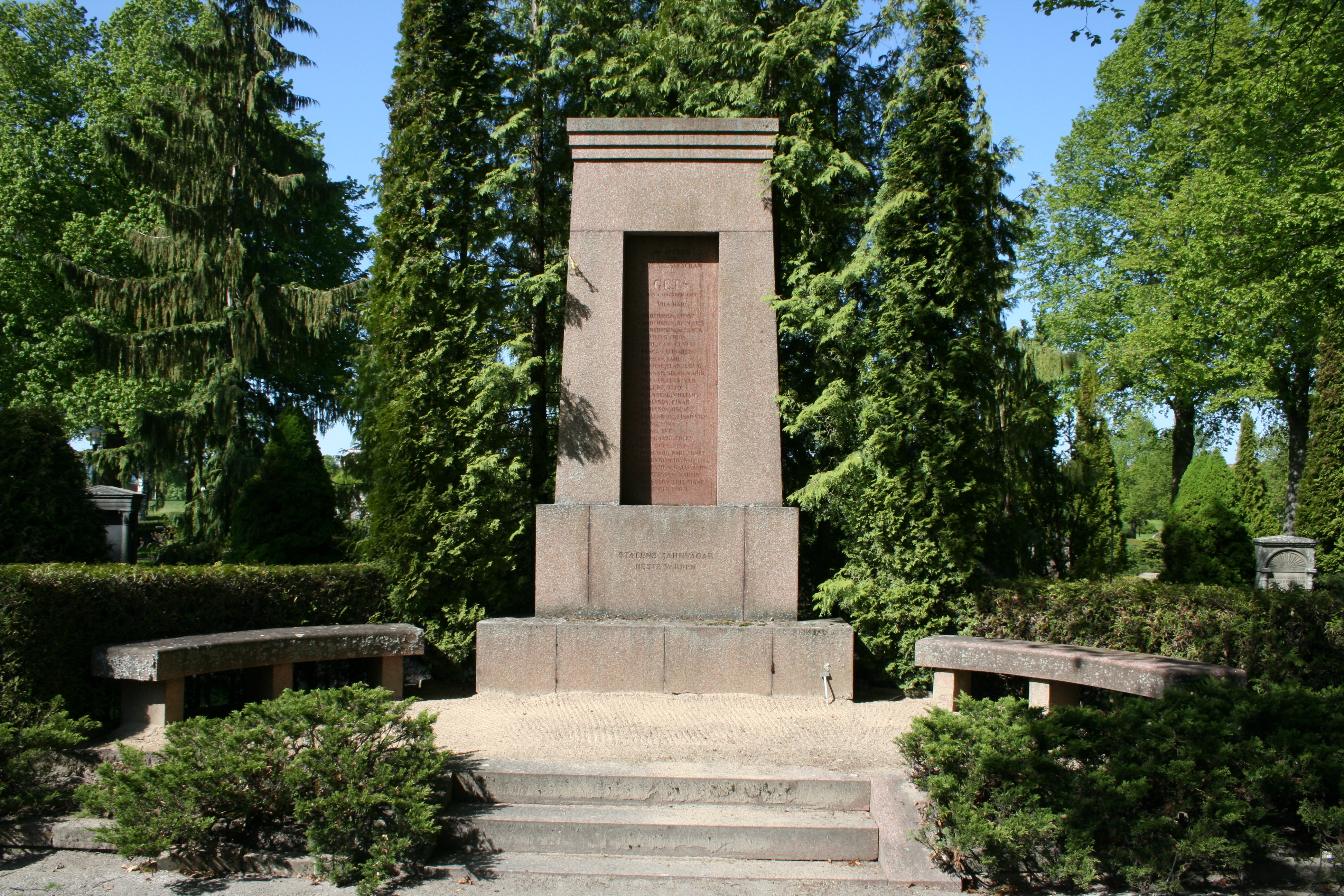
Locomotive F 1200 lay on its side until November 15, 1918. After overhaul, it returned to service and was test-driven on May 21, 1919. The Swedish State Railways operated it until 1937, when it was sold to the Danish State Railways for 30,876 Danish kroner. On April 21, 1943, the engine was hit in an Allied air raid near Korsor, Denmark - surviving two disasters across two countries. It now rests at the Swedish Railway Museum in Gavle. Two monuments mark the tragedy: one along the old road between Aby and Sandviken at the disaster site, another at Norra kyrkogarden cemetery in Norrkoping. A five-meter red granite stone from Graversfors marks the mass grave containing fifteen identified victims and those who could never be named.
From the Air
Located at 58.67N, 16.25E along the shore of Braviken Bay near Geta, now part of Norrkoping Municipality. The railway line and old road run parallel to the bay, with the disaster site between Aby and Krokek stations. The terrain shows the geological complexity that contributed to the disaster - coastal lowlands meeting hillside cuts. Nearby airports include Norrkoping Airport (ESSP) approximately 15 km southwest and Linkoping City Airport (ESSL) 50 km west. The memorial monument at the accident site may be visible from low altitude. Best viewed from 2,000-3,000 feet AGL following the railway line along Braviken Bay's western shore.