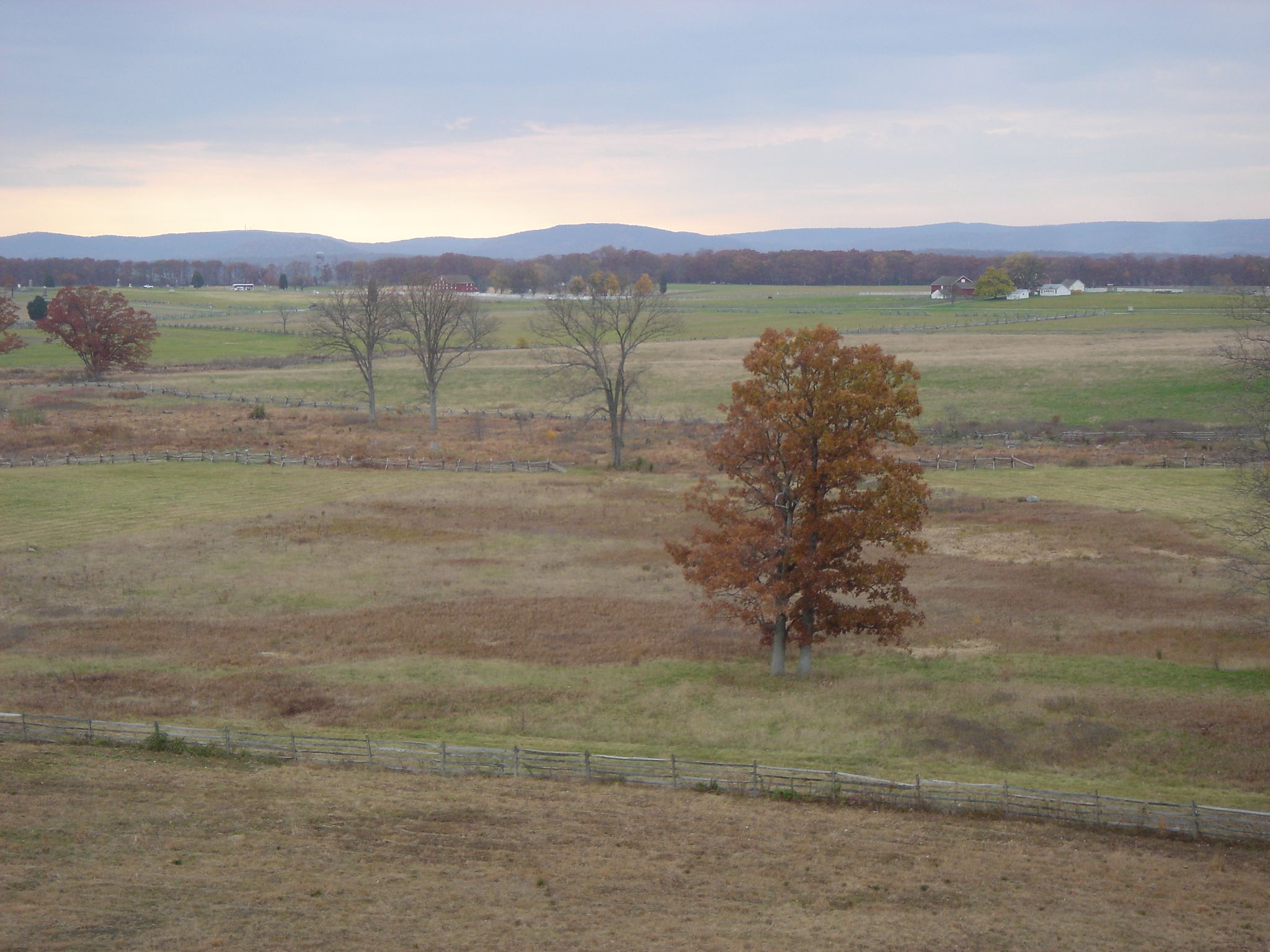
Gettysburg Battlefield
On July 1, 1863, advance elements of Robert E. Lee's Army of Northern Virginia collided with Union cavalry near the small Pennsylvania town of Gettysburg. What began as an encounter battle became the largest and bloodiest engagement of the Civil War - 165,000 soldiers fighting across fields, orchards, and rocky hillsides for three days, leaving over 51,000 casualties. When it ended, Lee's army retreated to Virginia, never again capable of offensive operations in the North. The Confederacy's best chance for victory had passed. Four months later, Abraham Lincoln arrived to dedicate a cemetery for the Union dead and delivered a 272-word speech that redefined the war as a test of whether government 'of the people, by the people, for the people' could endure. Gettysburg became more than a battlefield - it became the place where American democracy was defended and redefined.
Three Days in Hell
The battle unfolded in three distinct phases. On July 1, Confederate forces drove Union defenders through the town onto high ground to the south - Cemetery Hill, Cemetery Ridge, and the rocky summits of Little Round Top and Big Round Top. That night, Union General George Meade concentrated his army on this defensive ground while Lee planned to destroy it. On July 2, Confederate attacks battered both Union flanks: Longstreet's assault nearly captured Little Round Top, saved only by Colonel Joshua Chamberlain's 20th Maine charging with fixed bayonets when their ammunition ran out; Ewell's assault on Cemetery Hill was repulsed. On July 3, Lee ordered a massive frontal assault across a mile of open ground against the Union center. Approximately 12,500 men advanced into artillery and rifle fire. Less than half returned. Pickett's Charge marked the 'high water mark of the Confederacy' - the closest the South came to winning the war.
The Terrible Cost
The casualty figures remain staggering even at historical distance. Union forces suffered approximately 23,000 casualties - killed, wounded, captured, or missing. Confederate casualties exceeded 28,000. The combined dead numbered over 7,500, with thousands more dying of wounds in the weeks that followed. The town of Gettysburg, population 2,400, suddenly found itself responsible for 22,000 wounded soldiers from both armies. Every church, barn, and public building became a hospital. The stench of death hung over the landscape for weeks. When Lincoln arrived in November for the cemetery dedication, bodies were still being exhumed and reburied. Yet the slaughter achieved something: it proved that the Confederacy could not win by invasion, that the war would be decided by attrition that only the industrial North could sustain.
The Gettysburg Address
Lincoln's speech at the cemetery dedication on November 19, 1863, lasted barely two minutes. The main orator, Edward Everett, had spoken for two hours. Yet Lincoln's 272 words became the defining statement of American democracy. He reframed the war not merely as a struggle to preserve the Union but as a test of the revolutionary principle that all men are created equal. 'Four score and seven years ago our fathers brought forth on this continent, a new nation, conceived in Liberty, and dedicated to the proposition that all men are created equal.' The address never mentioned slavery directly, yet its meaning was unmistakable: the war was about whether America would fulfill or betray its founding promise. Lincoln himself thought the speech a failure; the crowd's response was muted. History judged otherwise.
The Battlefield Today
Gettysburg National Military Park preserves over 6,000 acres of the battlefield landscape, including the locations of major actions like Little Round Top, the Peach Orchard, the Wheatfield, and Cemetery Ridge. Over 1,300 monuments, markers, and memorials dot the terrain - more outdoor sculpture than any other location in the world. The Gettysburg Museum and Visitor Center houses the Gettysburg Cyclorama, an 1884 painting depicting Pickett's Charge that stands 42 feet tall and 377 feet in circumference. Licensed battlefield guides offer driving and walking tours that bring the complex three-day action to life. The National Cemetery, where Lincoln spoke, remains an active military cemetery. Each year, around 1.2 million visitors walk these fields where America's future was decided.
Visiting Gettysburg
Gettysburg lies in south-central Pennsylvania, roughly 90 miles north of Washington, DC and 80 miles west of Philadelphia. The battlefield roads cover 26 miles and can be driven in two to three hours, though a full day allows for proper appreciation. The visitor center offers orientation films, exhibits, and the Cyclorama experience. Licensed guides can join your vehicle for detailed battlefield interpretation - highly recommended for first-time visitors. Walking trails explore specific battle sites like Little Round Top, the Wheatfield, and Devil's Den. The town of Gettysburg offers lodging, restaurants, and ghost tours capitalizing on the battlefield's dark history. Summer brings crowds, especially around the July anniversary; spring and fall offer better conditions. The anniversary itself sees large-scale reenactments and commemorations. Come prepared for both the scale of the slaughter and the quiet beauty of Pennsylvania farmland where so many died.
From the Air
Located at 39.83°N, 77.23°W in Adams County, south-central Pennsylvania. The battlefield is visible from altitude as preserved farmland with scattered monuments surrounding the town of Gettysburg. Cemetery Ridge and the Round Tops are visible terrain features. Harrisburg International Airport (MDT) is 47 miles northeast. Baltimore-Washington International Airport (BWI) is 62 miles southeast.