Ghent City Museum
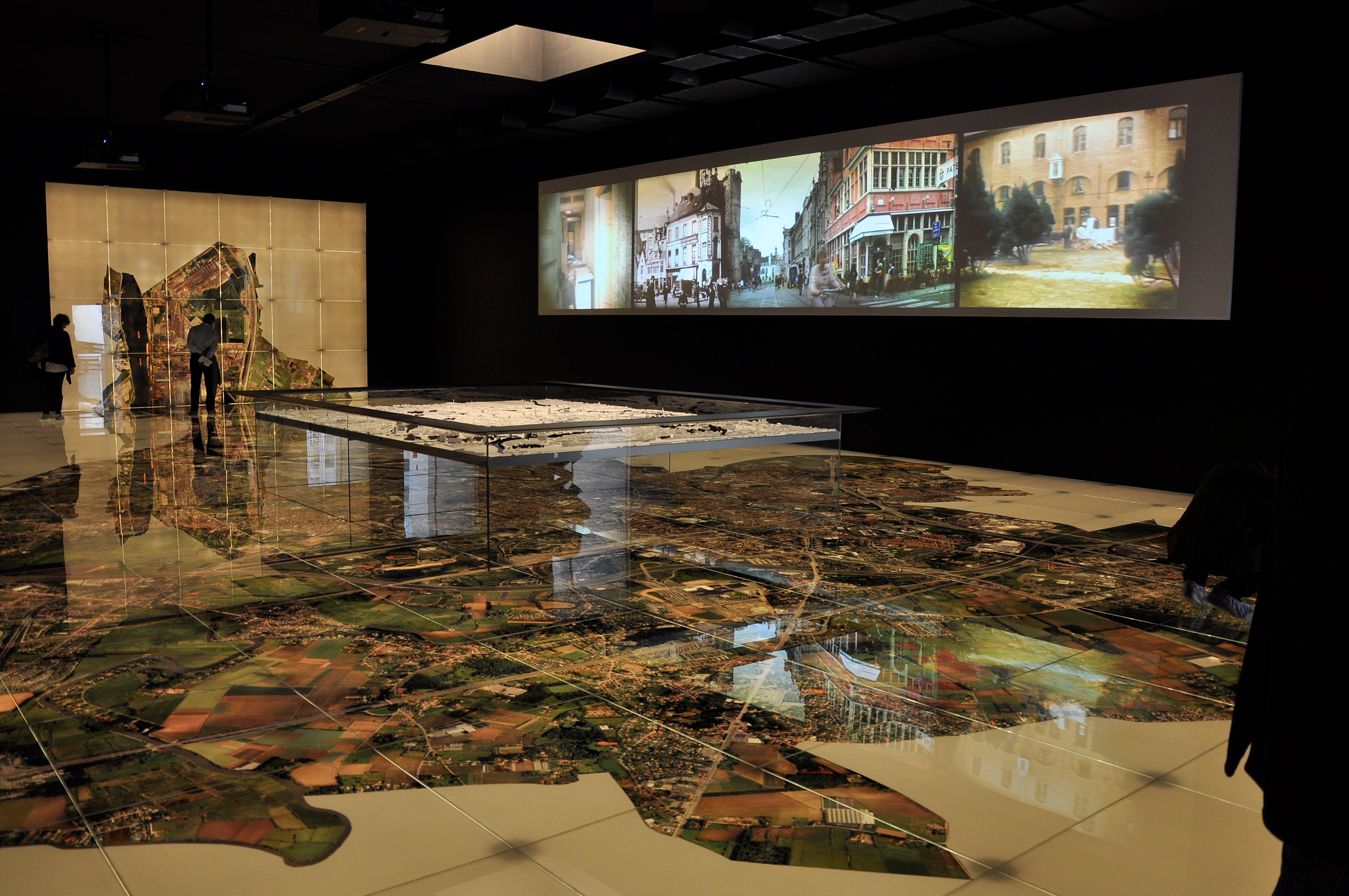
You take off your shoes, you walk onto the floor, and you are looking down at Ghent from somewhere above the cloud cover. The aerial photograph is 300 square meters, large enough to walk across, and detailed enough that you can find your hotel. Visitors stop in the middle of it - which is to say, in the middle of the city - and look down. Children lie on it. People kneel to trace the curve of the Scheldt. The STAM, Ghent's city museum, asks one question of every visitor and asks it without speaking: do you know where you are?
Bijloke, Restated
The building that holds the city museum was once a Cistercian nunnery. The Bijloke abbey, founded in the 13th century, ran a hospital that operated continuously into the 20th century. When the hospital finally moved out, the buildings sat among the most architecturally significant ensembles in Ghent: medieval infirmary, abbey church, refectory, cloister, all weathered into the soft brick and pale stone characteristic of the region. The collection that fills them is older than the museum's current incarnation. The Oudheidkundig Museum van de Bijloke was founded in 1833. It moved into the abbey complex in 1928, taking the building's name. In 2010, after expansion, redesign, and the addition of a new glass entrance pavilion by Ghent's city architect Koen Van Nieuwenhuyse, the institution reopened as the STAM - Stadsmuseum Gent. Two years later it won the Flemish Museum Prize.
Three Hundred Objects, One City
Walk across the aerial photo and continue into the medieval infirmary, and the city tells its story through three hundred objects - one for each chapter, more or less. A charter from Louis the Pious confirming Saint Bavo's Abbey its immunity. The tomb of Hugo II, viscount of Ghent from 1227 to 1232. A 16th-century city view from 1534. A floor plan from 1614, another from 1912. A model of the medieval Gravensteen castle. The curators chose the objects to be specific rather than comprehensive. Instead of showing you everything, they show you certain things very precisely, and let you assemble the city for yourself. The chronology is strict. The interpretation is loose. Between rooms, you cross a glass passerelle hung between the abbey's old buildings, which gives you a view of the cloister garden and a brief reminder that you are walking on top of nine hundred years of layered architecture.
Views On Ghent
One installation, called Views on Ghent, runs four images of the city in parallel on a single multimedia wall: the 1534 city view, the 1614 floor plan, the 1912 plan, and the contemporary aerial photo that you can walk on next door. The four views agree on a surprising amount. The Scheldt and the Leie have not moved. The towers - Saint Nicholas, the Belfry, Saint Bavo's - are visible in every one. The same medieval street grid threads through five centuries. What changes is the periphery. The walls open up. Suburbs ring out. Industry grows along the canal to Terneuzen, then shrinks back. The Gent-Sint-Pieters station appears in 1912, where there was farmland in 1614. The exhibition shows, without telling, the basic insight of urban history: cities are mostly the same and entirely different, at every scale at once.
What Is Not on Display
In 2022, an investigative article in De Standaard pointed out that Belgian museums were still holding artworks that had been looted from Jewish collectors during the Nazi occupation. The Bijloke museum, predecessor of STAM, had purchased a painting by Caspar de Crayer that had been seized from the collector Samuel Hartveld. The painting had since been transferred to the Museum of Fine Arts in Ghent, where it remained. The article's implication was uncomfortable: museums had been the legal end of an illegal chain. Restitution conversations have been continuing across Belgium since then, and STAM is part of a broader museum reckoning with how some of its predecessors' collections were assembled. The story is not displayed inside the exhibition. It is part of the institutional context in which the exhibition is now being read.
Stand In the Right Spot
The genius of the giant aerial photograph is that it does not interpret the city. It simply presents it - in slightly higher than human scale, at slightly more than human resolution, with every brick of the medieval core visible if you crouch. People orient themselves. They find the corner where they got married. They find the apartment they used to rent. A grandmother shows her grandchildren where she lived during the war. The Boekentoren is over there. Saint Bavo's is over there. The neighborhood is so-and-so. The museum has done in a single piece of design what most history museums never manage at all: it has put visitors back into their own city, with a view that is normally reserved for pilots and pigeons. Everything else in the building - and the building is full of beautiful things - is somehow auxiliary. The center of the museum is the floor.
From the Air
Located at 51.044 N, 3.717 E in the Bijloke complex about 1 km south of central Ghent. From the air, the museum reads as a long ensemble of medieval and modern buildings around courtyards, with the Bijloke abbey church distinguishable to the south. Best viewed at 1,500-3,000 ft - the historic three towers of Ghent are visible to the northeast, the Boekentoren to the east. Closest international airport: Brussels (EBBR), 60 km southeast. Wevelgem (EBKT) lies 40 km southwest.