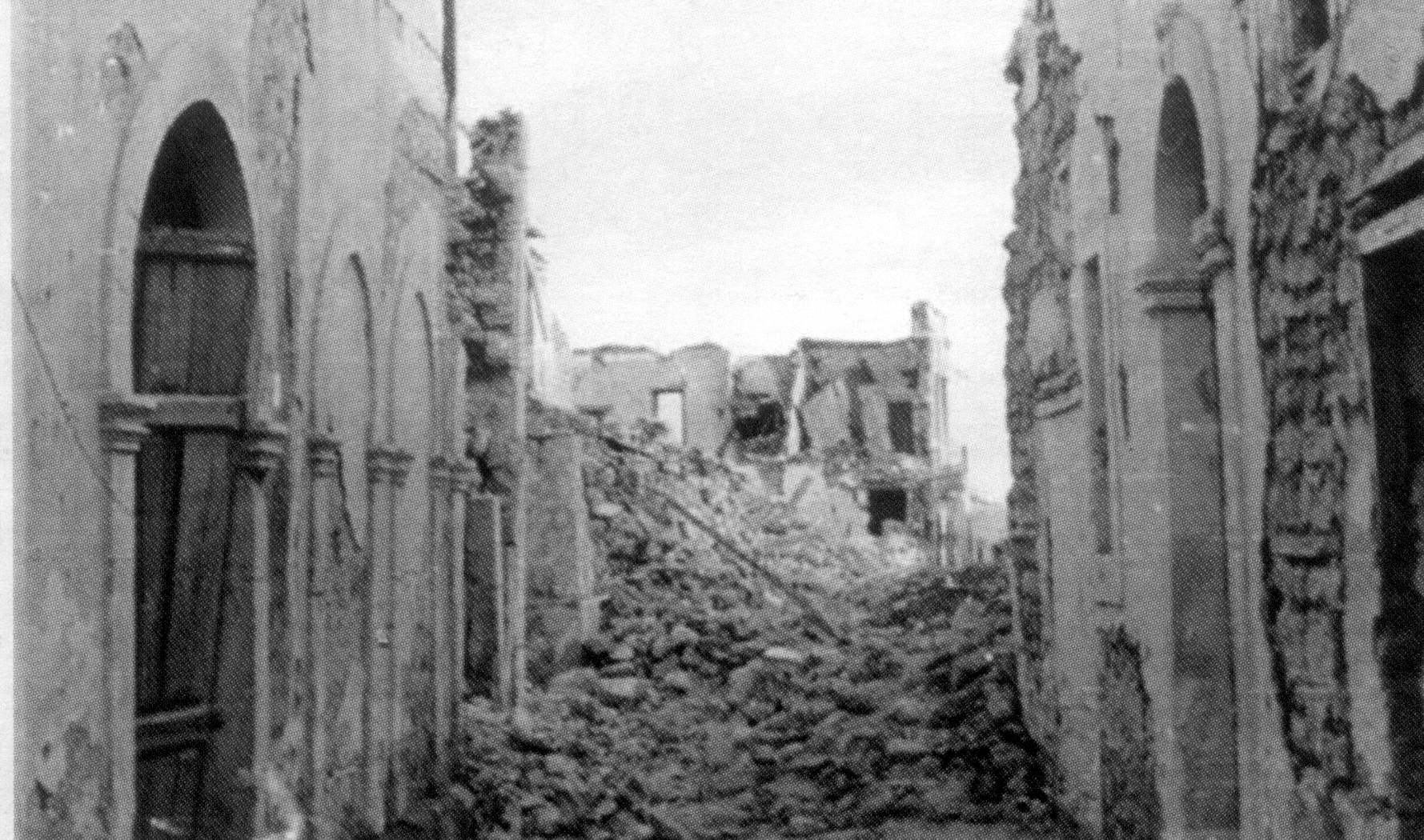
Giado Concentration Camp
Each day, Joseph went to the synagogue to check the list. Each day, his wife Bruria sat at home and cried. Then one day he came back and said, simply: we are going. The journey from Benghazi to Giado took five days across 2,000 kilometers of desert and mountain. Forty people were packed into each truck, guarded by two Italian policemen. Bruria later recalled that they were taken "like animals to the slaughter house." She did not know, at the time, how close that comparison would prove.
A Community Measured in Millennia
Libya's Jewish community traced its roots back thousands of years. In the mountain settlement of Giado, now called Jadu, Jewish families had lived in cave dwellings carved into the Nafusa escarpment since medieval times, with a cemetery dating to at least 1183. During Italian colonial rule from 1911, most Libyan Jews lived in the northern regions of Tripolitania and Cyrenaica. By 1941, Tripoli's population was 25 percent Jewish. Then Mussolini's racial laws arrived. Beginning in 1938, Jews could no longer hold state employment, practice skilled professions, marry non-Jews, or send their children to Italian schools. When Italy entered World War II allied with Nazi Germany, the community that had endured for millennia became a target.
The Lists in the Synagogue
On February 7, 1942, Mussolini ordered the internment of Jews from Cyrenaica and Tripolitania, ostensibly to prevent them from aligning with advancing British forces. A former military post in the Nafusa Mountains, roughly 153 kilometers southwest of Tripoli, was converted into a concentration camp. In Benghazi, Italian authorities demanded that the Jewish community prepare daily quotas of families for deportation. Renato Tesciuba, the community's official representative, refused to compile the list, citing what he called "Levantine disorder." Someone else volunteered. Lists went up in the synagogue each day naming 20 to 30 families. Approximately 2,600 Jews were eventually deported to Giado, with additional groups sent to satellite camps at Gharian, Yefren, and Triginna. The concentration of Libyan Jews at Giado was, according to postwar research, the first stage of a German plan to transfer all of Libya's Jews to European extermination camps.
Hunger, Typhus, and Tolerated Death
No prisoners at Giado were shot or otherwise executed by guards. They did not need to be. Starvation was tolerated by the camp administration, and louse-borne typhus swept through the overcrowded barracks. Of the 2,600 imprisoned, 562 died, giving Giado the highest death toll of any North African labor camp in World War II. Its victims represent the largest number of Jewish deaths during the war in any Muslim country. Initially, the sick were sent back to Tripoli for treatment. As the epidemic worsened, they were simply concentrated in a single barrack. Two Italian doctors and a handful of nurses treated patients as best they could. The dead were buried in the vicinity of the ancient medieval Jewish cemetery, a grim continuity between centuries of mountain life and this new horror.
The Order That Almost Came
After the Axis defeat at the Second Battle of El Alamein, an order came down: exterminate all Jews at Giado. The healthy were to be machine-gunned. The sick were to be burned alive in their quarantine barrack. Prisoners were gathered and forced to wait for hours as officers sought confirmation. Haim Gerbi, then fourteen or fifteen, remembered his mother hiding him. He crept out to look and saw police, captains, Arabs and Italians assembled. He ran, fell, and badly injured himself. The order was finally rescinded, for reasons that remain unclear. Historian Eric Salerno argues the Italian officers feared prosecution as war criminals if the Allies won. Whatever the reason, the camp survived until British troops liberated it on January 24, 1943. They found approximately 480 seriously ill prisoners who needed treatment before anyone could go home.
A Road Over Memory
After liberation, the camp's structures were demolished. A road was built over the site, and the ancient cave dwellings where Jewish families had lived for centuries were destroyed along with it. For decades, Giado remained what historian Stanislao Pugliese called "an important and neglected part of World War II Holocaust historiography," Italy's role in the death of Libyan Jews barely examined. That began to change in the 21st century. A diary written secretly in Italian by a prisoner named Dadush was discovered buried among old photographs. It took four years to decipher and translate into Hebrew. Its editor, Shlomo Abramovich, won the Israeli Prime Minister's Prize in 2022, and the diary was approved for Israeli high school curricula in 2021. After the liberation of Giado, someone composed a piyyut, a liturgical poem, titled with the Hebrew words for "Hallelujah, a people is born." It is still sung today.
From the Air
The site of the former Giado concentration camp is located at 31.97N, 12.02E in the Nafusa Mountains of northwestern Libya, near the modern town of Jadu. The terrain is elevated plateau with escarpment features. Nearest major airport is Tripoli International (HLLT), approximately 153 km to the northeast. The area is sparsely developed; the camp site itself is now beneath a modern road. Recommended altitude 8,000-10,000 ft AGL. Be aware of mountain weather conditions.