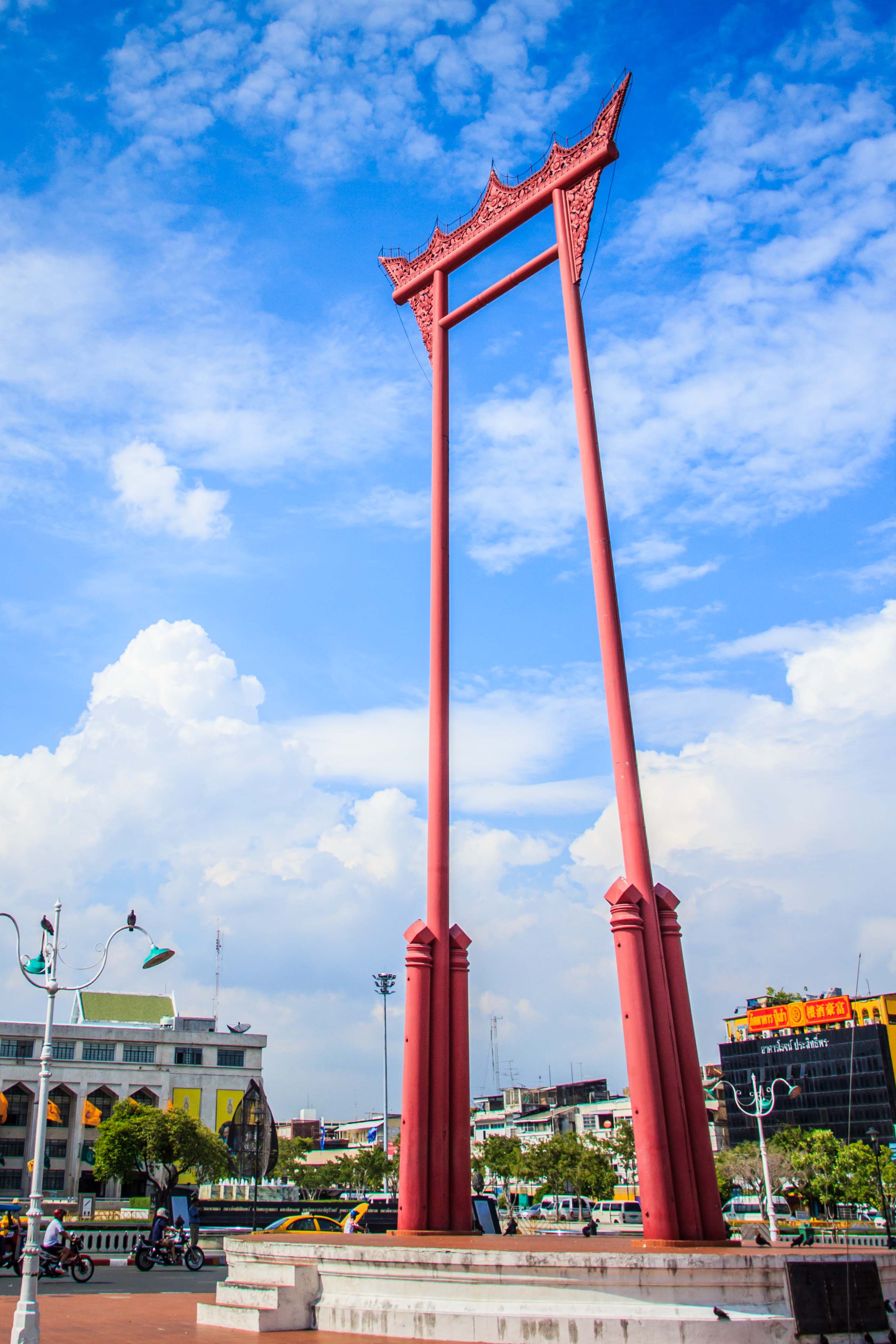
Giant Swing
The ceremony required courage verging on recklessness. Brahmin priests would climb aboard a wooden seat suspended from a frame of massive teak pillars and swing higher and higher, reaching for a bag of coins mounted on one of the posts. The pillars represented the mountains of the earth. The circular base represented the seas. The act of swinging reenacted the moment when Shiva, sent by Brahma to watch over the newly created world, descended from heaven while Naga serpents coiled around the mountains to hold the earth steady. When the serpents finally moved to the seas, the world was complete. For 150 years, this mythological drama played out annually in the heart of Bangkok -- until the injuries and deaths made it impossible to continue.
Tamil Hymns in a Thai Capital
King Rama I built the Giant Swing in 1784, the same year he established the Devasathan shrine directly behind it. The swing stood in front of the shrine as the centerpiece of the Triyampavai-Tripavai ceremony, an annual ritual whose very name reveals its origins far from Thailand. Triyampavai derives from Thiruvempavai, a Shaivite hymn by the Tamil poet Manikkavacakar, and Tripavai from Thiruppavai, a Vaishnavite hymn by the poet Andal. Tamil verses from Thiruvempavai -- specifically the passage known as Sivalaya Vasal Thirappu, meaning "opening the portals of Shiva's home" -- were recited during the ceremony. These same verses appeared in the coronation rituals of Thai kings and queens, threading Hindu devotional poetry from South India into the political fabric of Siamese statecraft.
Lightning, Gas, and Gravity
The swing's history reads like a catalog of destruction and repair. During the reign of Rama II, lightning damaged the structure so severely that the swinging ceremony was suspended. In 1920, the apparatus was renovated and relocated to its current position to make room for a gas plant -- a telling juxtaposition of sacred and industrial priorities. The ceremony resumed, but by 1935, several participants had died in falls during the swinging, and the ritual was permanently abolished for safety reasons. The swing itself survived, repaired again in 1959. By 2005, the wooden pillars were rotting from decades of tropical exposure. A complete reconstruction began in April of that year, using six teak trunks -- the two main pillars more than 3.5 meters in circumference and over 30 meters tall. The rebuilt swing was dedicated in September 2007 in ceremonies presided over by King Bhumibol Adulyadej. The timbers of the original 18th-century swing are preserved in the Bangkok National Museum.
The Sacred Quarter
The Giant Swing does not stand alone. It anchors a neighborhood dense with religious significance. Wat Suthat Thep Wararam rises directly behind it, one of Thailand's most important Buddhist temples, begun by Rama I and completed under Rama III. Its principal Buddha image, the Phra Sri Sagaya Munee, was brought from Wat Mahathat in Sukhothai. The Devasathan shrine, built in 1784, houses sanctuaries to Shiva and Parvati, Brahma and Sarasvati, Ganesha and Siddhi, Vishnu and Lakshmi -- the full Hindu pantheon maintained by Thailand's Royal Brahmin Office. Around the corner, the Tiger God Shrine dates to 1834 and draws Thai and Chinese worshippers seeking fortune in career, money, and love. A small Vishnu temple on Unakan Road, built in 1982 for the 250th anniversary of Rattanakosin by the Indian-Thai Chamber of Commerce, houses an idol brought from India. Hindu, Buddhist, Chinese -- every faith has staked a claim within a few hundred meters.
Standing Still, Still Standing
No one has swung from the Giant Swing in nearly a century. The bags of coins are gone, and the Naga serpents no longer need reenacting. But the frame remains -- teak pillars rising against the Bangkok skyline like a question the city has decided not to answer. In 2005, the Giant Swing and Wat Suthat were jointly proposed as a UNESCO World Heritage site, a recognition that would formalize what the neighborhood already knows about itself. The structure's distinctive silhouette, sometimes mistaken by visitors for a torii gate or a Korean hongsalmun, belongs to a tradition entirely its own. It even appeared in the Mario Kart Tour and Mario Kart 8 Deluxe video games as part of the Bangkok Rush racecourse -- Shiva's cosmic drama reduced to a hairpin turn. The real swing stands quieter, its teak darkening in the monsoon rains, the ceremony it was built for existing now only in the Tamil hymns still recited in the shrine behind it.
From the Air
Located at 13.752N, 100.501E in Bangkok's Phra Nakhon district, within the historic core of Rattanakosin. The Giant Swing's tall teak frame is a recognizable vertical landmark at low altitude (1,500-2,500 feet), standing in an open plaza in front of Wat Suthat's large temple complex. The red-orange frame contrasts with surrounding rooftops. Look for it south of the Democracy Monument and east of the Chao Phraya River. Nearest airports: Don Mueang (VTBD) approximately 15 nm north; Suvarnabhumi (VTBS) approximately 17 nm east-southeast.