Gibraltar National Museum
Eight years before quarry workers in Germany's Neander Valley pulled a skullcap from the limestone and gave their name to a species, a lieutenant in the Royal Artillery named Edmund Flint presented a skull to the Gibraltar Scientific Society. The date was March 3, 1848. The significance of what Flint had found was not recognized at the time -- the society filed it away and moved on. It would take decades for scientists to understand that the Gibraltar skull was a Neanderthal cranium, and that this small British territory perched on a Mediterranean rock had produced one of the most important fossils in the story of human origins. Today, the Gibraltar National Museum tells that story, along with millennia of other ones, from rooms built directly above a 14th-century Moorish bathhouse.
From Officers' Curiosity to National Institution
The impulse to collect and study Gibraltar's natural and historical heritage has deep roots. The Reverend John White served as chaplain from 1756 to 1774, collecting zoological specimens encouraged by his elder brother Gilbert White, the celebrated English naturalist. His manuscript, Fauna Calpensis, was never published, and his collections are lost. By 1830, St Bernard's Hospital had a room for specimens of natural history. In 1835, British Army officers meeting at the Garrison Library formed the Gibraltar Scientific Society, which established the first museum in rented rooms. The society became so important it renamed itself the Museum Society. But it was General Sir Alexander Godley, installed as Governor in 1928, who gave the museum permanent form. Within nine months of taking office, he launched the Gibraltar Society and secured two adjacent military quarters for a museum -- one of which, Ordnance House, sat atop the forgotten bathhouse.
The Baths Beneath
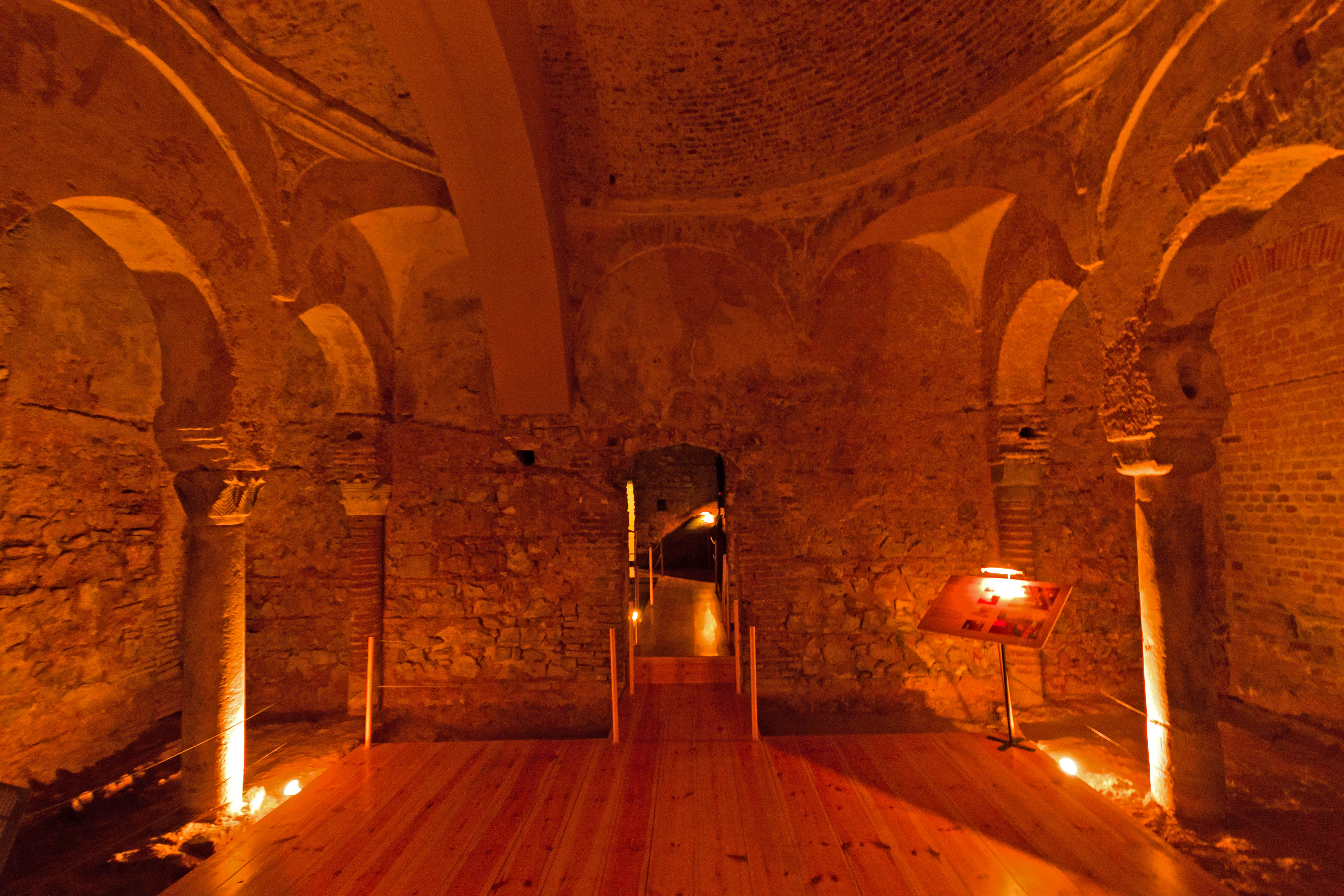
Under the floors of Ordnance House, the former residence of the assistant director of ordnance stores, lay chambers from the Moorish period -- a bathhouse that had been repurposed as a semi-underground stable during the British military occupation. The bathhouse dates to the 14th century, when the Moors controlled Gibraltar, and its vaulted chambers survive as one of the best-preserved examples of medieval Islamic architecture on the Rock. In 1906, Budgett Meakin, an authority on Moorish antiquities, documented the baths and noted their significance. When the museum opened in 1930, the bathhouse was incorporated as a permanent exhibit -- history literally supporting history, with visitors walking above 700-year-old chambers that had served purposes their builders never imagined.
Layers of History in Stone
Excavations in the museum's garden revealed a water conduit dating to the Spanish period, entering from Line Wall Road and running through the rooms into a cistern beneath the interior patio. The conduit is thought to have branched off an aqueduct that ran along the road from wells south of the town. A large-scale model of the Rock, commissioned by Major General Edward Charles Frome and painted by Captain Branfill in 1868, occupies one of the museum's rooms. The collection spans the full sweep of Gibraltar's past: from prehistoric cave finds to Moorish ceramics, from British military artifacts to exhibits on Gibraltarian social history. A cinema shows films about the territory's complex history -- a place that has been Phoenician, Roman, Moorish, Spanish, and British, each culture leaving physical traces in the limestone.
The Rock's Own Museum
In 2018, the Heritage and Antiquities Act formally recognized the institution as the national museum of Gibraltar, replacing the Heritage Trust Act of 1989. Professor Clive Finlayson, who has served as director since 1991, has led research at the nearby Gorham's Cave complex, another site critical to understanding Neanderthal life. The museum sits in the heart of Gibraltar's old town, a few streets from the border with Spain, in a territory of barely seven square kilometers where every construction project risks uncovering another archaeological layer. The Neanderthal skull that Lieutenant Flint presented in 1848 eventually found its way to the Natural History Museum in London, but its story begins here -- on a rock where the Mediterranean meets the Atlantic, where Africa stares at Europe across fourteen kilometers of water, and where a museum built above a bathhouse built above bedrock holds the compressed memory of a very small, very old, very complicated place.
From the Air
Coordinates: 36.139N, 5.354W. The museum is located in the city center of Gibraltar, on the western slope of the Rock near Line Wall Road. From altitude, Gibraltar's urban area is a narrow strip between the Rock's western face and the harbor. Gibraltar Airport (LXGB) occupies the isthmus connecting the Rock to Spain. The museum is not individually visible but lies within the dense old town area. The Rock of Gibraltar rises to 426 m and is one of the most recognizable landmarks in the Mediterranean.