Gifu Castle: The Fortress That Named a City
A samurai named Takenaka Hanbei once seized an entire castle with just thirteen men. He walked through the gates of Inabayama Castle in the 1560s claiming to visit his sick brother, then attacked the lord inside, who panicked and fled into the night. Hanbei held the fortress briefly, then gave it back -- not because he wanted it, but because he had proved a point about its cowardly master. That humiliation set the stage for Oda Nobunaga, the warlord who would take the same castle a few years later and rename it Gifu, launching his audacious bid to unify all of Japan from this single peak above the Nagara River.
A Fort Between Two Rivers
Gifu Castle sits on top of Mount Kinka, a 329-meter summit that rises sharply northeast of central Gifu city. The Nikaidō clan built the original fortification here between 1201 and 1204, during the Kamakura period, as little more than a small wooden fort. But the location was strategic genius. Before a severe flood rerouted the Kiso River in 1586, two major rivers flanked the mountain, forming a natural moat on a grand scale. The castle also commanded the main route into Mino Province from the Tōkaidō highway, the vital road connecting Kyoto with eastern Japan. Any army moving between the capital and the frontier had to pass beneath these walls. Whoever held this mountain controlled traffic, trade, and the balance of power across central Honshu.
The Viper and the Coward
In the Muromachi period, the Saitō clan rebuilt the castle on a far grander scale under Saitō Toshinaga, who served as military governor of Mino Province. But internal feuds weakened the clan until an adventurer from Kyoto revived its fortunes. Saitō Dōsan -- nicknamed the Viper of Mino -- clawed his way to power through ruthless cunning, expelling the rival Toki clan and repelling an invasion from neighboring Owari Province led by Oda Nobuhide. When Dōsan was killed in a revolt by his own son, Saitō Yoshitatsu, the castle passed through generations until it landed with Saitō Tatsuoki, a lord whose reputation would never recover from Takenaka Hanbei's brazen infiltration. Tatsuoki's retainers watched their master flee from thirteen men, and many abandoned his service in disgust. The castle still stood, but the loyalty holding it together had crumbled.
Nobunaga's Masterstroke
Oda Nobunaga launched his assault on Mino Province in 1567, crossing the Kiso River from Sunomata Castle and marching straight for Inabayama. Former Saitō retainers rallied to his banner along the way, and the defenders on the mountaintop could see their own clan's flags among the approaching army. Even so, the fortress seemed impregnable -- steep cliffs on every side, a garrison at the summit. The siege ground on for about two weeks. Then Nobunaga's retainer Kinoshita Tōkichirō -- the future Toyotomi Hideyoshi, who would himself become ruler of Japan -- led a small party up the unguarded rear cliffs, scaled the walls, and threw open the front gates from inside. Tatsuoki fled once more. Nobunaga made the castle his primary base of operations and gave it a new name: Gifu, modeled after the legendary Mount Qi in China from which the Zhou dynasty unified the realm. The message was unmistakable. Nobunaga intended to do the same.
Destruction and Rebirth on the Mountain
Nobunaga used Gifu Castle as his headquarters for roughly a decade, until he completed the grander Azuchi Castle around 1579. After his assassination in 1582, Gifu Castle passed through several hands before Tokugawa Ieyasu's forces destroyed it following the Battle of Sekigahara in 1600. The mountaintop sat empty for centuries. In 1910, a wooden replica was built as a tourist attraction, but fire consumed it in 1943. The current concrete reconstruction went up in 1956 and now houses a museum with exhibits on Nobunaga's era and the castle's turbulent history. The Gifu Castle Archives Museum sits nearby with additional collections, including historical musical instruments and images of castles from across Japan. The site was designated a National Historic Site in 2011.
The View Nobunaga Claimed
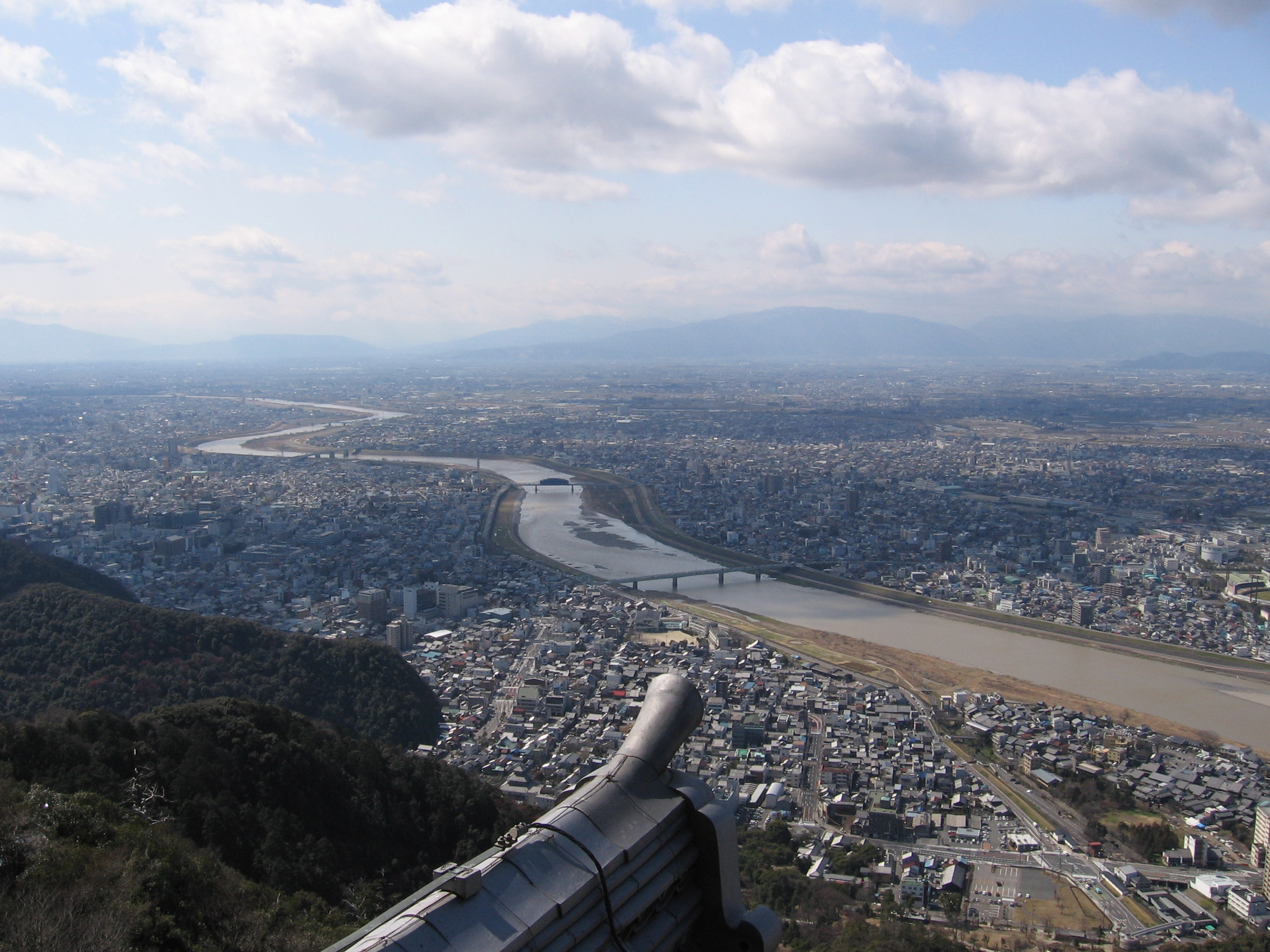
The Mount Kinka Ropeway carries visitors from Gifu Park at the base to the summit, where the castle perches above the surrounding Nōbi Plain like a white crown on a green peak. Hiking trails of varying difficulty wind through the forested slopes and take roughly an hour to climb. From the observation deck, the panorama stretches across the Nagara River below, out over the rooftops of Gifu city, and on clear days to the distant ridgeline of the Japanese Alps. The Nagara River itself is famous for ukai -- traditional cormorant fishing that has been practiced here for over 1,300 years. Standing where Nobunaga once surveyed his domain, you can trace the same geography that shaped five centuries of ambition: the rivers that protected the mountain, the roads that connected it to Kyoto, and the plains that stretched toward an empire he almost lived to complete.
From the Air
Located at 35.434°N, 136.782°E atop Mount Kinka (329 meters elevation) in Gifu City, Japan. From the air, the white castle reconstruction is visible on the forested summit northeast of the city center, with the Nagara River curving along the mountain's northern base. Best viewed at 2,000-4,000 feet AGL. Gifu Air Base (RJNG) lies approximately 7 nautical miles south. Chubu Centrair International Airport (RJGG) is roughly 40 nautical miles to the south-southeast. The surrounding Nōbi Plain provides clear visual reference in good weather.