Gifu Great Buddha: The Giant Built from Bamboo, Scripture, and Thirty-Eight Years of Faith
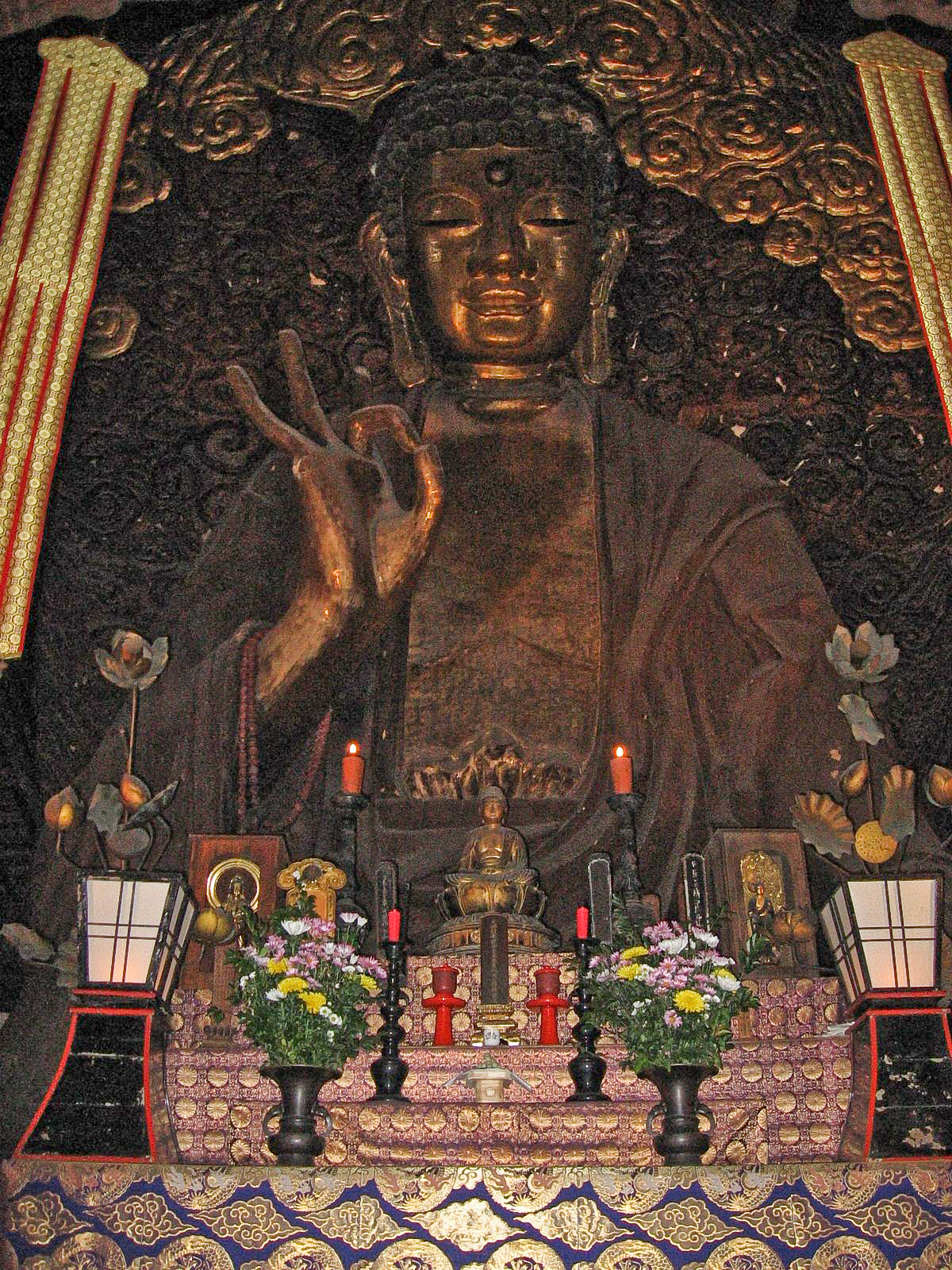
Most great Buddha statues in Japan are cast in bronze. The one in Gifu is built from a ginkgo tree, bamboo lattice, clay, Buddhist scriptures, lacquer, and gold leaf. It took thirty-eight years to finish. The priest who conceived it never lived to see it completed. When Ichyuu, the 11th head priest of Kinpouzan Shōhō-ji temple, began the project around 1790, he was responding to a string of devastating earthquakes and famines that had shaken the region. He believed a great Buddha could bring spiritual protection to the people of Gifu. Ichyuu died in 1815 with the statue still unfinished. His successor, Priest Kohshuu, carried the work forward for another seventeen years, finally completing the Gifu Daibutsu in April 1832. It stands 13.63 meters tall inside a wooden hall, serene and golden, built on faith and bamboo.
A Buddha Unlike Any Other
The construction method makes the Gifu Great Buddha unique among Japan's monumental Buddhist statues. Workers began by shaping a central pillar from ginkgo wood, 1.8 meters in circumference, strong enough to bear the weight of the massive figure above. Around this core they wove a framework of bamboo lattice, building up the seated Buddha's form in a cage of flexible strips. Clay was packed over the bamboo to sculpt the features -- the broad shoulders, the serene face, the long earlobes that signify wisdom in Buddhist iconography. Then came the layer that gives this statue its spiritual depth: actual Buddhist scriptures, handwritten on paper, were applied over the clay surface. The sacred texts became part of the Buddha's body. Finally, layers of lacquer and gold leaf sealed everything together, giving the statue its warm, luminous glow. It is the largest lacquered Buddha in Japan.
Born from Disaster
The late eighteenth century was a brutal stretch for central Japan. Earthquakes cracked foundations, crop failures brought famine, and communities across the region struggled to recover. Priest Ichyuu watched his congregation suffer and conceived the Great Buddha as both a spiritual anchor and a communal act of devotion. The project was enormous for a single temple -- gathering enough ginkgo wood, bamboo, clay, gold leaf, and handwritten scripture to build a seated figure over thirteen meters tall. Donations came slowly. Labor was painstaking. Ichyuu dedicated twenty-five years of his life to the effort before dying in 1815 with the statue incomplete. That it continued at all is a testament to the depth of commitment within the temple. Priest Kohshuu took up the burden and spent another seventeen years seeing it through. When the Gifu Daibutsu was finally completed in 1832, it represented not just one priest's vision but two generations of devotion.
The Three Great Buddhas
Japan traditionally counts three great Buddha statues as its most revered: the bronze Daibutsu at Tōdai-ji in Nara, the outdoor bronze at Kōtoku-in in Kamakura, and -- depending on which list you follow -- either the Gifu Great Buddha or the Takaoka Daibutsu in Toyama Prefecture holds the third position. The Gifu statue's claim rests on its unusual construction and its impressive scale. At 13.63 meters, it rivals the more famous bronze figures, but its layered composition of organic materials, sacred text, and lacquer gives it a warmth and intimacy that cold metal cannot match. Housed inside Shōhō-ji's wooden hall rather than exposed to the elements, the Gifu Daibutsu sits in filtered light, surrounded by rows of smaller Buddhist figures. The atmosphere is contemplative rather than monumental -- a giant built not to overpower but to shelter.
Scripture Made Flesh
The most remarkable detail of the Gifu Great Buddha is invisible to the eye. Beneath the lacquer and gold leaf, Buddhist scriptures are physically embedded in the statue's surface. This was not decoration -- it was theology made material. In Buddhist tradition, sacred texts carry the power of the dharma, the teachings of the Buddha. By layering scripture onto the statue's body, the builders fused the written word with the physical image, creating an object that is simultaneously a work of art, a feat of engineering, and a repository of religious knowledge. Visitors standing before the golden figure are looking at a library wrapped in lacquer. Every curve of the Buddha's face, every fold of the robe, rests on layers of handwritten prayer. The statue does not just represent the Buddha's teachings. It contains them.
From the Air
Located at 35.432°N, 136.772°E in central Gifu City, Japan, within the grounds of Shōhō-ji temple near Gifu Park. The temple and its wooden hall housing the Great Buddha are not individually distinguishable from altitude, but the site sits in the cultural district at the base of Mount Kinka, identifiable by Gifu Castle on the summit above. Best appreciated as a ground-level destination within the broader Gifu Castle and Gifu Park area visible from the air. Gifu Air Base (RJNG) lies approximately 7 nautical miles south. Chubu Centrair International Airport (RJGG) is roughly 40 nautical miles south-southeast.