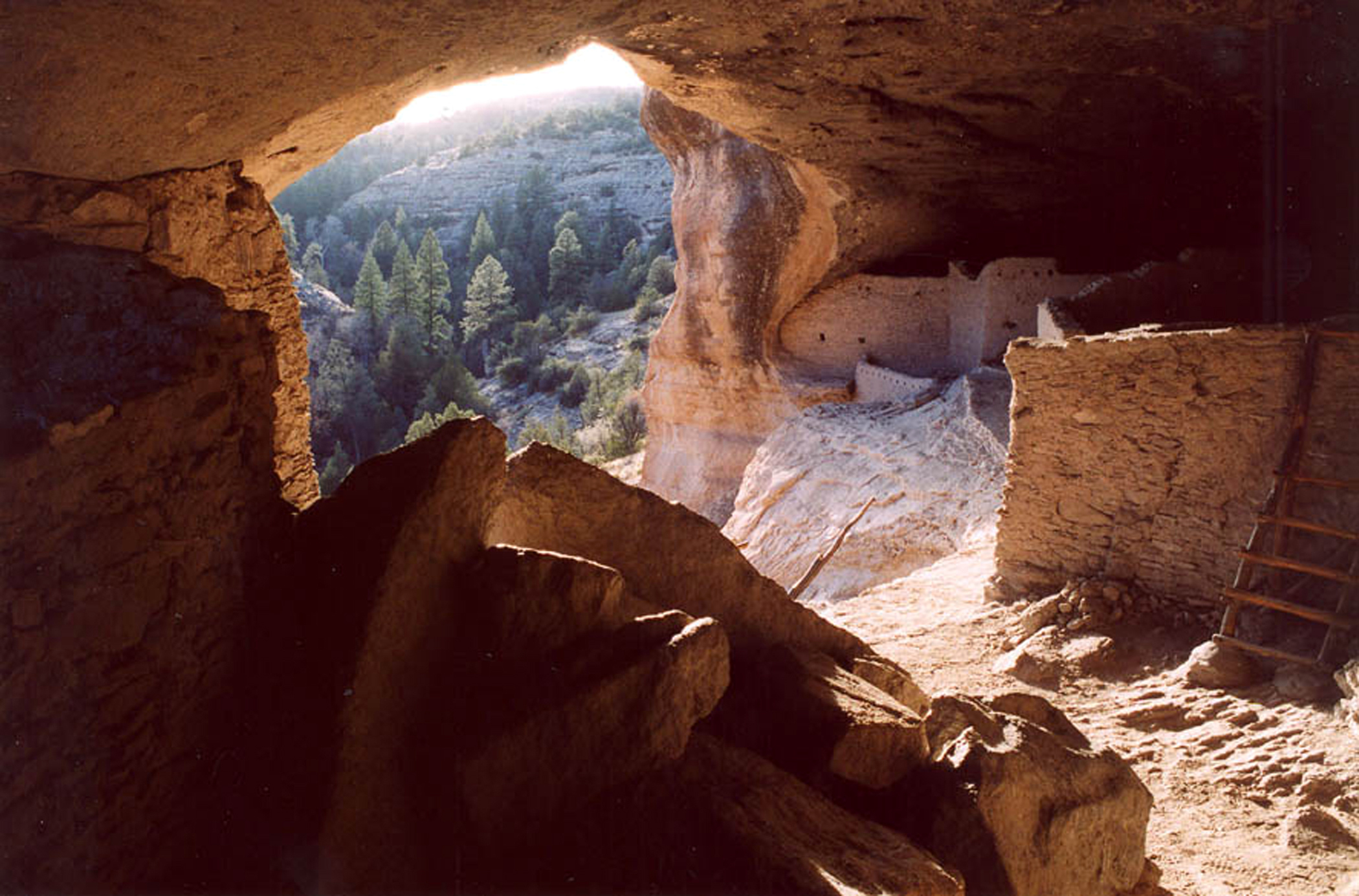
Gila Cliff Dwellings National Monument
Henry B. Ailman was dodging jury duty when he stumbled into history. In the summer of 1878, the Silver City resident organized a prospecting trip to the upper Gila River with friends, hoping to avoid a court summons. Instead, they discovered something that would outlast any verdict: cliff dwellings tucked into five natural caves above what would become known as Cliff Dweller Canyon. The Mogollon people had built these interlinked stone rooms between 1276 and 1287, dates pinpointed through tree-ring analysis of the original timbers. By the early 1300s, they had vanished, leaving 46 rooms and countless questions suspended in the volcanic alcoves.
Homes in the Rock
The Mogollon chose their location with care. The five cliff alcoves face south, capturing winter sun while sheltering inhabitants from summer heat. Archaeologists estimate 10 to 15 families lived here, part of a larger Mimbres Culture community that occupied several sites along the Gila River's forks. The builders used natural caves formed during the Oligocene epoch, when volcanic activity covered this region in ash and created the hot springs that still bubble up nearby. They constructed walls of local stone, fitted wooden beams cut from the surrounding forest, and shaped T-shaped doorways characteristic of Southwestern pueblo architecture. The site offered defensible positions, reliable water from the streams below, and fertile canyon bottoms for growing corn, beans, and squash.
From Resort to Refuge
After Ailman's discovery, visitors trickled into this remote corner of New Mexico. By the 1890s, the Hill brothers had established a resort at nearby Gila Hot Springs, guiding guests to the ruins. But souvenir hunters and collectors posed a growing threat. Several mummified bodies were found at the site; most disappeared into private collections before any scientific study. In December 1906, Gila Forest Supervisor R.C. McClure urged Washington to protect the site from further looting. Less than a year later, on November 16, 1907, President Theodore Roosevelt used the newly enacted Antiquities Act to designate Gila Cliff Dwellings as a National Monument, placing it among the first generation of sites protected under this landmark legislation.
Zeke and the Scientists
In 1912, workers discovered a burial ground containing a mummified infant who would become known as Zeke. The find made national headlines and transformed the monument's fortunes, drawing curious visitors and prompting improvements to trails and facilities. Zeke remains the only mummy acquired by the Smithsonian from this site. Doc Campbell, an early settler to the region, became the first park ranger, helping National Park Service crews stabilize the deteriorating ruins. His family continues the tradition today, guiding wilderness trips from Campbells Post at Gila Hot Springs. The monument passed from the Agriculture Department to the National Park Service in 1933, expanded under President Kennedy in the 1960s to include the largely unexcavated TJ Ruins on a mesa overlooking the river.
Ancient Trade Routes
A single bracelet in the monument's museum tells a story spanning hundreds of miles and multiple cultures. The artifact, crafted from Glycymeris clam shells, originated in the Gulf of California. Hohokam artisans at Snaketown, an ancient village near modern Phoenix, etched and drilled the shell into wearable art. From there, it traveled up the Gila River through trade networks that connected desert, mountain, and coast. The bracelet eventually reached this remote canyon, evidence that the Mogollon communities here participated in exchange systems stretching across the prehistoric Southwest. Today's visitor center displays this and other Apache and Mogollon artifacts, offering tangible connections to lives lived seven centuries past.
The Trail to the Past
Reaching the cliff dwellings requires a one-mile trail loop with several footbridges over the stream flowing through the canyon. The walk takes about an hour, climbing from the trailhead through a landscape of Ponderosa pine, Gambel's oak, and Douglas fir. The terrain tells its own ancient story: steep-sided canyons carved by spring rivers, mesas capped with volcanic remnants, hot springs marking the geologic past. At trail's end, visitors can enter the dwellings themselves, stand where Mogollon families once stood, and peer through T-shaped doorways at the same canyon views the original inhabitants knew. The surrounding Gila Wilderness, America's first designated wilderness area, ensures this landscape remains as wild as it was when the last residents departed.
From the Air
Gila Cliff Dwellings National Monument (33.23N, 108.27W) lies in the rugged canyon country at the headwaters of the Gila River in extreme southern Catron County, New Mexico. The monument sits at approximately 5,700 feet MSL within the Gila National Forest, surrounded by the Gila Wilderness. Access from the air requires navigating steep-sided canyons and forested mesas. The nearest airport is Grant County Airport (KSVC) near Silver City, approximately 40nm south. NM-15 winds northward from Silver City but is not visible from altitude due to tree cover. Look for the confluence of the West Fork and Middle Fork of the Gila River. Best viewed at 7,500-8,500 feet MSL in clear conditions. Afternoon thunderstorms common in summer months.