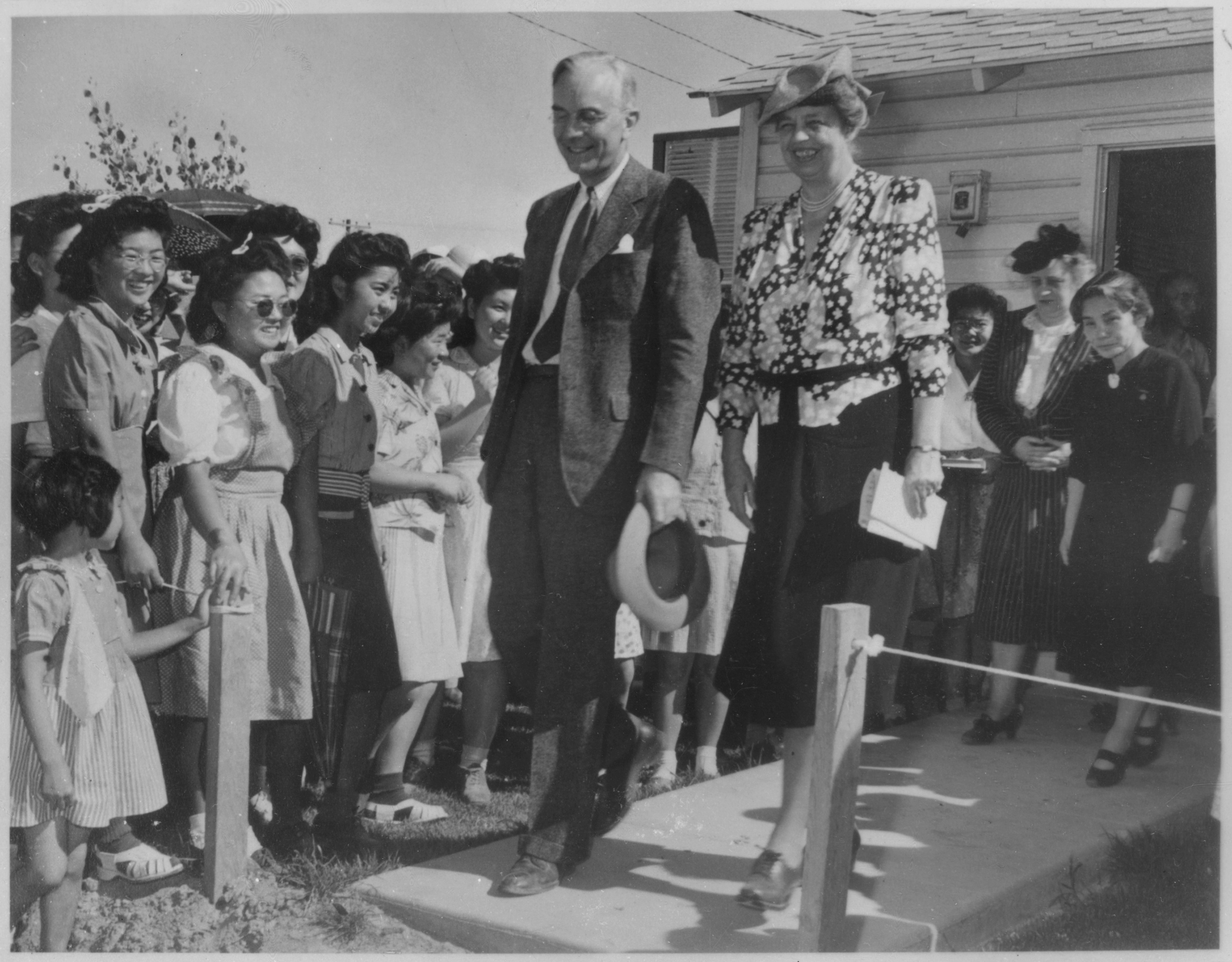
Gila River War Relocation Center
The baseball diamond at Butte Camp seated 6,000 fans. Kenichi Zenimura, a professional player imprisoned with his family, designed it himself, and historians would later call it the finest in the entire War Relocation Authority system. In this detail lies the central paradox of the Gila River War Relocation Center: that within the confines of an American concentration camp built on land the Pima Indians explicitly opposed being used for this purpose, 13,000 Japanese Americans created community, art, and athletic competition while waiting for their country to remember that they, too, were citizens.
Overnight Displacement
Executive Order 9066 gave families less than a week. In the spring of 1942, Japanese Americans from California, Oregon, Washington, and Arizona were forced to abandon homes, businesses, and everything they had built. Properties sold for fractions of their value. Livelihoods vanished. When families arrived at Gila River, they found two camps, Canal and Butte, hastily constructed on the Gila River Indian Reservation despite the tribal government's strong objections. The camp was designed for 10,000 but would eventually hold over 13,000 people. Some families were housed in mess halls, hanging blankets as makeshift walls for the semblance of privacy. In total, 119,000 Americans of Japanese descent were incarcerated during the war.
Life in the Desert
Gila River was considered among the least oppressive camps. It had only one watchtower. Its fences lacked barbed wire. Administrators allowed access to Phoenix amenities and encouraged recreation. But the desert environment was brutal. Barracks made of wood and fireproof shingles offered little protection from the searing heat. Water shortages plagued both camps. Rattlesnakes and scorpions kept Butte Hospital busy treating bites. Some incarcerees died en route or shortly after arrival. Among them was the mother of Iva Toguri, later wrongfully convicted as Tokyo Rose based on perjured testimony. Yet within these harsh conditions, residents built theaters for plays and films, planted trees to break the desolation, and established the first democratic governing body of internees in the WRA system.
Those Who Emerged
The camp that became Arizona's fourth-largest city produced remarkable people. Pat Morita, who would become beloved as Mr. Miyagi in the Karate Kid films, was interned here as a child before being transferred to Tule Lake. Kazuo Otani left Gila River to serve in the U.S. Army and was awarded the Medal of Honor. Paul Terasaki became a pioneering organ transplant scientist at UCLA. Michi Nishiura Weglyn wrote Years of Infamy: The Untold Story of America's Concentration Camps. George Hoshida created drawings documenting life in three internment camps. Their achievements stand as testimony to resilience in the face of their own government's betrayal.
What Remains
Canal Camp closed on September 28, 1945. Butte Camp followed on November 10, and Gila River officially shuttered on November 16. Decades later, during the Reagan administration, the federal government acknowledged the injustice. Congress passed the Civil Liberties Act of 1988, offering official apology and restitution to survivors and descendants. In 2006, President George W. Bush signed legislation guaranteeing $38 million to preserve Gila River and nine other former camps. Today, the land belongs to the Gila River Indian Tribe, who consider it sacred and restrict public access. The main structures are gone. What remains are concrete foundations, the road grid, manholes, cisterns, rock alignments, and dozens of small ponds, the footprint of a city that should never have existed.
From the Air
Located at 33.07N, 111.83W, approximately 30 miles southeast of Phoenix within the Gila River Indian Reservation near Sacaton. The site is not publicly accessible due to tribal restrictions on sacred land. From the air, the road grid patterns and foundation remnants may still be visible. Nearest airports include Phoenix-Mesa Gateway (KIWA) approximately 25 miles northeast, and Phoenix Sky Harbor (KPHX) approximately 35 miles northwest. Best viewed at 2,000-4,000 feet AGL. Note that the historic site sits within restricted tribal lands.