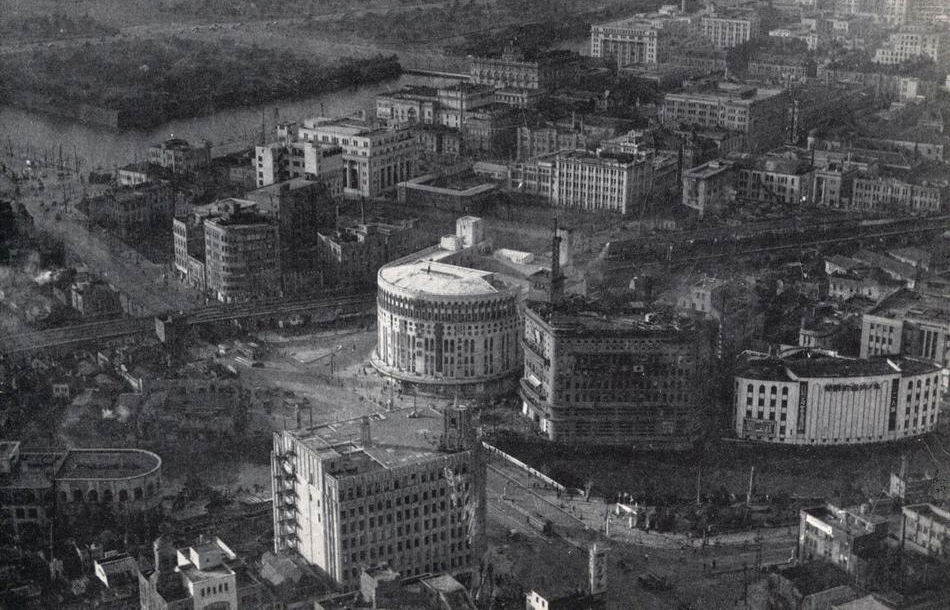
Ginza
The name means silver mint. In 1612, the Tokugawa shogunate established a coin-minting facility on reclaimed swampland along Edo's southern edge, and the district that grew around it kept the name long after the mint relocated. Four centuries later, Ginza is synonymous with a particular kind of Japanese elegance -- unhurried, precise, expensive. On weekend afternoons, the main boulevard closes to cars entirely and becomes a hokoten, a 'pedestrian heaven,' where families, tourists, and kimono-clad shoppers drift past the same blocks that burned to ash in 1872 and were rebuilt as Tokyo's first experiment in Western-style urban planning.
Swamp to Silver to Brick
Ginza began as marshland filled in during the 16th century. The silver mint that gave it a name operated during the Edo period, but the district's modern identity was forged by disaster. A devastating fire in 1872 leveled most of the area. The Meiji government saw opportunity in the destruction. Under the direction of Yamao Yozo and designed by Irish-born engineer Thomas Waters, Ginza was reconstructed with Western-style brick buildings, gas streetlamps, and tree-lined avenues -- a showcase of bunmei-kaika, the 'civilization and enlightenment' that Japan's modernizers championed. Newspaper offices and magazine publishers moved in, turning the neighborhood into a center for the latest trends. The custom of ginbura -- 'killing time in Ginza,' strolling the streets to see and be seen -- took root between the two world wars and has never really stopped.
The Clock Tower and the Department Stores
The Wako building anchors the Ginza 4-chome intersection with a clock tower dating to 1894, one of the district's most recognizable landmarks. Around it radiates a constellation of department stores -- Mitsukoshi, Matsuya, Hankyu -- that function less like Western shopping malls and more like curated exhibitions of taste. Basement floors are devoted to exquisite food halls. Upper floors house art galleries. Ginza Six, a more recent addition, occupies an entire block and includes a rooftop garden. The district is also home to traditional kimono shops like Ginza Motoji and Erizen, where visitors still dress in formal wear to window-shop. Luxury brands from Chanel and Louis Vuitton to Gucci and Dior maintain flagship stores here, their facades competing in architectural ambition along Chuo-dori, the main avenue.
Where the World Ate Sushi
Tucked in the basement of an office building on a Ginza side street, the ten-seat counter of Sukiyabashi Jiro became the first sushi restaurant in the world to receive three stars from the Michelin Guide. Chef Jiro Ono, born in 1925, was a living monument to the idea that simplicity pursued with absolute devotion becomes its own form of art. The restaurant was removed from the Michelin Guide in November 2019 because it no longer accepted reservations from the general public. But Ginza's culinary identity extends far beyond a single counter. The district harbors hundreds of restaurants, from the oldest tempura houses to French bistros, alongside the traditional kissaten -- coffeehouses with dark wood interiors, hand-dripped coffee, and an atmosphere that has barely changed in decades. The Sony showroom, which once occupied a building in Ginza 2-chome, and the first Apple Store opened outside the United States also called these blocks home.
Pedestrian Heaven
Every Saturday and Sunday from noon to five o'clock, Chuo-dori and its cross streets close to automobile traffic. Chairs and benches appear on the asphalt. Street performers set up -- magicians, musicians, dancers. The transformation is both practical and philosophical: a district defined by commerce temporarily becomes a public commons. The tradition dates to the postwar era and reflects a distinctly Japanese negotiation between modernity and livability. Ginza sits within the old Kyobashi ward, which along with Nihonbashi and Kanda formed the core of Shitamachi, Edo's original downtown. That legacy of dense, walkable urbanism is most visible on these weekend afternoons, when the boulevard becomes a promenade and the district's identity as a place for people -- not just shopping -- reasserts itself.
From the Air
Located at 35.671N, 139.765E in Chuo ward, central Tokyo. From the air, Ginza is identifiable as the dense commercial grid between the Imperial Palace grounds to the northwest and the Sumida River to the east, with the distinctive Tsukiji waterfront to the south. Nearest airports: Tokyo Haneda (RJTT) approximately 9 nm south-southwest, Narita International (RJAA) approximately 36 nm east. Best viewed at 2,000-4,000 feet AGL. The wide Chuo-dori boulevard running north-south through the district is visible at lower altitudes.