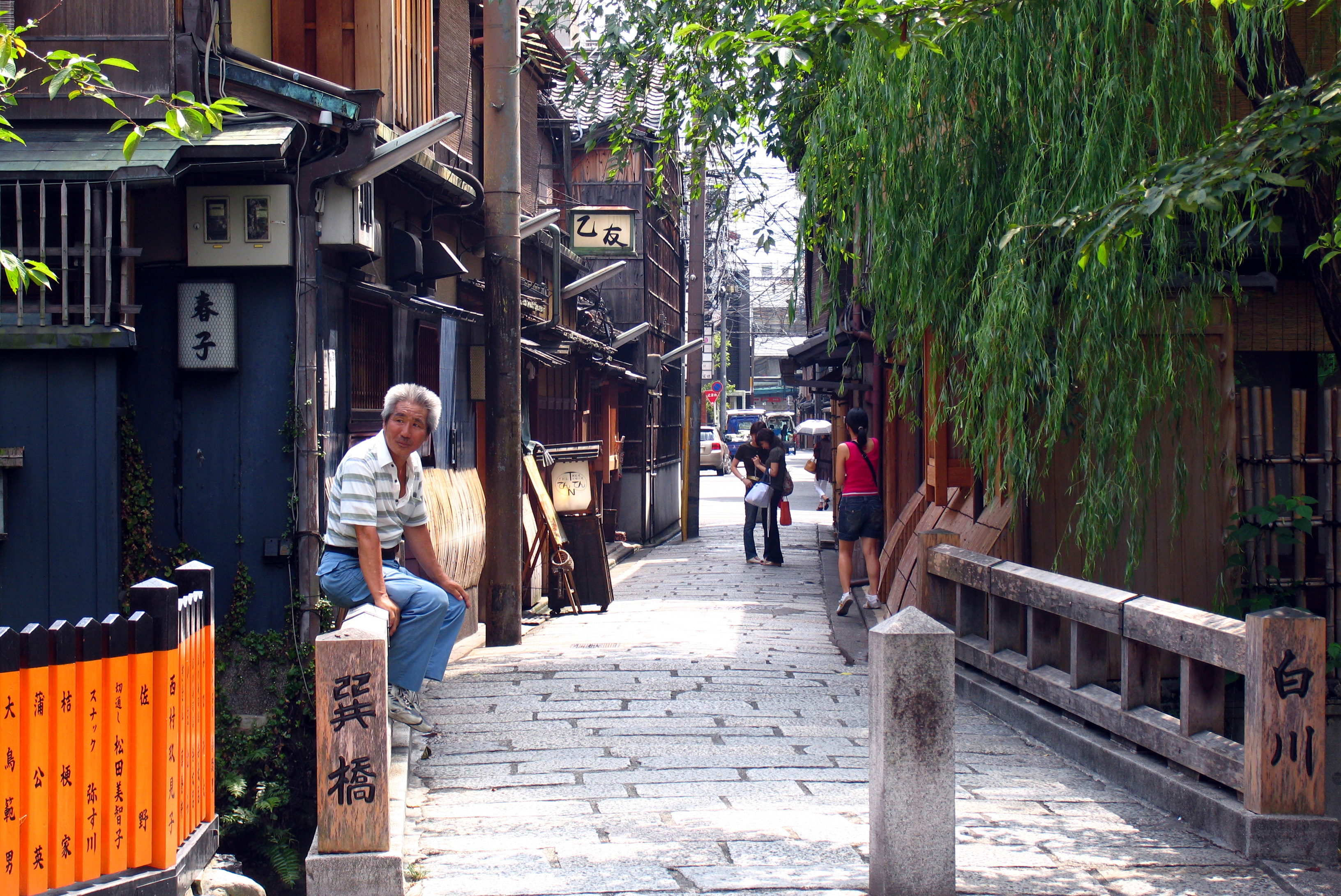
Gion
The correction comes gently, but it comes. In Gion, the women in white makeup and elaborate kimono are not geisha. They are geiko -- "women of art" -- and the distinction matters here the way terroir matters in Burgundy. This neighborhood in Kyoto's Higashiyama ward grew up around Yasaka Shrine during the Sengoku period, initially as a service district for pilgrims and travelers. Over the centuries it evolved into something rarer: a living institution of traditional Japanese arts where dance, music, conversation, and the ceremony of hospitality are practiced to standards that the rest of the country abandoned generations ago. By law, tourists who dress up in rented kimono at Gion's makeover studios must wear their costumes inaccurately, so that no visitor can be mistaken for the real thing.
Two Houses Divided
Gion is technically not one geisha district but two. In 1881, the original hanamachi split into Gion Kobu and Gion Higashi. Gion Kobu is the larger and more famous of the pair, occupying most of the district including Hanamikoji, the narrow street of wooden facades that has become one of the most photographed lanes in Japan. Gion Higashi is smaller, concentrated in the northeast corner around its rehearsal hall. Both maintain the ochaya -- teahouse -- system, where geiko and their apprentices, called maiko, entertain guests at private parties involving traditional dance performances, drinking games, singing, and the kind of elevated conversation that requires years of training. The number of practicing geiko has declined sharply over the past century, but the institution endures, protected by Kyoto's designation of parts of the district as a national historical preservation area.
Stones Without Wires
Walking through Gion's back streets is an exercise in deliberate anachronism. Since 1986, the City of Kyoto has been burying power lines underground and removing utility poles from the district's most atmospheric corridors. Nene no Michi, Hanamikoji, and the nearby entertainment alley of Pontocho have all had their skylines cleared, restoring sightlines that had been cluttered with cables since electrification. The traditional machiya townhouses lining these streets -- narrow wooden structures with latticed facades and tile roofs -- look much as they did in the Edo period. Many function as ochaya or as exclusive restaurants where reservations require an introduction. The famous Ichiriki Tei, a vermilion-walled teahouse at the corner of Hanamikoji and Shijo Street, has been operating since the early eighteenth century and played a role in the real-life events behind the story of the 47 Ronin.
Cherry Blossoms on the Shirakawa
The stretch of the Shirakawa River that threads through Gion before joining the Kamo River is one of Kyoto's most beautiful preserved landscapes. Traditional establishments line the south bank, their wooden balconies extending directly over the water. The north bank tells a different story: during World War II, the buildings along that side were demolished as a firebreak to prevent the spread of incendiary bombing. The cleared land was never rebuilt. Instead, it became a pedestrian promenade lined with cherry trees that are illuminated each spring, casting pink reflections onto the dark water. Year-round, the willow-draped canal, crossed by small stone bridges, creates an atmosphere so perfectly composed that it feels staged -- but the setting predates photography by centuries.
The Dances of the Old Capital
Every April, the geiko and maiko of Gion Kobu perform the Miyako Odori -- the "Dances of the Old Capital" -- a tradition that dates to the Kyoto exhibition of 1872. For the entire month, daily performances fill the Gion Kobu Kaburenjo theater with spectators who range from tatami-mat standees to guests in reserved seats who receive a small tea ceremony before the curtain rises. The choreography draws on centuries of classical Japanese dance, and the spectacle of dozens of performers in seasonal kimono moving in synchronized precision is among Kyoto's most iconic cultural events. Gion Higashi stages its own version, the Gion Odori, in early November during the autumn leaf season, though on a smaller scale. Together, these five hanamachi dance festivals -- each of Kyoto's geisha districts hosts one -- represent one of the last places where the performing arts of the Edo and Meiji periods can be experienced live and unaltered.
Fiction and Memory
The Western world's image of Gion was shaped largely by Arthur Golden's 1997 novel Memoirs of a Geisha, though the book drew controversy from Mineko Iwasaki, the Gion Kobu geiko whose life partly inspired it. Iwasaki published her own autobiography, Geisha of Gion, to set the record straight. The filmmaker Kenji Mizoguchi used the district as a setting twice, in 1936 and 1953, capturing a Gion that was already mourning its own transformation. Today the district exists in tension between preservation and tourism, between ochaya that still require personal introductions and Shijo Street's pachinko parlors and off-track betting shops. That friction is part of what makes Gion Gion -- a place where the most exclusive traditions in Japanese culture survive not in a museum but alongside the noise and commerce of a modern city.
From the Air
Located at 35.00N, 135.78E in the Higashiyama ward of eastern Kyoto, Japan. From the air, Gion is identifiable as the dense low-rise district between the Kamo River to the west and the forested hills of Higashiyama (Eastern Mountains) to the east. The orange torii of Yasaka Shrine at the district's eastern edge and the large roof of Kennin-ji temple to the south serve as landmarks. Nearest airports: Osaka Itami (RJOO) approximately 25nm southwest, Kansai International (RJBB) approximately 75nm south. Kyoto's basin geography, enclosed by mountains on three sides, can trap haze and low cloud. The Kamo River running north-south through the city is the primary visual reference for orientation.