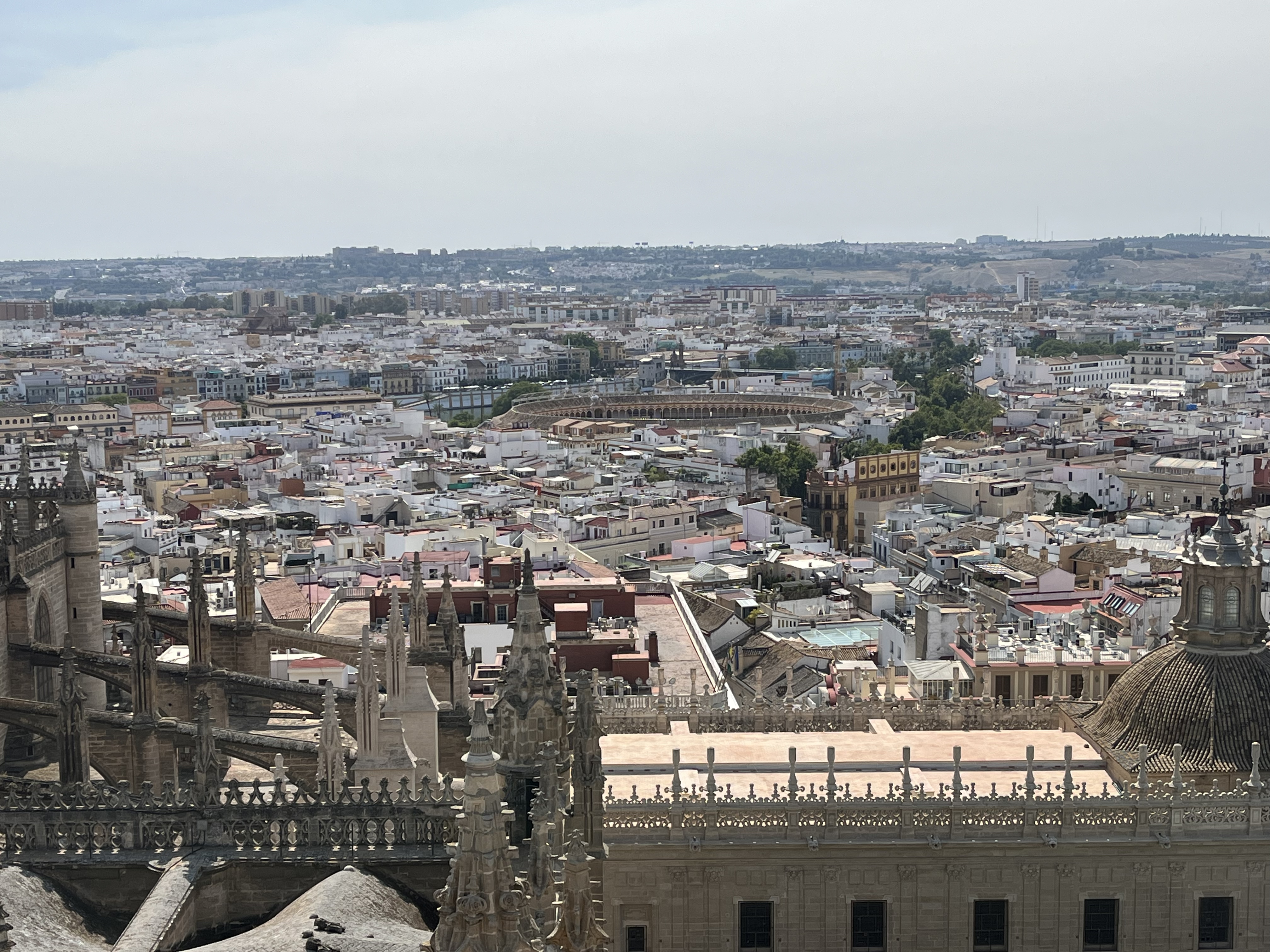
Giralda
The tower was already old when Spain first heard the word "cathedral." Built in the late 12th century as the minaret of the Great Mosque of Seville under the Almohad dynasty, the Giralda called Muslims to prayer for decades before the Christian reconquest turned it into something else entirely. Rather than tear down the minaret, the conquerors kept it and -- four centuries later -- added a Renaissance belfry on top. The result is a tower that reads like a vertical timeline: Islamic brick below, Catholic bells above, and between them, the peculiar genius of a city that has always preferred to absorb its conquerors' buildings rather than demolish them.
The Almohad Masterpiece
Caliph Abu Ya'qub Yusuf commissioned the mosque in 1171 to replace the older Mosque of Ibn Addabas, which could no longer accommodate the growing congregation. The minaret was built using local bricks and recycled marble from old Umayyad monuments -- even in its construction, the tower was a layered artifact. Its base is a square of 13.6 meters per side, sitting on a solid foundation of rectangular stones, some reused from the nearby Abbadid palace walls and from Roman city walls. The main shaft rises 50.51 meters, and a smaller second shaft sits on top. Inside, rather than stairs, a series of ramps wide enough for two horsemen to ride abreast winds to the summit -- a design that allowed the muezzin to ascend on horseback. Four gilded metal spheres originally crowned the tower, large enough to be visible from miles away.
Earthquake, Cathedral, Clock
The 1356 earthquake severely damaged the structure, and the metal spheres toppled from the summit. They were replaced in 1400 with a cross and bell -- a simple but profound transformation from Islamic to Christian identity. Around the same time, Spain's first public striking clock was installed in the tower. By 1433, construction of the current cathedral had begun around and below the former mosque. Stone was scarce locally, and skilled stonemasons scarcer still, so materials were shipped from overseas and artisans recruited from as far as Germany and the Netherlands. The cathedral took 73 years to complete, finished in 1506. The minaret, survivor of earthquake and conquest alike, remained throughout.
The Renaissance Crown
In the 16th century, architect Hernan Ruiz the Younger was commissioned to add a new belfry to the top of the Almohad tower. Constructed between 1558 and 1568, the Renaissance extension consists of several tiers: a lantern-like lower section with five openings on each side where the bells hang, a section above featuring oculi and a central arch, and decorative stone urns called carambolas crowning the edges. At the very top stands a bronze weathervane figure representing Faith, installed in the 16th century. This figure -- the Giraldillo -- gave the tower its name: Giralda, from the Spanish girar, to turn. The tower's total height, combining Almohad shaft and Renaissance belfry, makes it one of the tallest structures of the medieval world.
Echoes Across the World
The Giralda's silhouette has been replicated more than perhaps any other building in the world outside of classical Greek temples. The second Madison Square Garden in New York, designed by Stanford White in 1890, borrowed its tower profile. The San Francisco Ferry Building's clock tower, completed in 1895, echoes its proportions. Miami's Freedom Tower, the Biltmore Hotel in Coral Gables, the Wrigley Building in Chicago, and Cleveland's Terminal Tower all carry traces of the Giralda's outline. Even Soviet Moscow's Seven Sisters skyscrapers and Warsaw's Palace of Culture and Science owe a debt to the Almohad minaret. In 1987, UNESCO designated the Giralda, together with the cathedral and the adjacent Alcazar and Archive of the Indies, as a World Heritage Site -- formal recognition of a building that had been shaping skylines worldwide for a century.
From the Air
Located at 37.386N, 5.992W in central Seville, Spain. The Giralda is the tall tower immediately adjacent to Seville Cathedral, the largest Gothic cathedral in the world. Clearly visible from altitude and a key landmark for orienting within Seville. Nearest airport: LEZL (Seville-San Pablo, ~10 km northeast).