Girl with a Pearl Earring
Two guilders and thirty cents. That is what Arnoldus Andries des Tombe paid at auction in The Hague in 1881 for a small, dirty, partially flaking oil painting by an artist whose name was still recovering from two centuries of obscurity. Roughly twenty-four euros in modern purchasing power. Des Tombe had been tipped off by Victor de Stuers, a Dutch official obsessed with keeping Vermeer's rare works inside the country. The signature read IVMeer. There was no date. The painting depicted a girl, head turned over her shoulder, mouth slightly open, wearing an exotic blue and gold turban and what appeared to be an impossibly large pearl earring catching a single point of light. Des Tombe had no heirs. He left the painting and several others to the Mauritshuis in 1902. It has been there, with brief exceptions for international tours, ever since.
Not a Portrait
The painting is a tronie, a 17th-century Dutch term for a study of a head that was deliberately not a portrait of a specific person. Tronies were exercises, demonstrations, marketable objects sold without the formal commission that a true portrait required. Vermeer painted at least two tronies in what the inventory at his death called the Turkish fashion; this may have been one of them. The girl wears imagined exotic dress meant to evoke the Ottoman world that Europe was both fighting and fashionably borrowing from. She is not identified. She may be the artist's eldest daughter Maria; some historians dismiss this as anachronistic. Recently it has been proposed that she is Magdalena, the twelve-year-old daughter of Vermeer's patron Pieter Claesz van Ruijven, painted in biblical-style dress to commemorate her baptism. The truth may never be settled. The painting refuses to tell.
The Pearl That Might Not Be a Pearl
Look closely at the earring and the science gets strange. The 1994 restoration revealed that the dark background had originally been a deep enamel-like green, achieved by glazing indigo and weld over black; the organic pigments faded and the green disappeared. In 2014 the Dutch astrophysicist Vincent Icke argued that the so-called pearl is too large, too pear-shaped, and reflects light too sharply to be a real pearl. He proposed polished tin. A 2018 study called The Girl in the Spotlight, run by conservator Abbie Vandivere at the Mauritshuis, took the painting out of its frame in a glass workshop open to the public for two weeks. Microscopes and X-rays found delicate eyelashes, a green curtain behind the head that had vanished into the darkened background, and pigments shipped from across the world. The pearl, the team noted, has no contour and no hook to hang it from. It is, in some sense, not painted. It is implied.
From Head of a Girl to Global Icon
The painting has carried many names. Inventories called it variously a tronie in Turkish fashion, a portrait in antique costume, a head of a young girl. After the Mauritshuis bequest it was simply Girl with a Turban. By 1995 the Mauritshuis settled on Girl with a Pearl, and the longer English title with which it is now known became standard a few years after that. Pearls appear in twenty-one Vermeer paintings; the Woman with a Pearl Necklace in Berlin is one of his more famous others. But this one travelled further than any of them. A 2019 CNN survey named it one of the world's most recognisable paintings, often called the Mona Lisa of the North. Tracy Chevalier's 1999 historical novel, the 2003 Scarlett Johansson film, a 2008 stage play, Banksy's 2014 mural in Bristol replacing the earring with a wall alarm box, all flow from the same small canvas, oil on linen, 44.5 by 39 centimetres.
The Room Where She Lives
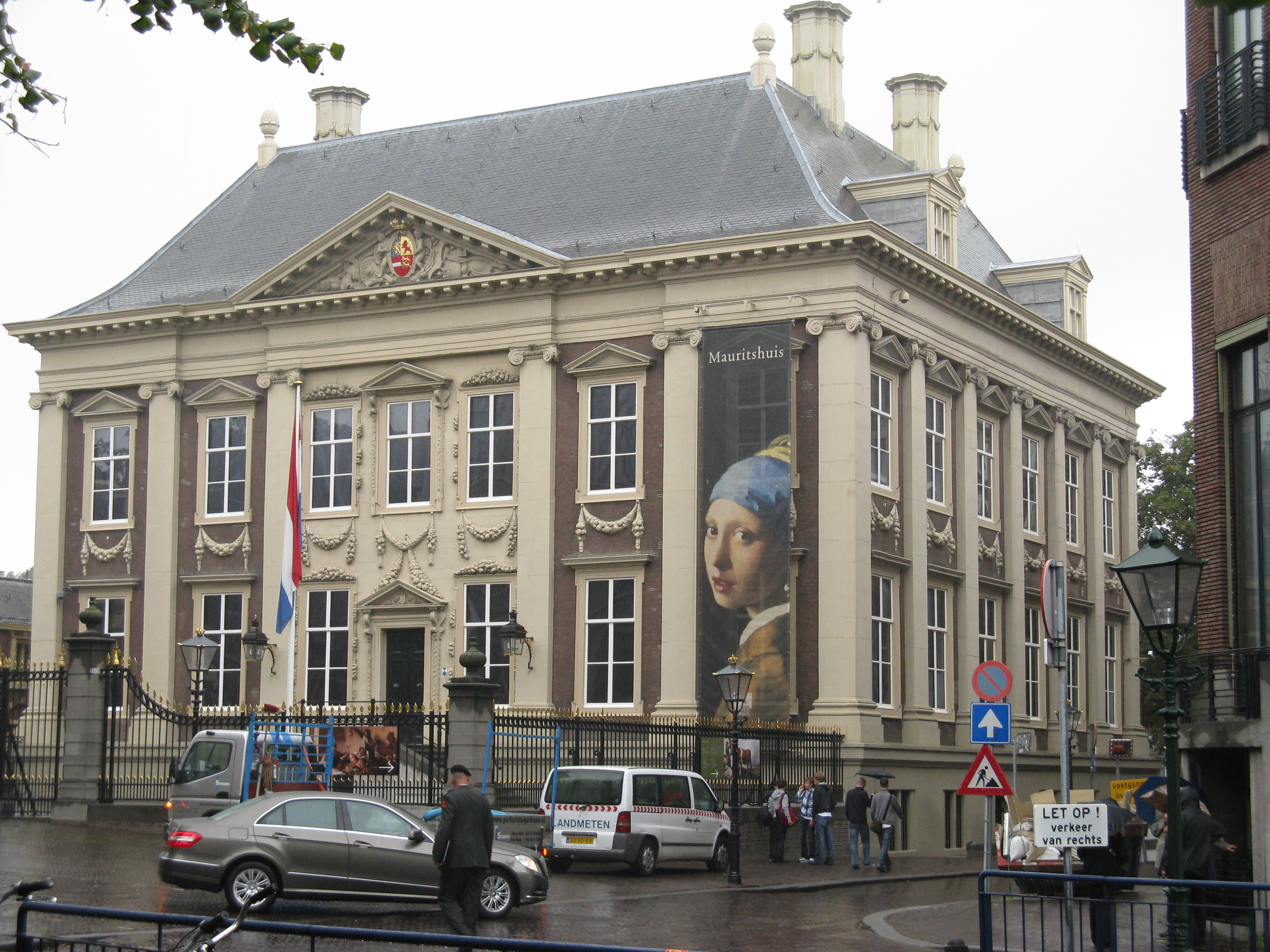
The Mauritshuis sits at Plein 29 in The Hague, a 17th-century town palace built for Johan Maurits of Nassau-Siegen and converted to a museum in 1822. The collection is small by global standards: about eight hundred works in a building you can walk through in under two hours. The girl hangs in a quiet room on the upper floor, alone or sometimes accompanied by Vermeer's View of Delft, his only surviving cityscape. In October 2022, a Just Stop Oil activist tried to glue his head to the glass protecting the painting and was covered in tomato soup by another protester. Three people were arrested. The painting was unharmed. After international tours that took her to New York, Tokyo, San Francisco, and Bologna, the Mauritshuis decided in 2014 that the girl would remain at home permanently. She is, after all, a national treasure that was very nearly sold abroad in 1881 for the price of a hot meal.
From the Air
The Mauritshuis is at Plein 29 in The Hague at 52.080 N, 4.314 E, beside the Binnenhof parliamentary complex on the Hofvijver pond. From cruise altitude in clear weather you can identify the Hofvijver as a small reflective rectangle in the city centre, just north of the Plein. Nearest airports: Rotterdam The Hague (EHRD) about 15 km southeast, Amsterdam Schiphol (EHAM) about 40 km northeast. The Hague tower-restricted airspace overlies the historic centre; check NOTAMs for royal flights.